
有氧运动对中老年人脑龄及健康的影响:一项单臂先导临床试验
Effects of Aerobic Exercise on Brain Age and Health in Middle-Aged and Older Adults: A Single-Arm Pilot Clinical Trial.
作者信息
Ouyang An, Zhang Can, Adra Noor, Tesh Ryan A, Sun Haoqi, Lei Dan, Jing Jin, Fan Peng, Paixao Luis, Ganglberger Wolfgang, Briggs Logan, Salinas Joel, Bevers Matthew B, Wrann Christiane Dorothea, Chemali Zeina, Fricchione Gregory, Thomas Robert J, Rosand Jonathan, Tanzi Rudolph E, Westover Michael Brandon
机构信息
Henry and Allison McCance Center for Brain Health, Massachusetts General Hospital, Boston, MA 02114, USA.
Department of Neurology, Massachusetts General Hospital, Boston, MA 02114, USA.
出版信息
Life (Basel). 2024 Jul 8;14(7):855. doi: 10.3390/life14070855.
BACKGROUNDS
Sleep disturbances are prevalent among elderly individuals. While polysomnography (PSG) serves as the gold standard for sleep monitoring, its extensive setup and data analysis procedures impose significant costs and time constraints, thereby restricting the long-term application within the general public. Our laboratory introduced an innovative biomarker, utilizing artificial intelligence algorithms applied to PSG data to estimate brain age (BA), a metric validated in cohorts with cognitive impairments. Nevertheless, the potential of exercise, which has been a recognized means of enhancing sleep quality in middle-aged and older adults to reduce BA, remains undetermined.
METHODS
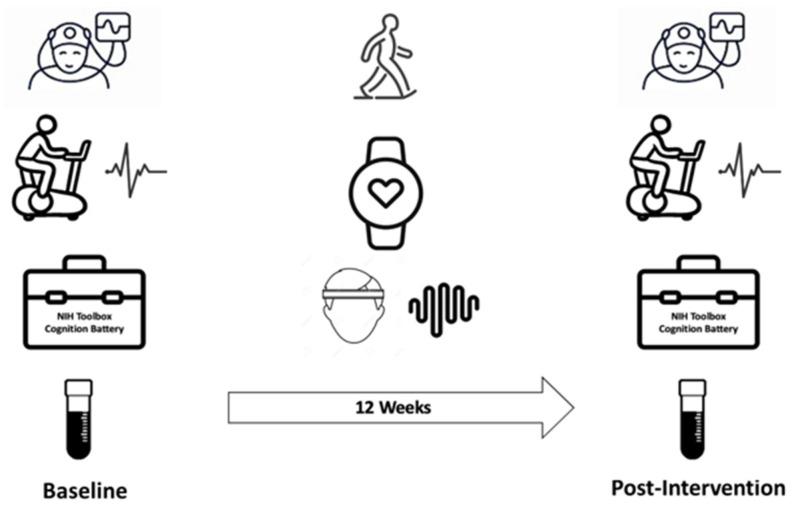
We conducted an exploratory study to evaluate whether 12 weeks of moderate-intensity exercise can improve cognitive function, sleep quality, and the brain age index (BAI), a biomarker computed from overnight sleep electroencephalogram (EEG), in physically inactive middle-aged and older adults. Home wearable devices were used to monitor heart rate and overnight sleep EEG over this period. The NIH Toolbox Cognition Battery, in-lab overnight polysomnography, cardiopulmonary exercise testing, and a multiplex cytokines assay were employed to compare pre- and post-exercise brain health, exercise capacity, and plasma proteins.
RESULTS
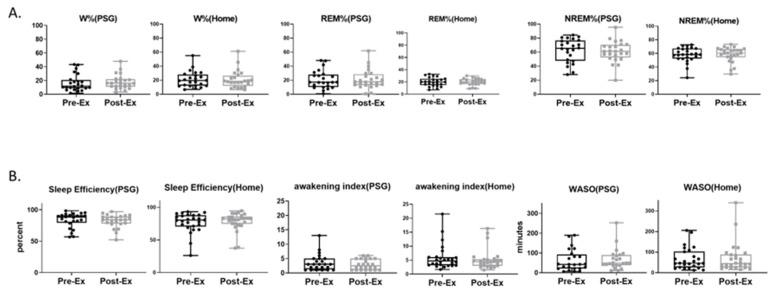
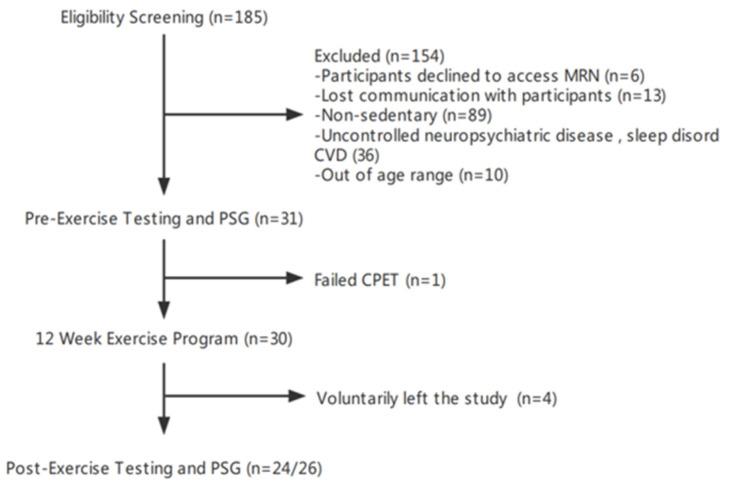
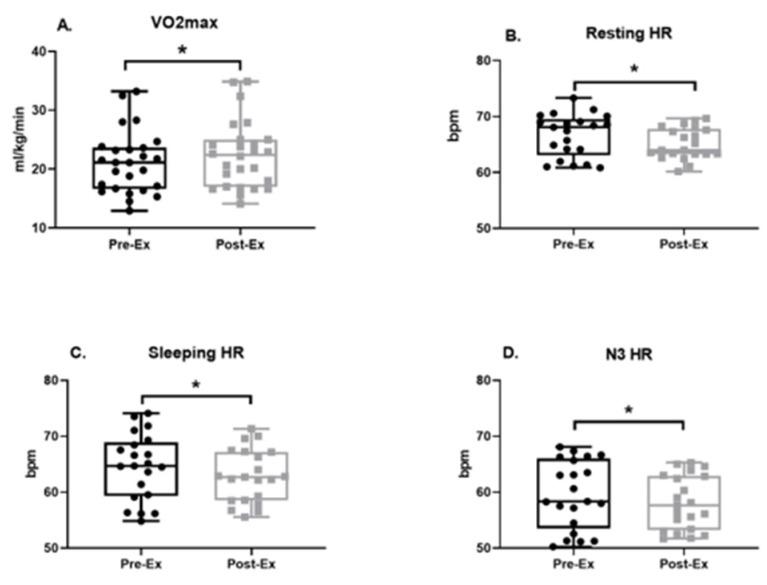
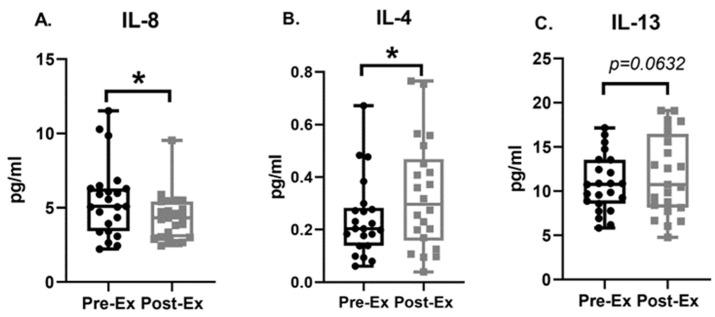
In total, 26 participants completed the initial assessment and exercise program, and 24 completed all procedures. Data are presented as mean [lower 95% CI of mean, upper 95% CI of mean]. Participants significantly increased maximal oxygen consumption (Pre: 21.11 [18.98, 23.23], Post 22.39 [20.09, 24.68], mL/kg/min; effect size: -0.33) and decreased resting heart rate (Pre: 66.66 [63.62, 67.38], Post: 65.13 [64.25, 66.93], bpm; effect size: -0.02) and sleeping heart rate (Pre: 64.55 [61.87, 667.23], Post: 62.93 [60.78, 65.09], bpm; effect size: -0.15). Total cognitive performance (Pre: 111.1 [107.6, 114.6], Post: 115.2 [111.9, 118.5]; effect size: 0.49) was significantly improved. No significant differences were seen in BAI or measures of sleep macro- and micro-architecture. Plasma IL-4 (Pre: 0.24 [0.18, 0.3], Post: 0.33 [0.24, 0.42], pg/mL; effect size: 0.49) was elevated, while IL-8 (Pre: 5.5 [4.45, 6.55], Post: 4.3 [3.66, 5], pg/mL; effect size: -0.57) was reduced.
CONCLUSIONS
Cognitive function was improved by a 12-week moderate-intensity exercise program in physically inactive middle-aged and older adults, as were aerobic fitness (VOmax) and plasma cytokine profiles. However, we found no measurable effects on sleep architecture or BAI. It remains to be seen whether a study with a larger sample size and more intensive or more prolonged exercise exposure can demonstrate a beneficial effect on sleep quality and brain age.
背景
睡眠障碍在老年人中很普遍。虽然多导睡眠图(PSG)是睡眠监测的金标准,但其广泛的设置和数据分析程序带来了高昂的成本和时间限制,从而限制了其在普通大众中的长期应用。我们实验室引入了一种创新的生物标志物,利用应用于PSG数据的人工智能算法来估计脑龄(BA),这一指标在认知障碍队列中得到了验证。然而,运动作为一种公认的改善中老年人睡眠质量以降低脑龄的方法,其潜力仍未确定。
方法
我们进行了一项探索性研究,以评估12周的中等强度运动是否能改善身体活动不足的中老年人的认知功能、睡眠质量和脑龄指数(BAI,一种根据夜间睡眠脑电图(EEG)计算得出的生物标志物)。在此期间,使用家用可穿戴设备监测心率和夜间睡眠EEG。采用美国国立卫生研究院工具箱认知电池、实验室夜间多导睡眠图、心肺运动测试和多重细胞因子检测来比较运动前后的脑健康、运动能力和血浆蛋白。
结果
共有26名参与者完成了初始评估和运动计划,24名完成了所有程序。数据以平均值[平均值的95%置信区间下限,平均值的95%置信区间上限]表示。参与者的最大摄氧量显著增加(运动前:21.11[18.98,23.23],运动后:22.39[20.09,24.68],mL/kg/min;效应量:-0.33),静息心率降低(运动前:66.66[63.62,67.38],运动后:65.13[64.25,66.93],bpm;效应量:-0.02)和睡眠心率降低(运动前:64.55[61.87,667.23],运动后:62.93[60.78,65.09],bpm;效应量:-0.15)。总认知表现(运动前:111.1[107.6,114.6],运动后:115.2[111.9,118.5];效应量:0.49)显著改善。脑龄指数或睡眠宏观和微观结构测量方面未发现显著差异。血浆白细胞介素-4(运动前:0.24[0.18,0.3],运动后:0.33[0.24,0.42],pg/mL;效应量:0.49)升高,而白细胞介素-8(运动前:5.5[4.45,6.55],运动后:4.3[3.66,5],pg/mL;效应量:-0.57)降低。
结论
在身体活动不足的中老年人中,为期12周的中等强度运动计划改善了认知功能、有氧适能(最大摄氧量)和血浆细胞因子谱。然而,我们未发现对睡眠结构或脑龄指数有可测量的影响。样本量更大、运动强度更高或运动时间更长的研究是否能证明对睡眠质量和脑龄有有益影响,还有待观察。


 Zotero 插件