
机器人辅助腹腔镜部分肾切除术后腹横肌平面阻滞多模式镇痛与鞘内注射吗啡及静脉自控镇痛效果的比较
Efficacy of Multimodal Analgesia with Transversus Abdominis Plane Block in Comparison with Intrathecal Morphine and Intravenous Patient-Controlled Analgesia after Robot-Assisted Laparoscopic Partial Nephrectomy.
作者信息
Shim Jung-Woo, Shin Dongho, Hong Sung-Hoo, Park Jaesik, Hong Sang Hyun
机构信息
Department of Anesthesiology and Pain Medicine, Seoul St. Mary's Hospital, College of Medicine, The Catholic University of Korea, Seoul 06591, Republic of Korea.
Department of Urology, Seoul St. Mary's Hospital, College of Medicine, The Catholic University of Korea, Seoul 06591, Republic of Korea.
出版信息
J Clin Med. 2024 Jul 9;13(14):4014. doi: 10.3390/jcm13144014.
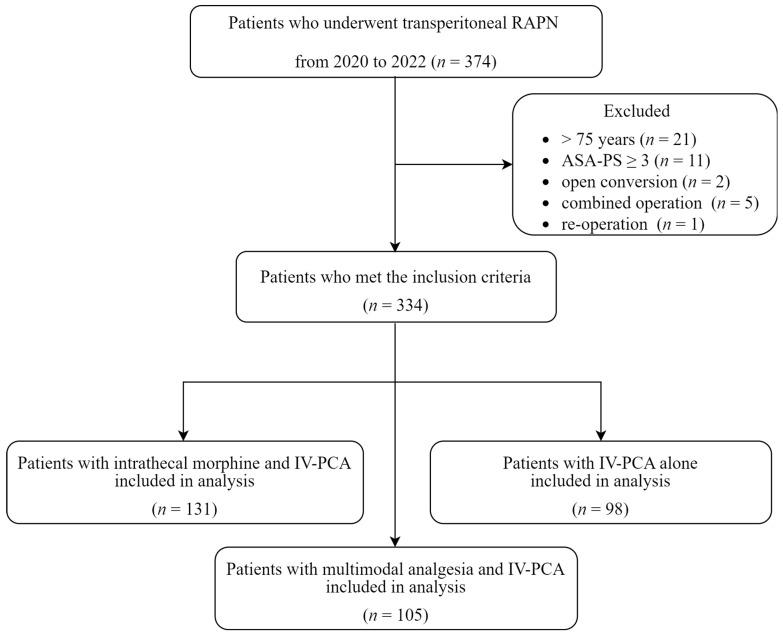
Robot-assisted laparoscopic partial nephrectomy (RAPN) for renal tumor treatment provides ergonomic advantages to surgeons and improves surgical outcomes. However, moderate-to-severe pain is unavoidable even after minimally invasive surgery. Despite the growing interest in multimodal analgesia, few studies have directly compared its efficacy with intrathecal morphine, a traditional opioid-based analgesic. We retrospectively investigated the efficacy of multimodal analgesia compared with that of intrathecal analgesia and intravenous patient-controlled analgesia (IV-PCA) in patients who underwent transperitoneal RAPN at our institute between 2020 and 2022. Among the 334 patients who met the inclusion criteria, intrathecal analgesia using morphine 200 µg was performed in 131 patients, and multimodal analgesia, including transversus abdominis plane block and intraoperative infusion of paracetamol 1 g and nefopam 20 mg, was administered to 105 patients. The remaining 98 patients received postoperative IV-PCA alone. As the primary outcome, the area under the curve of pain scores over 24 h was significantly lower in the intrathecal analgesia and multimodal analgesia groups than in the IV-PCA group (89 [62-108] vs. 86 [65-115] vs. 108 [87-126] h, < 0.001). Cumulative opioid requirements were also significantly lower in the intrathecal analgesia and multimodal analgesia groups at 24 h after surgery ( < 0.001). However, postoperative nausea and vomiting were significantly increased in the intrathecal analgesia group (27.5% vs. 13.3% vs. 13.3%, = 0.005). Multimodal analgesia with a transversus abdominis plane block is an efficient analgesic method with fewer adverse effects compared to other analgesic methods. Our findings suggest the efficacy and safety of a multimodal approach for opioid-sparing analgesia after RAPN in the current opioid epidemic.
机器人辅助腹腔镜肾部分切除术(RAPN)用于治疗肾肿瘤,为外科医生提供了人体工程学优势,并改善了手术效果。然而,即使是微创手术后,中度至重度疼痛也难以避免。尽管人们对多模式镇痛的兴趣日益浓厚,但很少有研究将其疗效与鞘内注射吗啡(一种传统的基于阿片类药物的镇痛药)直接进行比较。我们回顾性研究了2020年至2022年在我院接受经腹RAPN手术的患者中,多模式镇痛与鞘内镇痛和静脉自控镇痛(IV-PCA)相比的疗效。在334例符合纳入标准的患者中,131例患者采用200μg吗啡进行鞘内镇痛,105例患者采用多模式镇痛,包括腹横肌平面阻滞以及术中输注1g对乙酰氨基酚和20mg奈福泮。其余98例患者仅接受术后IV-PCA。作为主要结局指标,鞘内镇痛组和多模式镇痛组24小时疼痛评分曲线下面积显著低于IV-PCA组(89[62-108]对86[65-115]对108[87-126]小时,P<0.001)。术后24小时鞘内镇痛组和多模式镇痛组的累积阿片类药物需求量也显著更低(P<0.001)。然而,鞘内镇痛组术后恶心呕吐显著增加(27.5%对13.3%对13.3%,P=0.005)。与其他镇痛方法相比,腹横肌平面阻滞的多模式镇痛是一种有效的镇痛方法,不良反应较少。我们的研究结果表明,在当前阿片类药物流行的情况下,多模式方法用于RAPN术后阿片类药物节省镇痛具有疗效和安全性。
 Zotero 插件