
三阴性淋巴结构密度可预测乳腺癌脑转移的临床结局。
Density of tertiary lymphoid structures predicts clinical outcome in breast cancer brain metastasis.
机构信息
Department of General Surgery, Huashan Hospital, Shanghai Medical College, Fudan University, Shanghai, China.
Department of Neurosurgery, Huashan Hospital, Shanghai Medical College, Fudan University, Shanghai, China
出版信息
J Immunother Cancer. 2024 Jul 27;12(7):e009232. doi: 10.1136/jitc-2024-009232.
BACKGROUND
Patients with breast cancer brain metastases (BCBM) experience a rapid decline in their quality of life. Recently, tertiary lymphoid structures (TLSs), analogs of secondary lymphoid organs, have attracted extensive attention. However, the potential clinical implications of TLSs in BCBMs are poorly understood. In this study, we evaluated the density and composition of TLSs in BCBMs and described their prognostic value.
METHODS
Clinicopathological data were collected from 98 patients (2015-2021). TLSs were evaluated, and a TLS scoring system was constructed. Differences in progression-free survival (PFS) and overall survival (OS) between groups were calculated using the Kaplan-Meier method. Immunohistochemistry and multiplex immunofluorescence (mIF) were used to assess TLSs heterogeneity.
RESULTS
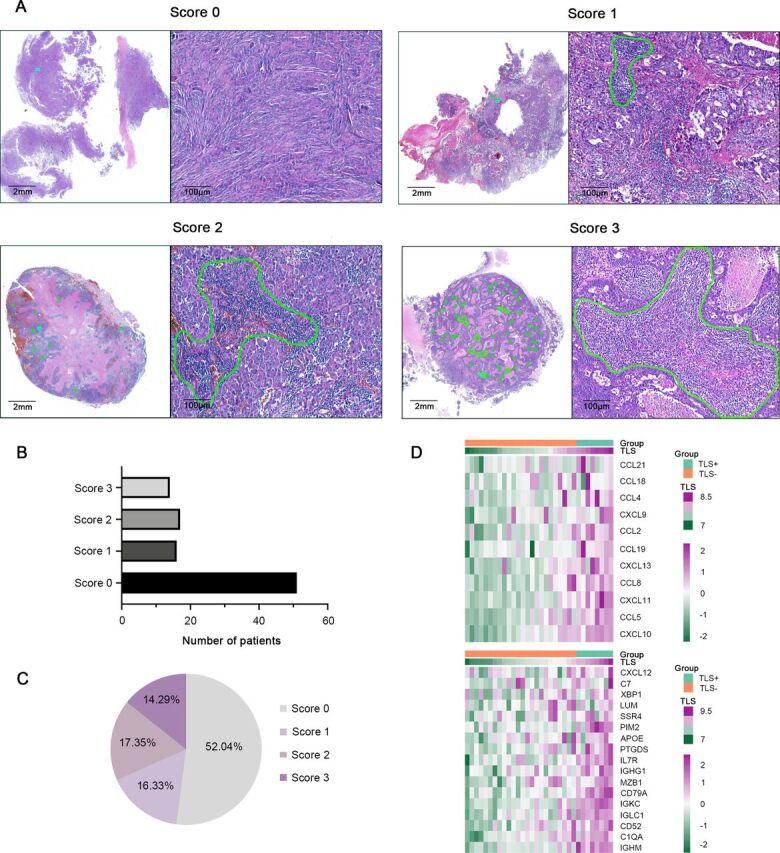
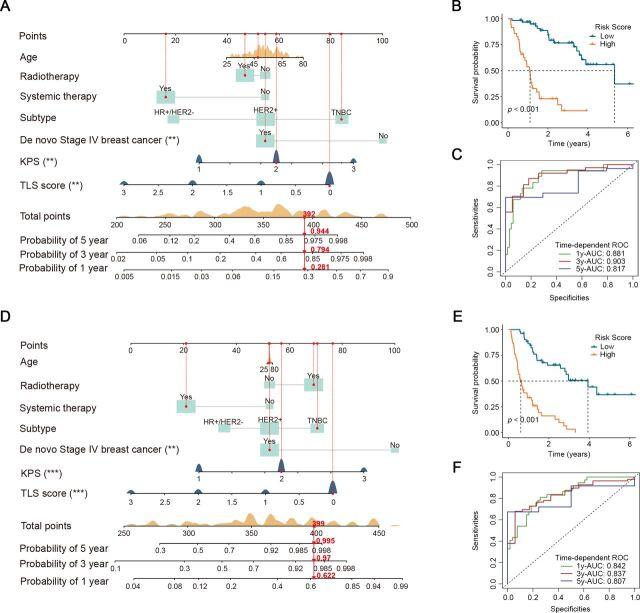
TLSs were identified in 47 patients with BCBM. High TLSs density indicated favorable survival (OS, p=0.003; PFS, p<0.001). TLS was positively associated with OS (p=0.0172) and PFS (p=0.0161) in the human epidermal growth factor receptor type 2-positive subtype, and with prolonged OS (p=0.0482) in the triple-negative breast cancer subtype. The mIF results showed significant differences in the percentages of T follicular helper (Tfh) cells, M2 macrophages, cytotoxic T lymphocytes, and CD8TIM-3 T lymphocytes between the groups of TLS scores 0-3 (cytotoxic T lymphocytes, p=0.044; Tfh, p=0.021; M2 macrophages, p=0.033; CD8TIM-3 T lymphocytes, p=0.018). Furthermore, novel nomograms incorporating the TLS scores and other clinicopathological predictors demonstrated prominent predictability of the 1-year, 3-year, and 5-year outcomes of BCBMs (area under the curve >0.800).
CONCLUSION
Our results highlight the impact of TLSs abundance on the OS and PFS of patients with BCBM. Additionally, we described the immune composition of TLSs and proposed novel nomograms to predict the prognosis of patients with BCBM.
背景
患有乳腺癌脑转移(BCBM)的患者生活质量迅速下降。最近,三级淋巴结构(TLSs),即次级淋巴器官的类似物,引起了广泛关注。然而,TLSs 在 BCBM 中的潜在临床意义尚不清楚。在本研究中,我们评估了 BCBM 中 TLSs 的密度和组成,并描述了其预后价值。
方法
收集了 98 例患者(2015-2021 年)的临床病理数据。评估了 TLSs,并构建了 TLS 评分系统。使用 Kaplan-Meier 方法计算无进展生存期(PFS)和总生存期(OS)的差异。免疫组织化学和多重免疫荧光(mIF)用于评估 TLSs 的异质性。
结果
在 47 例 BCBM 患者中发现了 TLSs。高 TLSs 密度预示着较好的生存(OS,p=0.003;PFS,p<0.001)。TLS 与人类表皮生长因子受体 2 阳性亚型的 OS(p=0.0172)和 PFS(p=0.0161)呈正相关,与三阴性乳腺癌亚型的 OS 延长(p=0.0482)呈正相关。mIF 结果显示,TLS 评分 0-3 组之间 T 滤泡辅助(Tfh)细胞、M2 巨噬细胞、细胞毒性 T 淋巴细胞和 CD8TIM-3 T 淋巴细胞的百分比有显著差异(细胞毒性 T 淋巴细胞,p=0.044;Tfh,p=0.021;M2 巨噬细胞,p=0.033;CD8TIM-3 T 淋巴细胞,p=0.018)。此外,包含 TLS 评分和其他临床病理预测因子的新诺莫图显示了对 BCBM 1 年、3 年和 5 年预后的显著预测能力(曲线下面积>0.800)。
结论
我们的研究结果强调了 TLSs 丰度对 BCBM 患者 OS 和 PFS 的影响。此外,我们描述了 TLSs 的免疫组成,并提出了新的诺莫图来预测 BCBM 患者的预后。



 Zotero 插件