
人工智能在医学教育中的应用——医学生的认知。
Artificial intelligence in medical education - perception among medical students.
机构信息
Pushpagiri Medical College, Tiruvalla, Kerala, India.
出版信息
BMC Med Educ. 2024 Jul 27;24(1):804. doi: 10.1186/s12909-024-05760-0.
BACKGROUND
As Artificial Intelligence (AI) becomes pervasive in healthcare, including applications like robotic surgery and image analysis, the World Medical Association emphasises integrating AI education into medical curricula. This study evaluates medical students' perceptions of 'AI in medicine', their preferences for AI training in education, and their grasp of AI's ethical implications in healthcare.
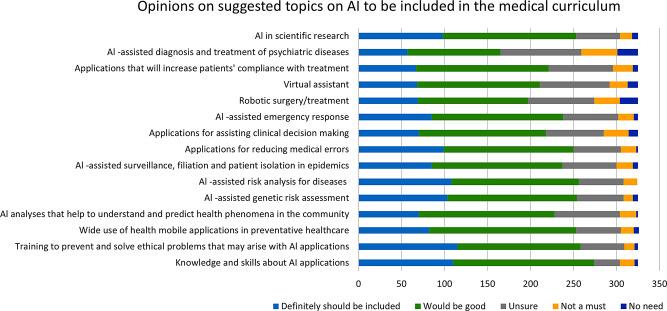
MATERIALS & METHODS: A cross-sectional study was conducted among 325 medical students in Kerala using a pre-validated, semi structured questionnaire. The survey collected demographic data, any past educational experience about AI, participants' self-evaluation of their knowledge and evaluated self-perceived understanding of applications of AI in medicine. Participants responded to twelve Likert-scale questions targeting perceptions and ethical aspects and their opinions on suggested topics on AI to be included in their curriculum.
RESULTS & DISCUSSION: AI was viewed as an assistive technology for reducing medical errors by 57.2% students and 54.2% believed AI could enhance medical decision accuracy. About 49% agreed that AI could potentially improve accessibility to healthcare. Concerns about AI replacing physicians were reported by 37.6% and 69.2% feared a reduction in the humanistic aspect of medicine. Students were worried about challenges to trust (52.9%), patient-physician relationships (54.5%) and breach of professional confidentiality (53.5%). Only 3.7% felttotally competent in informing patients about features and risks associated with AI applications. Strong demand for structured AI training was expressed, particularly on reducing medical errors (76.9%) and ethical issues (79.4%).
CONCLUSION
This study highlights medical students' demand for structured AI training in undergraduate curricula, emphasising its importance in addressing evolving healthcare needs and ethical considerations. Despite widespread ethical concerns, the majority perceive AI as an assistive technology in healthcare. These findings provide valuable insights for curriculum development and defining learning outcomes in AI education for medical students.
背景
随着人工智能(AI)在医疗保健领域的普及,包括机器人手术和图像分析等应用,世界医学协会强调将 AI 教育纳入医学课程。本研究评估了医学生对“医学中的 AI”的看法、他们对教育中 AI 培训的偏好,以及他们对 AI 在医疗保健中伦理影响的理解。
材料与方法
在喀拉拉邦对 325 名医学生进行了横断面研究,使用了预先验证的半结构化问卷。该调查收集了人口统计学数据、任何关于 AI 的过去教育经验、参与者对自己知识的自我评估,并评估了他们对 AI 在医学中的应用的自我感知理解。参与者对 12 个李克特量表问题做出了回应,这些问题针对的是看法和伦理方面,以及他们对课程中应包含的 AI 建议主题的看法。
结果与讨论
57.2%的学生认为 AI 是一种减少医疗错误的辅助技术,54.2%的学生认为 AI 可以提高医疗决策的准确性。约 49%的人认为 AI 有可能改善医疗保健的可及性。37.6%的人报告了对 AI 取代医生的担忧,69.2%的人担心医学的人文方面会减少。学生担心对信任的挑战(52.9%)、医患关系(54.5%)和职业保密性的侵犯(53.5%)。只有 3.7%的学生完全有能力告知患者有关 AI 应用相关特征和风险的信息。学生强烈要求进行结构化的 AI 培训,特别是在减少医疗错误(76.9%)和伦理问题(79.4%)方面。
结论
本研究强调了医学生对本科课程中结构化 AI 培训的需求,强调了其在应对不断发展的医疗保健需求和伦理考虑方面的重要性。尽管存在广泛的伦理问题,但大多数人认为 AI 是医疗保健中的一种辅助技术。这些发现为课程开发和定义医学生 AI 教育的学习成果提供了有价值的见解。

 Zotero 插件