
新型靶向成纤维细胞活化蛋白(FAP)的小分子用于放射性核素诊疗及其他肿瘤干预的体外和体内分析:eFAP研究
In vitro and in vivo analyses of eFAP: a novel FAP-targeting small molecule for radionuclide theranostics and other oncological interventions.
作者信息
van der Heide Circe D, Ma Hanyue, Hoorens Mark W H, Campeiro Joana D, Stuurman Debra C, de Ridder Corrina M A, Seimbille Yann, Dalm Simone U
机构信息
Department of Radiology and Nuclear Medicine, Erasmus MC University Medical Center Rotterdam, Rotterdam, 3015 GD, The Netherlands.
Department of Experimental Urology, Erasmus Medical Center, University Medical Center Rotterdam, Rotterdam, 3015 GD, The Netherlands.
出版信息
EJNMMI Radiopharm Chem. 2024 Jul 29;9(1):55. doi: 10.1186/s41181-024-00283-x.
BACKGROUND
Fibroblast activation protein (FAP), a transmembrane serine protease overexpressed by cancer-associated fibroblasts in the tumor stroma, is an interesting biomarker for targeted radionuclide theranostics. FAP-targeting radiotracers have demonstrated to be superior to [F]FDG PET/CT in various solid cancers. However, these radiotracers have suboptimal tumor retention for targeted radionuclide therapy (TRT). We aimed to develop a novel FAP-targeting pharmacophore with improved pharmacokinetics by introducing a substitution at the 8-position of (4-quinolinoyl)-glycyl-2-cyanopyrrolidine, which allows for conjugation of a chelator, dye, or other payloads.
RESULTS
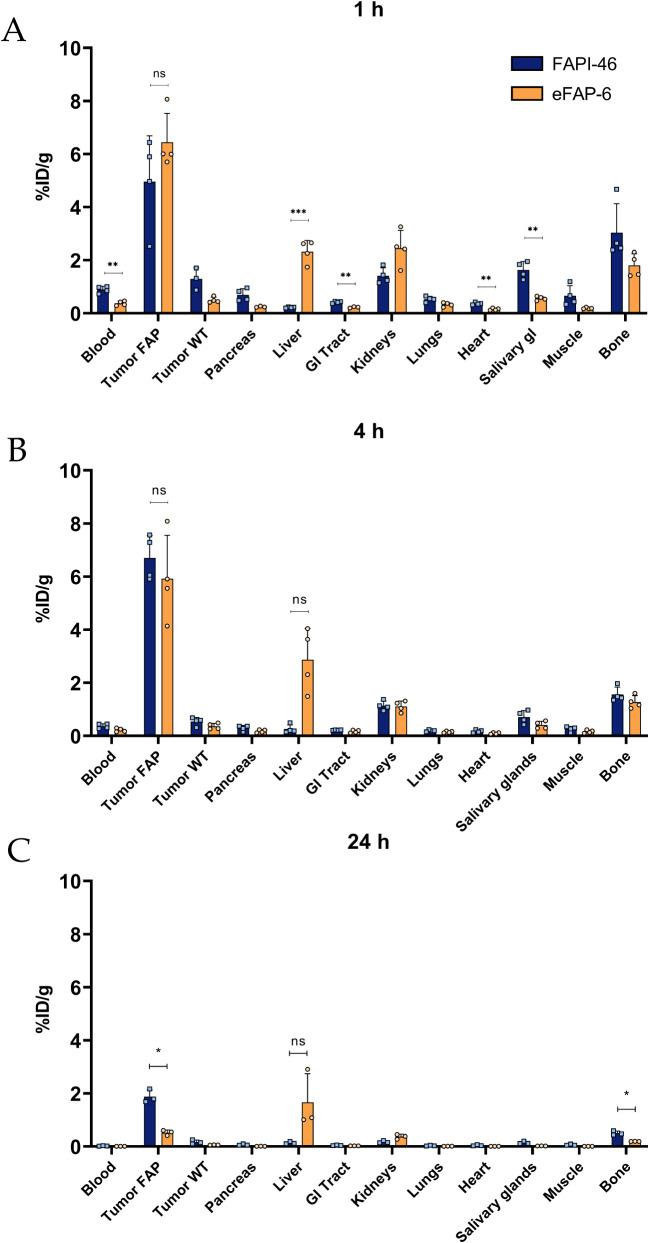
Here we showed the synthesis of DOTA-conjugated eFAP-6 and sulfo-Cyanine5-conjugated eFAP-7. After chemical characterization, the uptake and specificity of both tracers were determined on FAP-expressing cells. In vitro, [In]In-eFAP-6 demonstrated a superior affinity and a more rapid, although slightly lower, peak uptake than gold standard [In]In-FAPI-46. Confocal microscopy demonstrated a quick FAP-mediated internalization of eFAP-7. Studies with HT1080-huFAP xenografted mice confirmed a more rapid uptake of [Lu]Lu-eFAP-6 vs. [Lu]Lu-FAPI-46. However, tumor retention at 24 h post injection of [Lu]Lu-eFAP-6 was lower than that of [Lu]Lu-FAPI-46, hereby currently limiting its use for TRT.
CONCLUSION
The superior affinity and faster tumor accumulation of eFAP-6 over FAPI-46 makes it a suitable compound for radionuclide imaging. After further optimization, the eFAP series has great potential for various oncological interventions, including fluorescent-guided surgery and effective targeted radionuclide theranostics.
背景
成纤维细胞活化蛋白(FAP)是一种跨膜丝氨酸蛋白酶,在肿瘤基质中由癌症相关成纤维细胞过度表达,是靶向放射性核素诊疗的一个有趣的生物标志物。靶向FAP的放射性示踪剂已证明在各种实体癌中优于[F]FDG PET/CT。然而,这些放射性示踪剂在靶向放射性核素治疗(TRT)中的肿瘤滞留情况并不理想。我们旨在通过在(4-喹啉甲酰基)-甘氨酰-2-氰基吡咯烷的8位引入取代基来开发一种具有改善药代动力学的新型FAP靶向药效基团,这使得能够连接螯合剂、染料或其他有效载荷。
结果
在此我们展示了DOTA偶联的eFAP-6和磺基菁染料5偶联的eFAP-7的合成。经过化学表征后,在表达FAP的细胞上测定了两种示踪剂的摄取和特异性。在体外,[铟]铟-eFAP-6表现出比金标准[铟]铟-FAPI-46更高的亲和力以及更快的峰值摄取,尽管峰值摄取略低。共聚焦显微镜显示eFAP-7可通过FAP介导快速内化。对HT1080-人FAP异种移植小鼠的研究证实,[镥]镥-eFAP-6比[镥]镥-FAPI-46摄取更快。然而,注射[镥]镥-eFAP-6后24小时的肿瘤滞留低于[镥]镥-FAPI-46,因此目前限制了其在TRT中的应用。
结论
与FAPI-46相比,eFAP-6具有更高的亲和力和更快的肿瘤蓄积,使其成为放射性核素成像的合适化合物。经过进一步优化后,eFAP系列在包括荧光引导手术和有效的靶向放射性核素诊疗等各种肿瘤干预方面具有巨大潜力。


 Zotero 插件