
通过死因推断和微创组织采样确定的死产和儿童死亡原因的比较。
Comparison of causes of stillbirth and child deaths as determined by verbal autopsy and minimally invasive tissue sampling.
作者信息
Assefa Nega, Scott Anthony, Madrid Lola, Dheresa Merga, Mengesha Gezahegn, Mahdi Shabir, Mahtab Sana, Dangor Ziyaad, Myburgh Nellie, Mothibi Lesego Kamogelo, Sow Samba O, Kotloff Karen L, Tapia Milagritos D, Onwuchekwa Uma U, Djiteye Mahamane, Varo Rosauro, Mandomando Inacio, Nhacolo Ariel, Sacoor Charfudin, Xerinda Elisio, Ogbuanu Ikechukwu, Samura Solomon, Duduyemi Babatunde, Swaray-Deen Alim, Bah Abdulai, El Arifeen Shams, Gurley Emily S, Hossain Mohammed Zahid, Rahman Afruna, Chowdhury Atique Iqbal, Quique Bassat, Mutevedzi Portia, Cunningham Solveig A, Blau Dianna, Whitney Cyndy
机构信息
College of Health and Medical Sciences, Haramaya University, Harar, Ethiopia.
London School of Hygiene and Tropical Medicine, London, United Kingdom.
出版信息
PLOS Glob Public Health. 2024 Jul 29;4(7):e0003065. doi: 10.1371/journal.pgph.0003065. eCollection 2024.
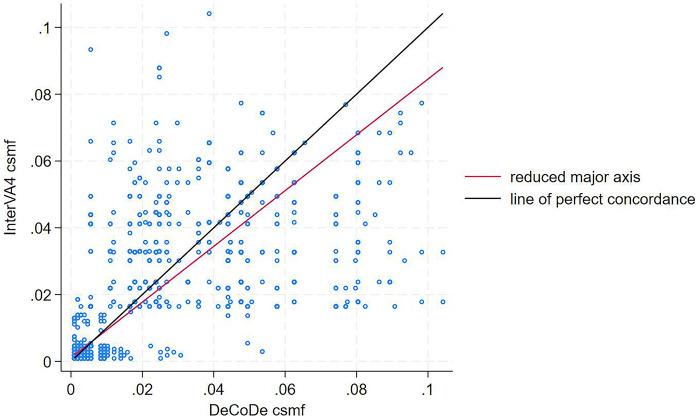
In resource-limited settings where vital registration and medical death certificates are unavailable or incomplete, verbal autopsy (VA) is often used to attribute causes of death (CoD) and prioritize resource allocation and interventions. We aimed to determine the CoD concordance between InterVA and CHAMPS's method. The causes of death (CoDs) of children <5 were determined by two methods using data from seven low- and middle-income countries (LMICs) enrolled in the Child Health and Mortality Prevention Surveillance (CHAMPS) network. The first CoD method was from the DeCoDe panel using data from Minimally Invasive Tissue Sampling (MITS), whereas the second method used Verbal Autopsy (VA), which utilizes the InterVA software. This analysis evaluated the agreement between the two using Lin's concordance correlation coefficient. The overall concordance of InterVA4 and DeCoDe in assigning causes of death across surveillance sites, age groups, and causes of death was poor (0.75 with 95% CI: 0.73-0.76) and lacked precision. We found substantial differences in agreement by surveillance site, with Mali showing the lowest and Mozambique and Ethiopia the highest concordance. The InterVA4 assigned CoD agrees poorly in assigning causes of death for U5s and stillbirths. Because VA methods are relatively easy to implement, such systems could be more useful if algorithms were improved to more accurately reflect causes of death, for example, by calibrating algorithms to information from programs that used detailed diagnostic testing to improve the accuracy of COD determination.
在生命登记和医学死亡证明不可用或不完整的资源有限环境中,常常使用口头尸检(VA)来确定死亡原因(CoD),并对资源分配和干预措施进行优先排序。我们旨在确定InterVA和CHAMPS方法之间的死亡原因一致性。使用来自参与儿童健康与死亡率预防监测(CHAMPS)网络的七个低收入和中等收入国家(LMIC)的数据,通过两种方法确定了5岁以下儿童的死亡原因。第一种死亡原因确定方法来自使用微创组织采样(MITS)数据的DeCoDe小组,而第二种方法使用了利用InterVA软件的口头尸检(VA)。本分析使用林氏一致性相关系数评估了两者之间的一致性。InterVA4和DeCoDe在跨监测地点、年龄组和死亡原因分配死亡原因方面的总体一致性较差(0.75,95%CI:0.73 - 0.76)且缺乏精确性。我们发现不同监测地点在一致性方面存在显著差异,马里的一致性最低,莫桑比克和埃塞俄比亚的一致性最高。InterVA4在为5岁以下儿童和死产分配死亡原因方面的一致性较差。由于VA方法相对易于实施,如果改进算法以更准确地反映死亡原因,例如通过将算法校准为来自使用详细诊断测试以提高死亡原因确定准确性的项目的信息,这样的系统可能会更有用。

 Zotero 插件