
C反应蛋白-白蛋白-淋巴细胞(CALLY)指数与PCI术后CAD患者不良临床结局的关联:一项真实世界研究的结果
Association between the C-Reactive Protein-Albumin-Lymphocyte (CALLY) Index and Adverse Clinical Outcomes in CAD Patients after PCI: Findings of a Real-World Study.
作者信息
Pan Ying, Wu Ting-Ting, Deng Chang-Jiang, Jiang Zhi-Hui, Yang Yi, Hou Xian-Geng, Yan Tuo, Wang Shun, Feng Yu-Juan, Zheng Ying-Ying, Xie Xiang
机构信息
State Key Laboratory of Pathogenesis, Prevention, Treatment of Central Asian High Incidence Diseases, 830054 Urumqi, Xinjiang, China.
Department of Cardiology, Xinjiang Medical University Affiliated First Hospital, 830054 Urumqi, Xinjiang, China.
出版信息
Rev Cardiovasc Med. 2024 Mar 25;25(4):111. doi: 10.31083/j.rcm2504111. eCollection 2024 Apr.
BACKGROUND
The C-reactive protein-albumin-lymphocyte (CALLY) index is a novel inflammatory biomarker, and its association with the prognosis of coronary artery disease (CAD) after percutaneous coronary intervention (PCI) has not previously been studied. Therefore, this study aimed to investigate the effect of using the CALLY index on adverse outcomes in CAD patients undergoing PCI.
METHODS
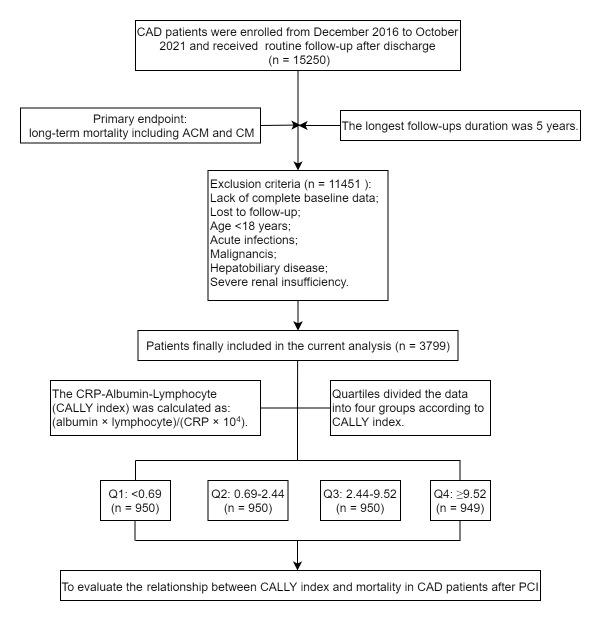
From December 2016 to October 2021, we consecutively enrolled 15,250 CAD patients and performed follow-ups for primary endpoints consisting of all-cause mortality (ACM) and cardiac mortality (CM). The CALLY index was computed using the following formula: (albumin lymphocyte)/(C-reactive protein (CRP) ). The average duration of the follow-up was 24 months.
RESULTS
A total of 3799 CAD patients who had undergone PCI were ultimately enrolled in the present study. The patients were divided into four groups according to the CALLY index quartiles: Q1 ( 0.69, n = 950), Q2 (0.69-2.44, n = 950), Q3 (2.44-9.52, n = 950), and Q4 ( 9.52, n = 949). The low-Q1 group had a significantly higher prevalence of ACM ( 0.001), CM ( 0.001), major adverse cardiac events (MACEs) ( = 0.002), and major adverse cardiac and cerebrovascular events (MACCEs) ( = 0.002). Kaplan-Meier analysis revealed that a low CALLY index was significantly linked with adverse outcomes. After univariate and multivariate Cox regression analysis, the risk of ACM, CM, MACEs, and MACCEs decreased by 73.7% (adjust hazard risk [HR] = 0.263, 95% CI: 0.147-0.468, 0.001), 70.6% (adjust HR = 0.294, 95% CI: 0.150-0.579, 0. 001), 37.4% (adjust HR = 0.626, 95% CI: 0.422-0.929, = 0.010), and 41.5% (adjust HR = 0.585, 95% CI: 0.401-0.856, = 0.006), respectively, in the Q4 quartiles compared with the Q1 quartiles.
CONCLUSIONS
This study revealed that a decreased CALLY index was associated with worse prognoses for CAD patients after PCI. The categorization of patients with a decreased CALLY index could provide valuable evidence for the risk stratification of adverse outcomes in CAD patients after PCI.
CLINICAL TRIAL REGISTRATION
The details are available at http://www.chictr.org.cn (Identifier: NCT05174143).
背景
C反应蛋白-白蛋白-淋巴细胞(CALLY)指数是一种新型炎症生物标志物,此前尚未研究过其与经皮冠状动脉介入治疗(PCI)后冠心病(CAD)预后的相关性。因此,本研究旨在探讨使用CALLY指数对接受PCI的CAD患者不良结局的影响。
方法
2016年12月至2021年10月,我们连续纳入15250例CAD患者,并对包括全因死亡率(ACM)和心源性死亡率(CM)在内的主要终点进行随访。CALLY指数采用以下公式计算:(白蛋白×淋巴细胞)/(C反应蛋白(CRP))。随访平均时长为24个月。
结果
本研究最终纳入3799例接受PCI的CAD患者。根据CALLY指数四分位数将患者分为四组:Q1(≤0.69,n = 950)、Q2(0.69 - 2.44,n = 950)、Q3(2.44 - 9.52,n = 950)和Q4(>9.52,n = 949)。低CALLY指数的Q1组在ACM(P<0.001)、CM(P<0.001)、主要不良心脏事件(MACEs)(P = 0.002)和主要不良心脑血管事件(MACCEs)(P = 0.002)方面的患病率显著更高。Kaplan-Meier分析显示,低CALLY指数与不良结局显著相关。经过单因素和多因素Cox回归分析,与Q1四分位数相比,Q4四分位数中ACM、CM、MACEs和MACCEs的风险分别降低了73.7%(调整后风险比[HR] = 0.263,95%置信区间:0.147 - 0.468,P<0.001)、70.6%(调整后HR = 0.294,95%置信区间:0.150 - 0.579,P<0.001)、37.4%(调整后HR = 0.626,95%置信区间:0.422 - 0.929,P = 0.010)和41.5%(调整后HR = 0.585,95%置信区间:0.401 - 0.856,P = 0.006)。
结论
本研究表明,CALLY指数降低与PCI术后CAD患者的预后较差相关。CALLY指数降低的患者分类可为PCI术后CAD患者不良结局的风险分层提供有价值的证据。
临床试验注册


 Zotero 插件