
解析中性有机自由基中的双重态发光机制:自旋交换耦合、反向四重态机制、激发态动力学
Deciphering the doublet luminescence mechanism in neutral organic radicals: spin-exchange coupling, reversed-quartet mechanism, excited-state dynamics.
作者信息
Lv LingLing, Zhang YanYing, Ning ZiYe
机构信息
School of Chemical Engineering and Technology, Tianshui Normal University Tianshui Gansu 741001 China
Key Laboratory of Advanced Optoelectronic Functional Materials of Gansu Province, Tianshui Normal University Tianshui Gansu 741001 China.
出版信息
RSC Adv. 2024 Jul 31;14(33):23987-23999. doi: 10.1039/d4ra03566f. eCollection 2024 Jul 26.
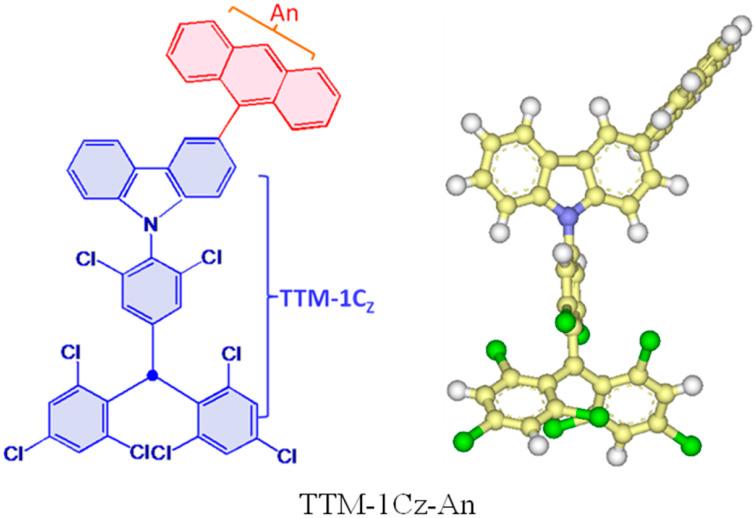
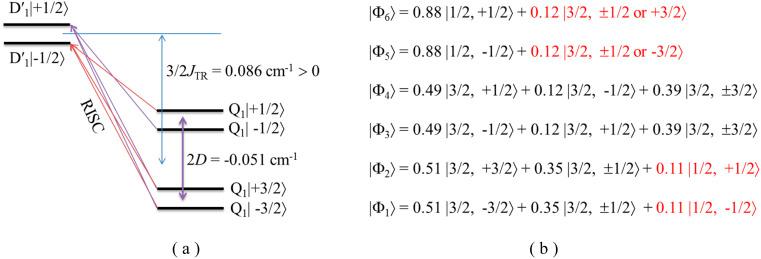
Neutral organic radical molecules have recently attracted considerable attention as promising luminescent and quantum-information materials. However, the presence of a radical often shortens their excited-state lifetime and results in fluorescence quenching due to enhanced intersystem crossing (EISC). Recently, an experimental report introduced an efficient luminescent radical molecule, tris(2,4,6-trichlorophenyl)methyl-carbazole-anthracene (TTM-1Cz-An). In this study, we systematically performed quantum theoretical calculations combined with the path integral approach to quantitatively calculate the excited-state dynamics processes and spectral characteristics. Our theoretical findings suggest that the sing-doublet D state, originating from the anthracene excited singlet state, is quickly converted to the doublet (trip-doublet) state EISC, facilitated by a significant nonequivalence exchange interaction, with Δ = 0.174 cm. The formation of the quartet state (Q, trip-quartet) was predominantly dependent on the exchange coupling 3/2 = 0.086 cm between the triplet spin electrons of anthracene and the TTM-1Cz radical. Direct spin-orbit coupling ISC to the Q state was minimal due to the nearly identical spatial wavefunctions of the and Q levels. The effective occurrence of reverse intersystem crossing (RISC) from the Q to D state is a critical step in controlling the luminescence of TTM-1Cz-An. The calculated RISC rate , including the Herzberg-Teller effect, was 3.64 × 10 s at 298 K, significantly exceeding the phosphorescence and nonradiative rates of the Q state, thus enabling the D repopulation. Subsequently, a strong electronic coupling of 37.4 meV was observed between the D and D states, along with a dense manifold of doublet states near the D state energy, resulting in a larger reverse internal conversion rate of 9.26 × 10 s. Distributed to the D state, the obtained emission rate of = 2.98-3.18 × 10 s was in quite good agreement with the experimental value of 1.28 × 10 s, and its temperature effect was not remarkable. Our study not only provides strong support for the experimental findings but also offers valuable insights for the molecular design of high-efficiency radical emitters.
中性有机自由基分子最近作为有前景的发光和量子信息材料引起了相当大的关注。然而,自由基的存在通常会缩短它们的激发态寿命,并由于增强的系间窜越(EISC)导致荧光猝灭。最近,一份实验报告介绍了一种高效发光自由基分子,三(2,4,6-三氯苯基)甲基-咔唑-蒽(TTM-1Cz-An)。在本研究中,我们系统地进行了量子理论计算,并结合路径积分方法来定量计算激发态动力学过程和光谱特征。我们的理论结果表明,源自蒽激发单重态的单重-双重态D态,通过显著的非等价交换相互作用(Δ = 0.174 cm)促进,迅速转换为双重态(三重-双重态)态EISC。四重态(Q,三重-四重态)的形成主要取决于蒽的三重态自旋电子与TTM-1Cz自由基之间的交换耦合3/2 = 0.086 cm。由于和Q能级的空间波函数几乎相同,直接自旋-轨道耦合ISC到Q态的作用最小。从Q态到D态的有效反向系间窜越(RISC)的发生是控制TTM-1Cz-An发光的关键步骤。计算得到的包括赫兹伯格-泰勒效应的RISC速率,在298 K时为3.64×10 s,显著超过Q态的磷光和非辐射速率,从而实现D态的再填充。随后,在D和D态之间观察到37.4 meV的强电子耦合,以及在D态能量附近的密集双重态流形,导致更大的反向内转换速率为9.26×10 s。分布到D态,得到的发射速率 = 2.98 - 3.18×10 s与1.28×10 s的实验值相当吻合,并且其温度效应不显著。我们的研究不仅为实验结果提供了有力支持,也为高效自由基发射体的分子设计提供了有价值的见解。




 Zotero 插件