
寡转移结直肠癌患者转移灶切除术后mFOLFOXIRI方案II期研究的试验方案(FANTASTIC研究)
Trial Protocol of a Phase II Study of mFOLFOXIRI after Metastasectomy in Patients with Oligometastatic Colorectal Cancer (FANTASTIC Study).
作者信息
Kataoka Kozo, Yamada Takeshi, Yamazaki Kentaro, Mori Keita, Matsuhashi Nobuhisa, Shiozawa Manabu, Iwai Takuma, Goto Masahiro, Yasui Masayoshi, Takii Yasumasa, Suto Takeshi, Takamizawa Yasuyuki, Takase Naoto, Sharma Shruti, Ensor Joe, Jurdi Adham, Liu Minetta C, Ikeda Masataka, Kanemitsu Yukihide
机构信息
Division of Lower GI, Department of Gastroenterological Surgery, Hyogo Medical University, Nishinomiya, Japan.
Department of Gastrointestinal Surgery, Nippon Medical School, Tokyo, Japan.
出版信息
J Anus Rectum Colon. 2024 Jul 30;8(3):246-252. doi: 10.23922/jarc.2024-025. eCollection 2024.
BACKGROUND
The survival benefit of adjuvant chemotherapy after surgical resection of oligometastases from colorectal cancer (CRC) remains unclear. The prognostic role of circulating-tumor DNA (ctDNA) was reported recently and a risk stratification strategy based on monitoring minimal/molecular residual disease (MRD) has been proposed, however, which drug regimen is most effective for ctDNA-positive patients is unknown.
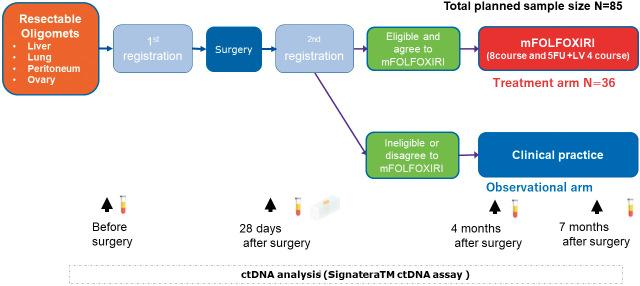
METHODS/DESIGN: Oligometastatic CRC patients planning to undergo surgery were registered in this study. After metastasectomy, the registered patients were enrolled in the treatment arm, in which 8 courses of modified-FOLFOXIRI (mFOLFOXIRI; irinotecan 150 mg/m, oxaliplatin 85 mg/m, l-leucovorin (l-LV) 200 mg/m, and 46-h continuous infusion of 5-fluorouracil (5-FU) 2400 mg/m every 2 weeks) followed by 4 courses of 5-FU/l-LV are administered. The patients who did not meet the eligibility criteria for the treatment arm or did not consent to mFOLFOXIRI enrolled in the observation arm in which standard of care treatment is provided. Prospective blood collections for retrospective ctDNA analysis are scheduled pre-surgery, and at 28 days, 4 and 7 months after surgery. The primary endpoint is treatment compliance at 8 courses of mFOLFOXIRI and the key secondary endpoints are the ctDNA-positivity rate and survival outcomes in ctDNA-positive and -negative groups. A total of 85 patients will be enrolled from 11 institutions. First patient-in was on July 2020. Accrual completed in February 2024.
DISCUSSION
This study will potentially identify a better treatment strategy for patients with resectable oligometastatic CRC having postsurgical ctDNA positivity, compared to the current standard of care approaches.
背景
结直肠癌(CRC)寡转移灶手术切除后辅助化疗的生存获益仍不明确。循环肿瘤DNA(ctDNA)的预后作用最近已有报道,并且已经提出了基于监测微小/分子残留疾病(MRD)的风险分层策略,然而,哪种药物方案对ctDNA阳性患者最有效尚不清楚。
方法/设计:本研究纳入计划接受手术的寡转移CRC患者。转移灶切除术后,登记的患者进入治疗组,接受8个疗程的改良FOLFOXIRI方案(mFOLFOXIRI;伊立替康150mg/m²,奥沙利铂85mg/m²,左亚叶酸(l-LV)200mg/m²,每2周46小时持续输注5-氟尿嘧啶(5-FU)2400mg/m²),随后进行4个疗程的5-FU/l-LV治疗。不符合治疗组纳入标准或不同意接受mFOLFOXIRI治疗的患者进入观察组,接受标准治疗。计划在术前、术后28天、4个月和7个月进行前瞻性血液采集,用于回顾性ctDNA分析。主要终点是8个疗程mFOLFOXIRI治疗的依从性,关键次要终点是ctDNA阳性和阴性组的ctDNA阳性率及生存结果。将从11个机构招募85例患者。首例患者于2020年7月入组。2024年2月完成入组。
讨论
与当前的标准治疗方法相比,本研究可能为术后ctDNA阳性的可切除寡转移CRC患者确定更好的治疗策略。
 Zotero 插件