
量化和描述食入西非红树林牡蛎体内的微塑料。
Quantification and characterization of microplastics ingested by mangrove oysters across West Africa.
机构信息
Department of Marine and Fisheries Sciences, University of Ghana, Accra, Ghana.
Institute for Marine and Antarctic Studies, University of Tasmania, Taroona, 7053, Australia.
出版信息
Environ Sci Pollut Res Int. 2024 Aug;31(38):50283-50296. doi: 10.1007/s11356-024-34470-9. Epub 2024 Aug 1.
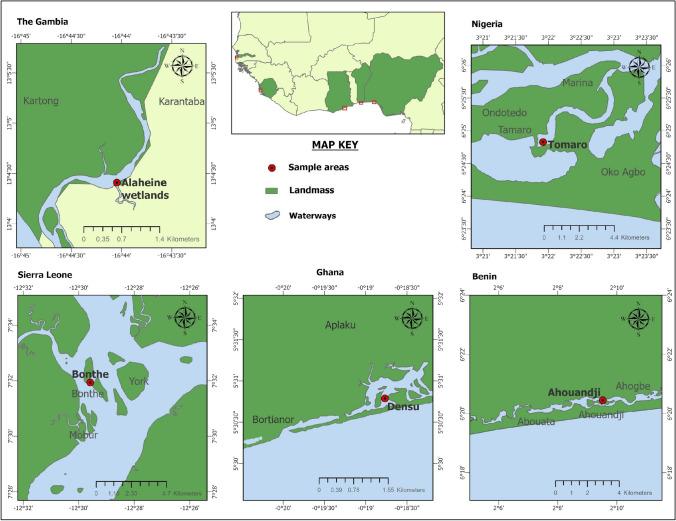
Microplastic ingestion by marine organisms presents a challenge to both ecosystem functioning and human health. We characterized microplastic abundance, shape, size, and polymer types ingested by the West African mangrove oyster, Crassostrea tulipa (Lamarck, 1819) sampled from estuaries and lagoons from the Gambia, Sierra Leone, Ghana, Benin, and Nigeria using optical microscopy and Fourier transform infrared (FTIR) techniques. A total of 780 microplastics were isolated in the whole tissues of the 250 oysters (n = 50 oysters per country). The abundance and distribution of microplastics in the oysters followed the pattern: the Gambia > Ghana > Sierra Leone > Nigeria > Benin. The Tanbi wetlands in the Gambia recorded the highest average of 10.50 ± 6.69 per oyster while the Ouidah lagoon in Benin recorded the lowest average of 1.80 ± 1.90 per oyster. Overall, microplastic numbers varied significantly (p < 0.05) among the five countries. Microfibers, particularly those within 1001-5000 μm size, dominated the total microplastic count with a few fragments and films. No spherical microplastics were isolated in the oysters. In the Sierra Leone and Benin oysters, fragments and films were absent in the samples. Microplastic between the 1001 and 5000 μm size class dominated the counts, followed by 501-1000 μm, 101-500 μm, and 51-100 μm. Five polymer groups namely polyethylene, polyester, nylon, polypropylene, and polyamide were identified across the five countries, with polyethylene occurring in oysters from all five countries and polyester occurring in all but the oysters from Nigeria. This diversity of polymers suggests varied sources of microplastics ingested by the studied oysters. The absence of microspheres across the five supports findings from other studies that they are the least ingested and highly egested by the oysters.
海洋生物摄入微塑料对生态系统功能和人类健康构成挑战。我们使用光学显微镜和傅里叶变换红外(FTIR)技术,对来自冈比亚、塞拉利昂、加纳、贝宁和尼日利亚的河口和泻湖中的西非红树林牡蛎 Crassostrea tulipa(拉马克,1819)进行了微塑料丰度、形状、大小和聚合物类型的特征描述。在 250 个牡蛎的整个组织中总共分离出 780 个微塑料(每个国家 50 个牡蛎)。牡蛎中微塑料的丰度和分布遵循以下模式:冈比亚>加纳>塞拉利昂>尼日利亚>贝宁。冈比亚的坦比湿地记录的平均每个牡蛎微塑料数量最高,为 10.50±6.69,而贝宁的奥迪亚泻湖记录的平均每个牡蛎微塑料数量最低,为 1.80±1.90。总体而言,五个国家之间的微塑料数量差异显著(p<0.05)。微纤维,尤其是 1001-5000μm 大小范围内的微纤维,占总微塑料计数的主导地位,其中有少量碎片和薄膜。牡蛎中未分离出球形微塑料。在塞拉利昂和贝宁的牡蛎中,样本中不存在碎片和薄膜。1001-5000μm 大小范围内的微塑料占主导地位,其次是 501-1000μm、101-500μm 和 51-100μm。五个聚合物组,即聚乙烯、聚酯、尼龙、聚丙烯和聚酰胺,在五个国家均有发现,其中聚乙烯存在于五个国家的牡蛎中,而聚酯存在于除尼日利亚牡蛎以外的所有牡蛎中。这种聚合物的多样性表明,研究中的牡蛎摄入的微塑料来源多样。五个国家的牡蛎均未发现微球体,这与其他研究的发现一致,即微球体是牡蛎摄入最少和排泄最多的微塑料。



 Zotero 插件