
验光中的智能设备:临床验光的现状与未来展望
Smart Devices in Optometry: Current and Future Perspectives to Clinical Optometry.
作者信息
Ramamurthy Dharani, Srinivasan Sangeetha, Chamarty Sruthi, Velappan Tharaniy, Verkicharla Pavan Kumar, Samuel Paulraj Angeline Kirubha
机构信息
Department of Optometry, Faculty of Medical & Health Sciences, SRM Medical College Hospital & Research Centre, SRM Institute of Science and Technology, Chennai, Tamil Nadu, 603203, India.
Vision Research Foundation, Chennai, Tamil Nadu, 600006, India.
出版信息
Clin Optom (Auckl). 2024 Jul 29;16:169-190. doi: 10.2147/OPTO.S447554. eCollection 2024.
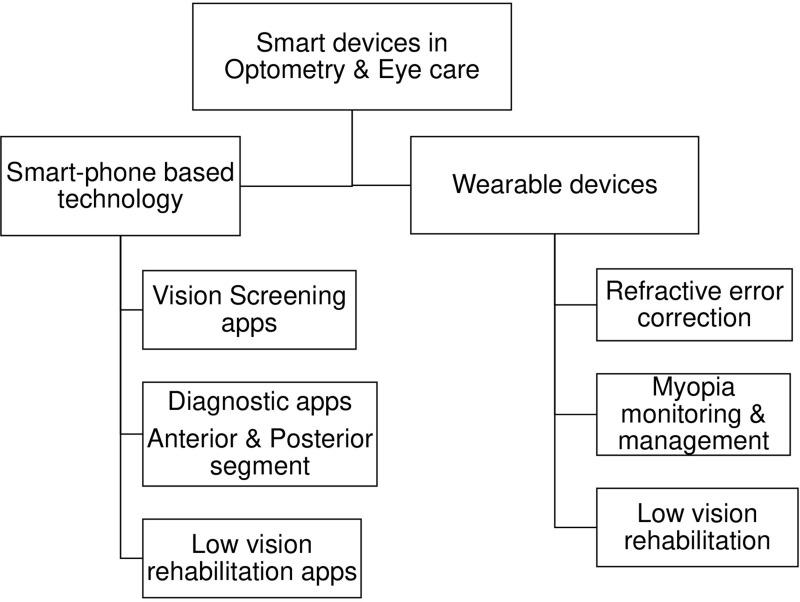
There is a huge unmet need for eye care with more than a hundred million people living without basic eye care services and facilities. There is an exigency to deploy adequate resources in terms of manpower and equipment to address this. The usage of smart devices in optometry and eye care practice has been gaining momentum for last half a decade, due to the COVID-19 pandemic and technological advancements in telemedicine. These smart devices will help facilitate remote monitoring of important visual functions, ocular signs and symptoms, thus providing better eye care services and facilities and promoting outreach services. Smart devices in optometry exist in the form of gadgets that can be worn in the wrist, and spectacle-mounted or head-mounted devices. On the other hand, with the ubiquitous nature of smartphones, a large number of smartphone applications have been developed and tested for advanced optometry and primary eye care practice, which may potentially reduce the burden of inadequate resources and the unmet need for eye care. This article aims to give an overview of the current trends and future perspectives on the application of such smart devices in optometric practice.
超过一亿人生活在没有基本眼保健服务和设施的情况下,眼保健存在着巨大的未满足需求。迫切需要在人力和设备方面部署足够的资源来解决这一问题。由于新冠疫情和远程医疗的技术进步,智能设备在验光和眼保健实践中的使用在过去五年中一直在加速发展。这些智能设备将有助于促进对重要视觉功能、眼部体征和症状的远程监测,从而提供更好的眼保健服务和设施,并推广外展服务。验光领域的智能设备有可戴在手腕上的小工具、安装在眼镜上或头戴式设备等形式。另一方面,鉴于智能手机的普及性,已经开发并测试了大量用于高级验光和初级眼保健实践的智能手机应用程序,这可能会减轻资源不足的负担以及眼保健未满足需求的问题。本文旨在概述此类智能设备在验光实践中的应用现状和未来前景。

 Zotero 插件