
结直肠癌转移中脂肪酸代谢相关酶:从生物学功能到分子机制
Fatty acid metabolism-related enzymes in colorectal cancer metastasis: from biological function to molecular mechanism.
作者信息
Li Biao, Mi Jing, Yuan Qi
机构信息
College of Life Sciences, Mudanjiang Medical University, Mudanjiang, China.
出版信息
Cell Death Discov. 2024 Aug 5;10(1):350. doi: 10.1038/s41420-024-02126-9.
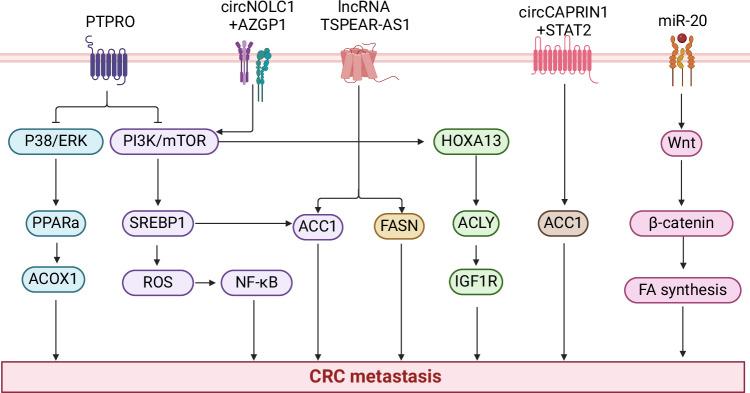
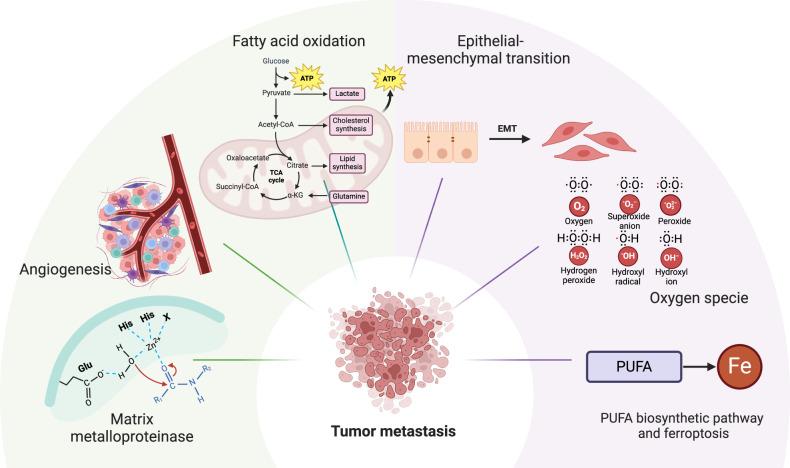
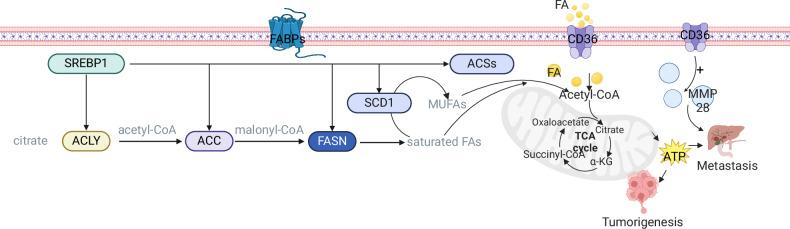
Colorectal cancer (CRC) is a highly aggressive and life-threatening malignancy that metastasizes in ~50% of patients, posing significant challenges to patient survival and treatment. Fatty acid (FA) metabolism regulates proliferation, immune escape, metastasis, angiogenesis, and drug resistance in CRC. FA metabolism consists of three pathways: de novo synthesis, uptake, and FA oxidation (FAO). FA metabolism-related enzymes promote CRC metastasis by regulating reactive oxygen species (ROS), matrix metalloproteinases (MMPs), angiogenesis and epithelial-mesenchymal transformation (EMT). Mechanistically, the PI3K/AKT/mTOR pathway, wnt/β-catenin pathway, and non-coding RNA signaling pathway are regulated by crosstalk of enzymes related to FA metabolism. Given the important role of FA metabolism in CRC metastasis, targeting FA metabolism-related enzymes and their signaling pathways is a potential strategy to treat CRC metastasis.
结直肠癌(CRC)是一种极具侵袭性且危及生命的恶性肿瘤,约50%的患者会发生转移,这给患者的生存和治疗带来了巨大挑战。脂肪酸(FA)代谢调节CRC中的增殖、免疫逃逸、转移、血管生成和耐药性。FA代谢由三条途径组成:从头合成、摄取和脂肪酸氧化(FAO)。FA代谢相关酶通过调节活性氧(ROS)、基质金属蛋白酶(MMPs)、血管生成和上皮-间质转化(EMT)促进CRC转移。从机制上讲,PI3K/AKT/mTOR途径、Wnt/β-连环蛋白途径和非编码RNA信号通路受FA代谢相关酶的串扰调节。鉴于FA代谢在CRC转移中的重要作用,靶向FA代谢相关酶及其信号通路是治疗CRC转移的一种潜在策略。
 Zotero 插件