
废聚合物化学-生物混合升级循环利用中的生物膜缓解
Biofilm mitigation in hybrid chemical-biological upcycling of waste polymers.
作者信息
Stoddard Hunter, Kulas Daniel, Zolghadr Ali, Aloba Sulihat, Schaerer Laura G, Putman Lindsay, Valencia Isabel, Lacey Jeffrey A, Shonnard David R, Techtmann Stephen M, Ong Rebecca G
机构信息
Department of Chemical Engineering, Michigan Technological University, Houghton, MI, United States.
Department of Biological Sciences, Michigan Technological University, Houghton, MI, United States.
出版信息
Front Bioeng Biotechnol. 2024 Jul 22;12:1435695. doi: 10.3389/fbioe.2024.1435695. eCollection 2024.
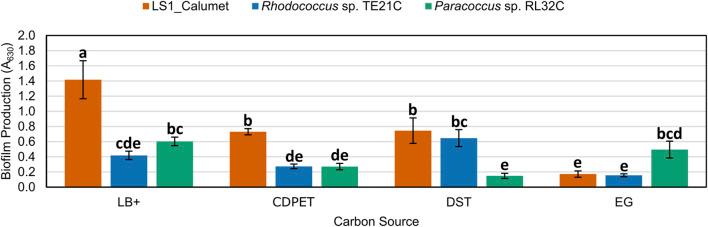
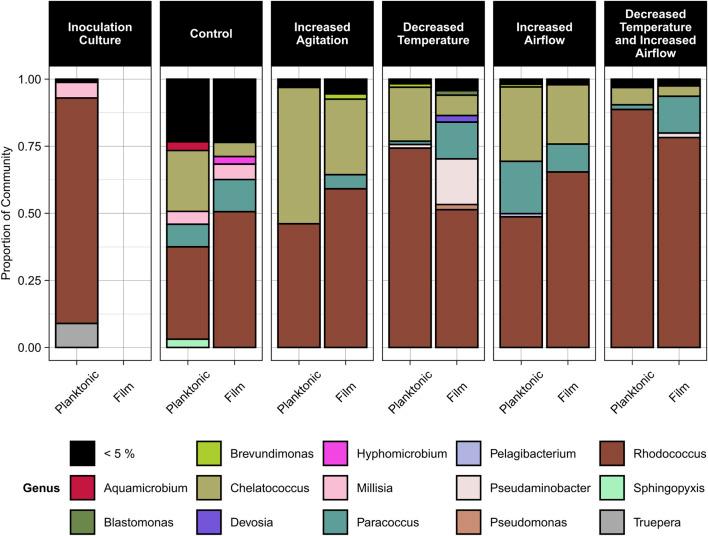
Accumulation of plastic waste in the environment is a serious global issue. To deal with this, there is a need for improved and more efficient methods for plastic waste recycling. One approach is to depolymerize plastic using pyrolysis or chemical deconstruction followed by microbial-upcycling of the monomers into more valuable products. Microbial consortia may be able to increase stability in response to process perturbations and adapt to diverse carbon sources, but may be more likely to form biofilms that foul process equipment, increasing the challenge of harvesting the cell biomass. To better understand the relationship between bioprocess conditions, biofilm formation, and ecology within the bioreactor, in this study a previously-enriched microbial consortium (LS1_Calumet) was grown on (1) ammonium hydroxide-depolymerized polyethylene terephthalate (PET) monomers and (2) the pyrolysis products of polyethylene (PE) and polypropylene (PP). Bioreactor temperature, pH, agitation speed, and aeration were varied to determine the conditions that led to the highest production of planktonic biomass and minimal formation of biofilm. The community makeup and diversity in the planktonic and biofilm states were evaluated using 16S rRNA gene amplicon sequencing. Results showed that there was very little microbial growth on the liquid product from pyrolysis under all fermentation conditions. When grown on the chemically-deconstructed PET the highest cell density (0.69 g/L) with minimal biofilm formation was produced at 30°C, pH 7, 100 rpm agitation, and 10 sL/hr airflow. Results from 16S rRNAsequencing showed that the planktonic phase had higher observed diversity than the biofilm, and that and were the most abundant genera for all process conditions. Biofilm formation by sp. And sp. Isolates was typically lower than the full microbial community and varied based on the carbon source. Ultimately, the results indicate that biofilm formation within the bioreactor can be significantly reduced by optimizing process conditions and using pure cultures or a less diverse community, while maintaining high biomass productivity. The results of this study provide insight into methods for upcycling plastic waste and how process conditions can be used to control the formation of biofilm in bioreactors.
环境中塑料垃圾的积累是一个严重的全球问题。为了解决这一问题,需要改进和提高塑料垃圾回收的方法。一种方法是通过热解或化学解构使塑料解聚,然后将单体进行微生物升级循环转化为更有价值的产品。微生物群落可能能够提高对工艺扰动的稳定性并适应多种碳源,但更有可能形成生物膜,污染工艺设备,增加收获细胞生物质的难度。为了更好地理解生物工艺条件、生物膜形成和生物反应器内生态之间的关系,在本研究中,一个先前富集的微生物群落(LS1_Calumet)在(1)氢氧化铵解聚的聚对苯二甲酸乙二酯(PET)单体和(2)聚乙烯(PE)和聚丙烯(PP)的热解产物上生长。改变生物反应器的温度、pH值、搅拌速度和通气量,以确定导致浮游生物量产量最高和生物膜形成最少的条件。使用16S rRNA基因扩增子测序评估浮游态和生物膜态的群落组成和多样性。结果表明,在所有发酵条件下,热解液体产物上的微生物生长很少。当在化学解构的PET上生长时,在30°C、pH值7、100 rpm搅拌和10 sL/hr气流条件下,产生了最高细胞密度(0.69 g/L)且生物膜形成最少。16S rRNA测序结果表明,浮游相比生物膜具有更高的观察到的多样性,并且在所有工艺条件下, 和 是最丰富的属。 属和 属菌株形成的生物膜通常低于整个微生物群落,并且根据碳源而变化。最终,结果表明,通过优化工艺条件并使用纯培养物或多样性较低的群落,同时保持高生物量生产力,可以显著减少生物反应器内生物膜的形成。本研究结果为塑料垃圾升级循环利用的方法以及如何利用工艺条件控制生物反应器中生物膜的形成提供了见解。


 Zotero 插件