
在急性肺损伤恢复过程中,化学反射致敏在雄性和雌性大鼠中均会发生。
Chemoreflex sensitization occurs in both male and female rats during recovery from acute lung injury.
作者信息
Kamra Kajal, Zucker Irving H, Schultz Harold D, Wang Han-Jun
机构信息
Department of Cellular and Integrative Physiology, University of Nebraska Medical Center, Omaha, NE, United States.
Department of Anesthesiology, University of Nebraska Medical Center, Omaha, NE, United States.
出版信息
Front Physiol. 2024 Jul 22;15:1401774. doi: 10.3389/fphys.2024.1401774. eCollection 2024.
INTRODUCTION
Sex-specific patterns in respiratory conditions, such as asthma, COPD, cystic fibrosis, obstructive sleep apnea, and idiopathic pulmonary fibrosis, have been previously documented. Animal models of acute lung injury (ALI) have offered insights into sex differences, with male mice exhibiting distinct lung edema and vascular leakage compared to female mice. Our lab has provided evidence that the chemoreflex is sensitized in male rats during the recovery from bleomycin-induced ALI, but whether sex-based chemoreflex changes occur post-ALI is not known. To bridge this gap, the current study employed the bleomycin-induced ALI animal model to investigate sex-based differences in chemoreflex activation during the recovery from ALI.
METHODS
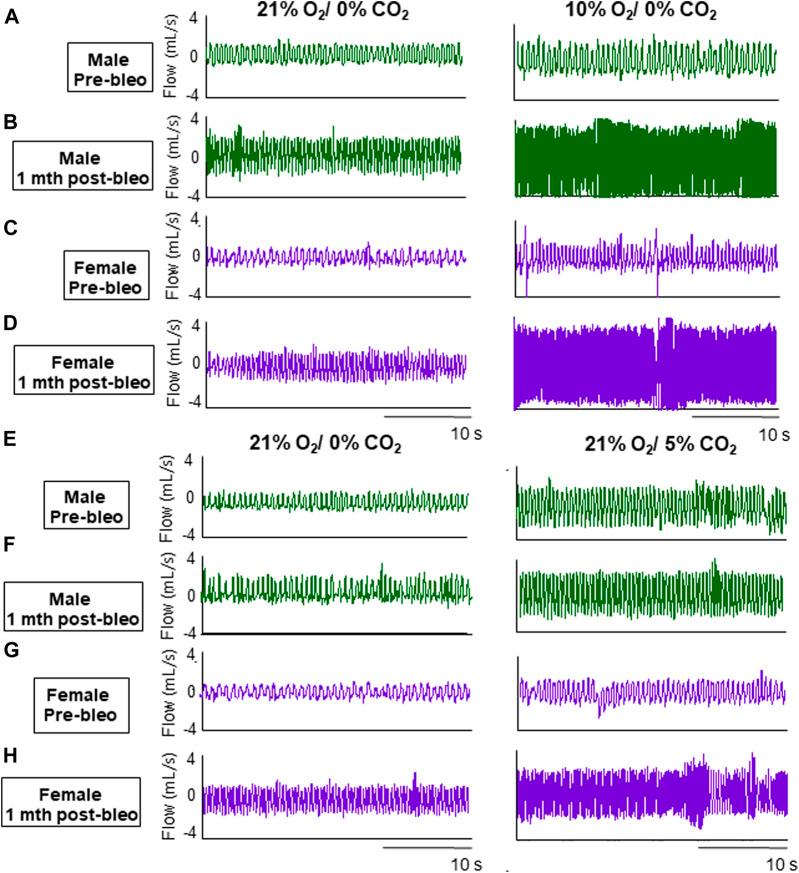
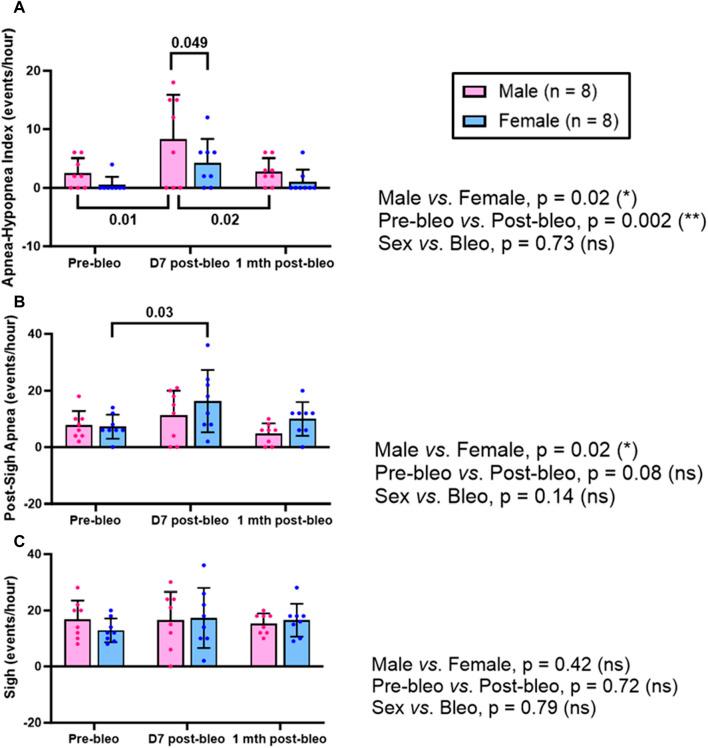
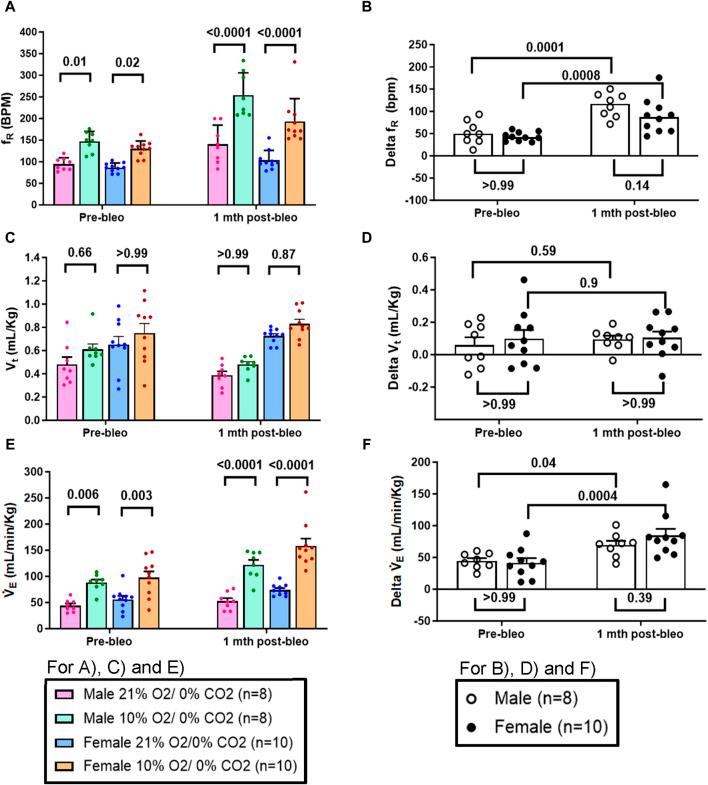
ALI was induced using a single intra-tracheal instillation of bleomycin (bleo, 2.5 mg/Kg) (day 1). Resting respiratory frequency (f) was measured at 1-2 days pre-bleo, day 7 (D7) post-bleo, and 1 month (1 mth) post-bleo. The chemoreflex responses to hypoxia (10% O, 0% CO) and normoxic-hypercapnia (21% O, 5% CO) were measured before bleo administration (pre-bleo) and 1 mth post-bleo using whole-body plethysmography. The apnea-hypopnea Index (AHI), post-sigh apneas, and sighs were measured at each time point.
RESULTS
There were no significant differences in resting f between male and female rats at the pre-bleo time point or in the increase in resting f at D7 post-bleo. At 1 mth post-bleo, the resting f was partially restored in both sexes but the recovery towards normal ranges of resting f was significantly lower in male rats. The AHI, post-sigh apneas, and sighs were not different between male and female rats pre-bleo and 1 mth post-bleo. However, at D7 post-bleo, the male rats exhibited a higher AHI than female rats. Both male and female rats exhibited a sensitized chemoreflex in response to hypoxia and normoxic-hypercapnia with no significant differences between sexes.
CONCLUSION
A sex difference in resting ventilatory parameters occurs post ALI with a prolonged increase in resting f and larger AHI in male rats. On the other hand, we did not find any sex differences in the chemoreflex sensitization that occurs at 1 mth post-bleo. This work contributes to a better understanding of sex-based variations in lung disorders.
引言
先前已有文献记载了哮喘、慢性阻塞性肺疾病、囊性纤维化、阻塞性睡眠呼吸暂停和特发性肺纤维化等呼吸系统疾病中的性别特异性模式。急性肺损伤(ALI)动物模型为性别差异提供了见解,与雌性小鼠相比,雄性小鼠表现出明显的肺水肿和血管渗漏。我们实验室已提供证据表明,在博来霉素诱导的ALI恢复过程中,雄性大鼠的化学反射会敏感化,但ALI后是否会发生基于性别的化学反射变化尚不清楚。为了填补这一空白,本研究采用博来霉素诱导的ALI动物模型,研究ALI恢复过程中化学反射激活的性别差异。
方法
在第1天通过气管内单次注射博来霉素(bleo,2.5mg/Kg)诱导ALI。在博来霉素注射前1-2天、博来霉素注射后第7天(D7)和博来霉素注射后1个月(1个月)测量静息呼吸频率(f)。在博来霉素给药前(博来霉素前)和博来霉素注射后1个月,使用全身体积描记法测量对低氧(10%O,0%CO)和常氧高碳酸血症(21%O,5%CO)的化学反射反应。在每个时间点测量呼吸暂停低通气指数(AHI)、叹息后呼吸暂停和叹息次数。
结果
在博来霉素前时间点,雄性和雌性大鼠的静息f无显著差异,博来霉素注射后第7天静息f的增加也无显著差异。在博来霉素注射后1个月,两性的静息f均部分恢复,但雄性大鼠静息f恢复到正常范围的程度明显较低。博来霉素前和博来霉素注射后1个月,雄性和雌性大鼠的AHI、叹息后呼吸暂停和叹息次数无差异。然而,在博来霉素注射后第7天,雄性大鼠的AHI高于雌性大鼠。雄性和雌性大鼠对低氧和常氧高碳酸血症均表现出敏感化的化学反射,两性之间无显著差异。
结论
ALI后静息通气参数存在性别差异,雄性大鼠静息f持续增加且AHI更大。另一方面,我们在博来霉素注射后1个月发生的化学反射敏感化中未发现任何性别差异。这项工作有助于更好地理解肺部疾病中基于性别的差异。


 Zotero 插件