
载蟾毒灵多功能光热纳米颗粒通过靶向 SRC-3/HIF-1α 通路抑制厌氧糖酵解,提高结直肠癌的温和光热治疗效果。
Bufalin-Loaded Multifunctional Photothermal Nanoparticles Inhibit the Anaerobic Glycolysis by Targeting SRC-3/HIF-1α Pathway for Improved Mild Photothermal Therapy in CRC.
机构信息
Interventional Cancer Institute of Chinese Integrative Medicine, Putuo Hospital, Shanghai University of Traditional Chinese Medicine, Shanghai, 200062, People's Republic of China.
Shanghai Frontiers Science Center of Optogenetic Techniques for Cell Metabolism, Shanghai Key Laboratory of New Drug Design, School of Pharmacy, East China University of Science and Technology, Shanghai, 200237, People's Republic of China.
出版信息
Int J Nanomedicine. 2024 Aug 1;19:7831-7850. doi: 10.2147/IJN.S470005. eCollection 2024.
PURPOSE
Compared with traditional photothermal therapy (PTT, >50°C), mild PTT (≤45°C) is a promising strategy for tumor therapy with fewer adverse effects. Unfortunately, its anti-tumor efficacy is hampered by thermoresistance induced by overexpression of heat shock proteins (HSPs). In our previous study, we found bufalin (BU) is a glycolysis inhibitor that depletes HSPs, which is expected to overcome thermotolerance of tumor cells. In this study, BU-loaded multifunctional nanoparticles (NPs) were developed for enhancing the mild PTT of colorectal cancer (CRC).
METHODS
FeO NPs coated with the polydopamine (PDA) shell modified with polyethylene glycol (PEG) and cyclic arginine-glycyl-aspartic peptide (cRGD) for loading BU (FeO@PDA-PEG-cRGD/BU NPs) were developed. The thermal variations in FeO@PDA-PEG-cRGD/BU NPs solution under different conditions were measured. Glycolysis inhibition was evaluated by measuring the glucose uptake, extracellular lactate, and intracellular adenosine triphosphate (ATP) levels. The cellular cytotoxicity of FeO@PDA-PEG-cRGD/BU NPs was analyzed using a cell counting kit-8 assay, Calcein-AM/PI double staining, and flow cytometry in HCT116 cells. The magnetic resonance imaging (MRI) performance and anti-tumor therapeutic efficacy of FeO@PDA-PEG-cRGD/BU NPs were evaluated in HCT116-tumor bearing mice.
RESULTS
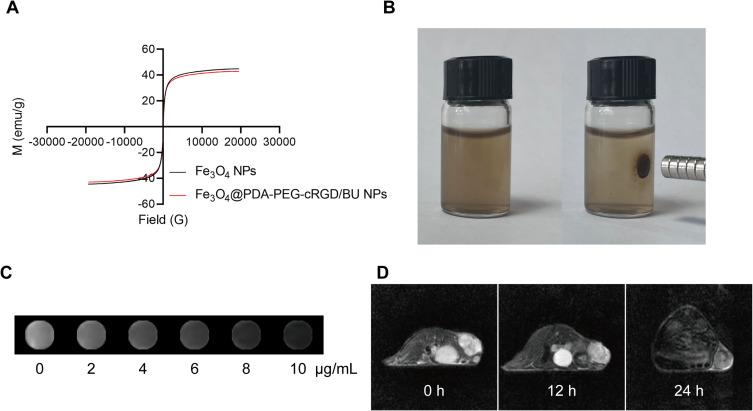
FeO@PDA-PEG-cRGD/BU NPs had an average diameter of 260.4±3.5 nm, the zeta potential of -23.8±1.6 mV, the drug loading rate of 1.1%, which had good thermal stability, photothermal conversion efficiencies and MRI performance. In addition, the released BU not only killed tumor cells but also interfered with glycolysis by targeting the steroid receptor coactivator 3 (SRC-3)/HIF-1α pathway, preventing intracellular ATP synthesis, and combating HSP-dependent tumor thermoresistance, ultimately strengthening the thermal sensitivity toward mild PTT both in vitro and in vivo.
CONCLUSION
This study provides a highly effective strategy for enhancing the therapeutic effects of mild PTT toward tumors.
目的
与传统光热疗法(PTT,>50°C)相比,温和的 PTT(≤45°C)是一种具有较少副作用的肿瘤治疗有前景的策略。不幸的是,其抗肿瘤功效受到热休克蛋白(HSPs)过表达诱导的热抗性的阻碍。在我们之前的研究中,我们发现蟾毒灵(BU)是一种糖酵解抑制剂,可耗尽 HSPs,有望克服肿瘤细胞的热耐受性。在这项研究中,开发了载 BU 的多功能纳米粒子(NPs)用于增强结直肠癌(CRC)的温和 PTT。
方法
开发了用聚多巴胺(PDA)壳修饰的载有 BU 的 FeO NPs(FeO@PDA-PEG-cRGD/BU NPs),该壳用聚乙二醇(PEG)和环精氨酸-甘氨酸-天冬氨酸肽(cRGD)修饰以负载 BU。测量不同条件下 FeO@PDA-PEG-cRGD/BU NPs 溶液的热变化。通过测量葡萄糖摄取、细胞外乳酸和细胞内三磷酸腺苷(ATP)水平来评估糖酵解抑制作用。使用细胞计数试剂盒-8 分析、Calcein-AM/PI 双重染色和流式细胞术在 HCT116 细胞中分析 FeO@PDA-PEG-cRGD/BU NPs 的细胞毒性。在 HCT116 荷瘤小鼠中评估 FeO@PDA-PEG-cRGD/BU NPs 的磁共振成像(MRI)性能和抗肿瘤治疗效果。
结果
FeO@PDA-PEG-cRGD/BU NPs 的平均直径为 260.4±3.5nm,zeta 电位为-23.8±1.6mV,载药量为 1.1%,具有良好的热稳定性、光热转换效率和 MRI 性能。此外,释放的 BU 不仅通过靶向类固醇受体共激活剂 3(SRC-3)/HIF-1α 通路杀死肿瘤细胞,而且还干扰糖酵解,阻止细胞内 ATP 合成,对抗 HSP 依赖性肿瘤热抗性,最终在体外和体内均增强了对温和 PTT 的热敏感性。
结论
这项研究为增强温和 PTT 对肿瘤的治疗效果提供了一种高效策略。



 Zotero 插件