
众包反馈以提高住院医师错误披露技能:一项随机临床试验。
Crowdsourced Feedback to Improve Resident Physician Error Disclosure Skills: A Randomized Clinical Trial.
机构信息
Department of Medicine, University of Washington School of Medicine, Seattle.
National Board of Medical Examiners, Philadelphia, Pennsylvania.
出版信息
JAMA Netw Open. 2024 Aug 1;7(8):e2425923. doi: 10.1001/jamanetworkopen.2024.25923.
IMPORTANCE
Residents must prepare for effective communication with patients after medical errors. The video-based communication assessment (VCA) is software that plays video of a patient scenario, asks the physician to record what they would say, engages crowdsourced laypeople to rate audio recordings of physician responses, and presents feedback to physicians.
OBJECTIVE
To evaluate the effectiveness of VCA feedback in resident error disclosure skill training.
DESIGN, SETTING, AND PARTICIPANTS: This single-blinded, randomized clinical trial was conducted from July 2022 to May 2023 at 7 US internal medicine and family medicine residencies (10 total sites). Participants were second-year residents attending required teaching conferences. Data analysis was performed from July to December 2023.
INTERVENTION
Residents completed 2 VCA cases at time 1 and were randomized to the intervention, an individual feedback report provided in the VCA application after 2 weeks, or to control, in which feedback was not provided until after time 2. Residents completed 2 additional VCA cases after 4 weeks (time 2).
MAIN OUTCOMES AND MEASURES
Panels of crowdsourced laypeople rated recordings of residents disclosing simulated medical errors to create scores on a 5-point scale. Reports included learning points derived from layperson comments. Mean time 2 ratings were compared to test the hypothesis that residents who had access to feedback on their time 1 performance would score higher at time 2 than those without feedback access. Residents were surveyed about demographic characteristics, disclosure experience, and feedback use. The intervention's effect was examined using analysis of covariance.
RESULTS
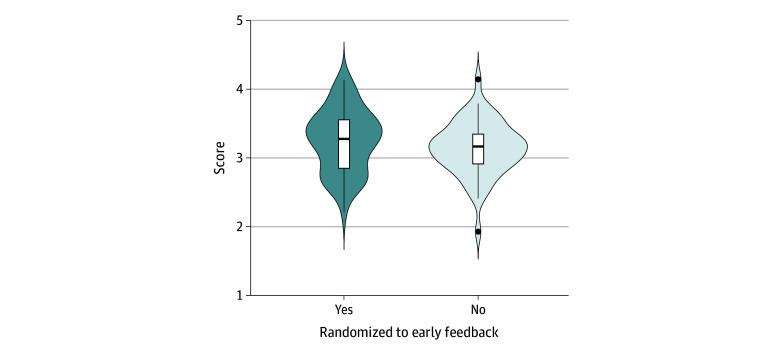
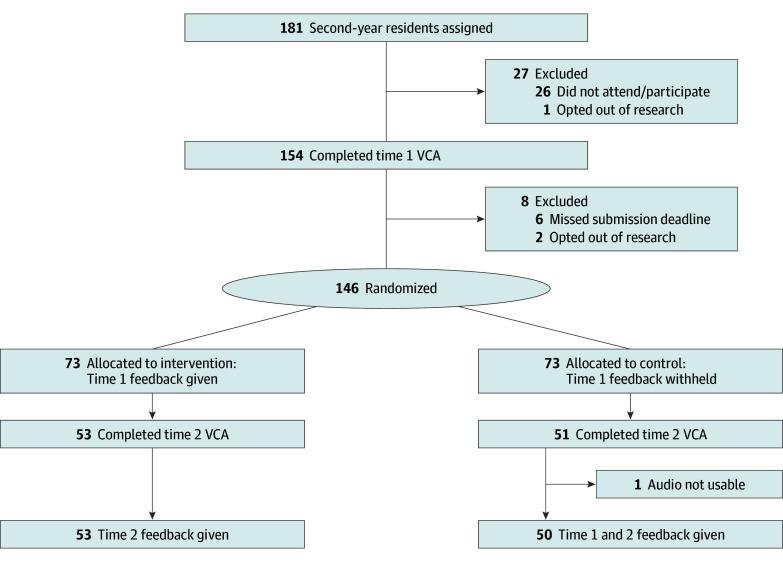
A total of 146 residents (87 [60.0%] aged 25-29 years; 60 female [41.0%]) completed the time 1 VCA, and 103 (70.5%) completed the time 2 VCA (53 randomized to intervention and 50 randomized to control); of those, 28 (54.9%) reported reviewing their feedback. Analysis of covariance found a significant main effect of feedback between intervention and control groups at time 2 (mean [SD] score, 3.26 [0.45] vs 3.14 [0.39]; difference, 0.12; 95% CI, 0.08-0.48; P = .01). In post hoc comparisons restricted to residents without prior disclosure experience, intervention residents scored higher than those in the control group at time 2 (mean [SD] score, 3.33 [0.43] vs 3.09 [0.44]; difference, 0.24; 95% CI, 0.01-0.48; P = .007). Worse performance at time 1 was associated with increased likelihood of dropping out before time 2 (odds ratio, 2.89; 95% CI, 1.06-7.84; P = .04).
CONCLUSIONS AND RELEVANCE
In this randomized clinical trial, self-directed review of crowdsourced feedback was associated with higher ratings of internal medicine and family medicine residents' error disclosure skill, particularly for those without real-life error disclosure experience, suggesting that such feedback may be an effective way for residency programs to address their requirement to prepare trainees for communicating with patients after medical harm.
TRIAL REGISTRATION
ClinicalTrials.gov Identifier: NCT06234085.
重要性
住院医师在发生医疗错误后必须为与患者进行有效沟通做好准备。基于视频的沟通评估(VCA)是一种软件,它可以播放患者情景的视频,要求医生记录他们要说的话,让众包的非专业人士对医生的回答进行录音评分,并向医生提供反馈。
目的
评估 VCA 反馈在住院医师错误披露技能培训中的效果。
设计、地点和参与者:这是一项在 2022 年 7 月至 2023 年 5 月期间在美国 7 个内科和家庭医学住院医师实习基地(共 10 个地点)进行的单盲、随机临床试验。参与者是参加必修教学会议的第二年住院医师。数据分析于 2023 年 7 月至 12 月进行。
干预
住院医师在第一次时完成了 2 个 VCA 案例,然后随机分为干预组,在两周后在 VCA 应用程序中提供个人反馈报告,或对照组,在第二次时才提供反馈。4 周后(第二次),住院医师完成了另外 2 个 VCA 案例。
主要结果和测量
众包的非专业人士对住院医师模拟医疗错误的披露录音进行评分,创建一个 5 分制的评分。报告包括从非专业人士评论中得出的学习要点。比较第二次的平均评分以检验以下假设:在第一次有机会获得对其表现的反馈的住院医师,其在第二次的评分将高于没有反馈机会的住院医师。对居民进行了关于人口统计学特征、披露经验和反馈使用的调查。使用协方差分析来检验干预的效果。
结果
共有 146 名居民(87 名[60.0%]年龄在 25-29 岁;60 名女性[41.0%])完成了第一次 VCA,其中 103 名(70.5%)完成了第二次 VCA(53 名随机分配到干预组,50 名随机分配到对照组);其中 28 名(54.9%)报告审查了他们的反馈。协方差分析发现,干预组和对照组在第二次的反馈之间存在显著的主效应(平均[SD]评分,3.26[0.45]与 3.14[0.39];差异,0.12;95%CI,0.08-0.48;P=0.01)。在限制在没有先前披露经验的居民中进行的事后比较中,干预组的居民在第二次的评分高于对照组(平均[SD]评分,3.33[0.43]与 3.09[0.44];差异,0.24;95%CI,0.01-0.48;P=0.007)。第一次表现较差与在第二次之前退出的可能性增加相关(比值比,2.89;95%CI,1.06-7.84;P=0.04)。
结论和相关性
在这项随机临床试验中,自我指导的众包反馈审查与内科和家庭医学住院医师错误披露技能的更高评分相关,特别是对于那些没有实际错误披露经验的住院医师,这表明这种反馈可能是住院医师计划为培训他们在医疗伤害后与患者沟通做好准备的有效方法。
试验注册
ClinicalTrials.gov 标识符:NCT06234085。

 Zotero 插件