
远程护理和远程医疗中的预测性数据分析:系统综述
Predictive Data Analytics in Telecare and Telehealth: Systematic Scoping Review.
作者信息
Anderson Euan, Lennon Marilyn, Kavanagh Kimberley, Weir Natalie, Kernaghan David, Roper Marc, Dunlop Emma, Lapp Linda
机构信息
Department of Computer and Information Sciences, University of Strathclyde, Glasgow, United Kingdom.
Department of Mathematics and Statistics, University of Strathclyde, Glasgow, United Kingdom.
出版信息
Online J Public Health Inform. 2024 Aug 7;16:e57618. doi: 10.2196/57618.
BACKGROUND
Telecare and telehealth are important care-at-home services used to support individuals to live more independently at home. Historically, these technologies have reactively responded to issues. However, there has been a recent drive to make better use of the data from these services to facilitate more proactive and predictive care.
OBJECTIVE
This review seeks to explore the ways in which predictive data analytics techniques have been applied in telecare and telehealth in at-home settings.
METHODS
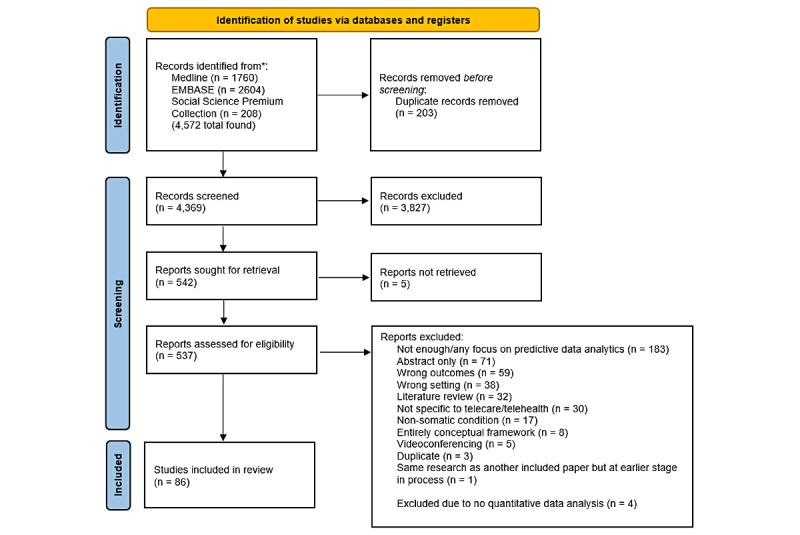
The PRISMA-ScR (Preferred Reporting Items for Systematic Reviews and Meta-Analyses extension for Scoping Reviews) checklist was adhered to alongside Arksey and O'Malley's methodological framework. English language papers published in MEDLINE, Embase, and Social Science Premium Collection between 2012 and 2022 were considered and results were screened against inclusion or exclusion criteria.
RESULTS
In total, 86 papers were included in this review. The types of analytics featuring in this review can be categorized as anomaly detection (n=21), diagnosis (n=32), prediction (n=22), and activity recognition (n=11). The most common health conditions represented were Parkinson disease (n=12) and cardiovascular conditions (n=11). The main findings include: a lack of use of routinely collected data; a dominance of diagnostic tools; and barriers and opportunities that exist, such as including patient-reported outcomes, for future predictive analytics in telecare and telehealth.
CONCLUSIONS
All papers in this review were small-scale pilots and, as such, future research should seek to apply these predictive techniques into larger trials. Additionally, further integration of routinely collected care data and patient-reported outcomes into predictive models in telecare and telehealth offer significant opportunities to improve the analytics being performed and should be explored further. Data sets used must be of suitable size and diversity, ensuring that models are generalizable to a wider population and can be appropriately trained, validated, and tested.
背景
远程护理和远程医疗是重要的居家护理服务,用于支持个人在家中更独立地生活。从历史上看,这些技术一直是对问题做出被动反应。然而,最近人们一直在努力更好地利用这些服务中的数据,以促进更主动和预测性的护理。
目的
本综述旨在探讨预测性数据分析技术在居家环境中的远程护理和远程医疗中的应用方式。
方法
遵循PRISMA-ScR(系统评价和Meta分析扩展的范围综述的首选报告项目)清单以及Arksey和O'Malley的方法框架。考虑了2012年至2022年间发表在MEDLINE、Embase和社会科学高级收藏中的英文论文,并根据纳入或排除标准筛选结果。
结果
本综述共纳入86篇论文。本综述中出现的分析类型可分为异常检测(n=21)、诊断(n=32)、预测(n=22)和活动识别(n=11)。所代表的最常见健康状况是帕金森病(n=12)和心血管疾病(n=11)。主要发现包括:常规收集的数据使用不足;诊断工具占主导地位;以及存在的障碍和机会,例如纳入患者报告的结果,以便在远程护理和远程医疗中进行未来的预测性分析。
结论
本综述中的所有论文都是小规模试点,因此,未来的研究应寻求将这些预测技术应用于更大规模的试验。此外,将常规收集的护理数据和患者报告的结果进一步整合到远程护理和远程医疗的预测模型中,为改进正在进行的分析提供了重大机会,应进一步探索。所使用的数据集必须具有合适的规模和多样性,确保模型能够推广到更广泛的人群,并能够进行适当的训练、验证和测试。
 Zotero 插件