
人类季节性冠状病毒的全球流行病学与季节性:一项系统综述
Global Epidemiology and Seasonality of Human Seasonal Coronaviruses: A Systematic Review.
作者信息
Wilson Rory, Kovacs Dory, Crosby Mairi, Ho Antonia
机构信息
Department of Global Health and Population, Harvard T.H. Chan School of Public Health, Boston, Massachusetts, USA.
College of Medical, Veterinary, and Life Sciences, University of Glasgow, Glasgow, UK.
出版信息
Open Forum Infect Dis. 2024 Jul 18;11(8):ofae418. doi: 10.1093/ofid/ofae418. eCollection 2024 Aug.
BACKGROUND
We characterized the global epidemiology and seasonality of human coronaviruses (HCoVs) OC43, NL63, 229E, and HKU1.
METHODS
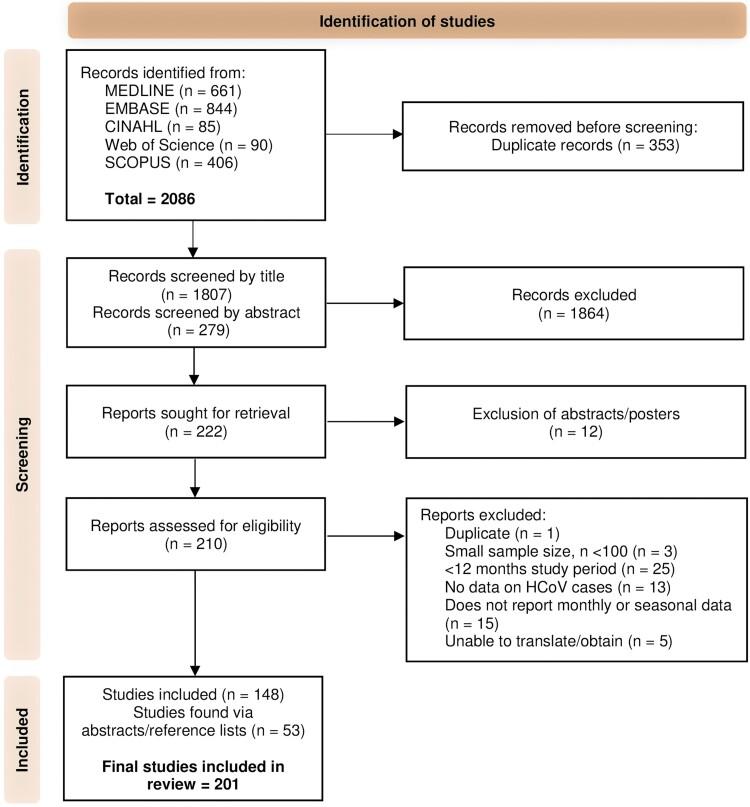
In this systematic review, we searched MEDLINE, EMBASE, Web of Science, SCOPUS, CINAHL, and backward citations for studies published until 1 September 2023. We included studies with ≥12 months of consecutive data and tested for ≥1 HCoV species. Case reports, review articles, animal studies, studies focusing on SARS-CoV-1, SARS-CoV-2, and/or Middle East respiratory syndrome, and those including <100 cases were excluded. Study quality and risk of bias were assessed using Joanna Briggs Institute Critical Appraisal Checklist tools. We reported the prevalence of all HCoVs and individual species. Seasonality was reported for studies that included ≥100 HCoVs annually. This study is registered with PROSPERO, CRD42022330902.
RESULTS
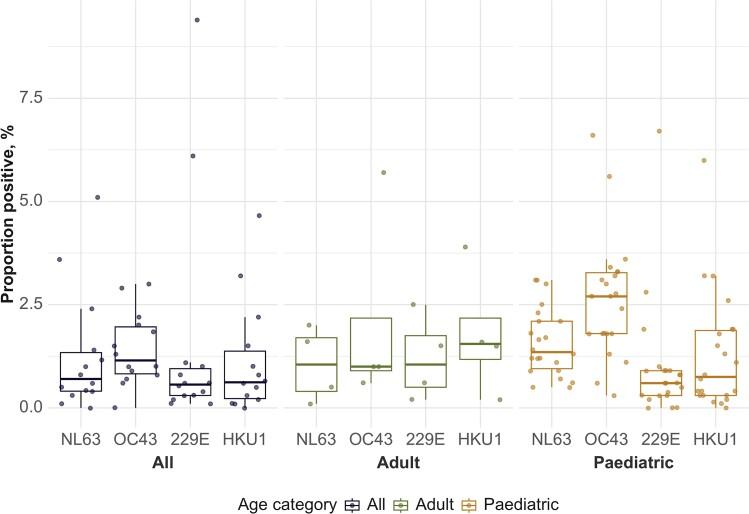
A total of 201 studies (1 819 320 samples) from 68 countries were included. A high proportion were from China (19.4%; n = 39), whereas the Southern Hemisphere was underrepresented. Most were case series (77.1%, n = 155) with samples from secondary care (74.1%, n = 149). Seventeen (8.5%) studies included asymptomatic controls, whereas 76 (37.8%) reported results for all 4 HCoV species. Overall, OC43 was the most prevalent HCoV. Median test positivity of OC43 and NL63 was higher in children, and 229E and HKU1 in adults. Among 18 studies that described seasonality (17 from the Northern Hemisphere), circulation of all HCoVs mostly peaked during cold months.
CONCLUSIONS
In our comprehensive review, few studies reported the prevalence of individual HCoVs or seasonality. Further research on the burden and circulation of HCoVs is needed, particularly from Africa, South Asia, and Central/South America.
背景
我们对人冠状病毒(HCoV)OC43、NL63、229E和HKU1的全球流行病学及季节性特征进行了描述。
方法
在这项系统评价中,我们检索了MEDLINE、EMBASE、Web of Science、SCOPUS、CINAHL以及回溯引文,以查找截至2023年9月1日发表的研究。我们纳入了具有连续≥12个月数据且检测≥1种HCoV的研究。病例报告、综述文章、动物研究、聚焦于严重急性呼吸综合征冠状病毒1(SARS-CoV-1)、严重急性呼吸综合征冠状病毒2(SARS-CoV-2)和/或中东呼吸综合征的研究,以及病例数<100的研究均被排除。使用乔安娜·布里格斯研究所批判性评价清单工具评估研究质量和偏倚风险。我们报告了所有HCoV及各毒株型别的流行率。对于每年检测≥100例HCoV的研究,报告其季节性情况。本研究已在国际前瞻性系统评价注册库(PROSPERO)注册,注册号为CRD42022330902。
结果
共纳入来自68个国家的201项研究(1819320份样本)。很大一部分研究来自中国(19.4%;n = 39),而南半球的研究较少。大多数研究为病例系列(77.1%,n = 155),样本来自二级医疗机构(74.1%,n = 149)。17项研究(8.5%)纳入了无症状对照,76项研究(37.8%)报告了所有4种HCoV毒株型别的检测结果。总体而言,OC43是最常见的HCoV。儿童中OC43和NL63的检测阳性率中位数较高,成人中229E和HKU-1的检测阳性率中位数较高。在18项描述季节性的研究中(17项来自北半球),所有HCoV的传播大多在寒冷月份达到高峰。
结论
在我们的综合评价中,很少有研究报告单个HCoV的流行率或季节性情况。需要对HCoV的负担和传播情况开展进一步研究,特别是来自非洲、南亚以及中美洲/南美洲的研究。

 Zotero 插件