
晚期癌症患者的早期综合姑息治疗:一项随机临床试验。
Early Integrated Palliative Care in Patients With Advanced Cancer: A Randomized Clinical Trial.
作者信息
Kang EunKyo, Kang Jung Hun, Koh Su-Jin, Kim Yu Jung, Seo Seyoung, Kim Jung Hoon, Cheon Jaekyung, Kang Eun Joo, Song Eun-Kee, Nam Eun Mi, Oh Ho-Suk, Choi Hye Jin, Kwon Jung Hye, Bae Woo Kyun, Lee Jeong Eun, Jung Kyung Hae, Yun Young Ho
机构信息
National Cancer Control Institute, National Cancer Center, Goyang, Republic of Korea.
Department of Family Medicine, National Cancer Center, Goyang, Republic of Korea.
出版信息
JAMA Netw Open. 2024 Aug 1;7(8):e2426304. doi: 10.1001/jamanetworkopen.2024.26304.
IMPORTANCE
Limited data suggest that early palliative care (EPC) improves quality of life (QOL) and survival in patients with advanced cancer.
OBJECTIVE
To evaluate whether comprehensive EPC improves QOL; relieves mental, social, and existential burdens; increases survival rates; and helps patients develop coping skills.
DESIGN, SETTING, AND PARTICIPANTS: This nonblinded randomized clinical trial (RCT) recruited patients from 12 hospitals in South Korea from September 2017 to October 2018. Patients aged 20 years or older with advanced cancer who were not terminally ill but for whom standard chemotherapy has not been effective were eligible. Participants were randomized 1:1 to the control (receiving usual supportive oncological care) or intervention (receiving EPC with usual oncological care) group. Intention-to-treat data analysis was conducted between September and December 2022.
INTERVENTIONS
The intervention group received EPC through a structured program of self-study education materials, telephone coaching, and regular assessments by an integrated palliative care team.
MAIN OUTCOMES AND MEASURES
The primary outcome was the change in overall QOL score (assessed with the European Organization for Research and Treatment of Cancer Quality of Life Questionnaire Core 15 Palliative Care) from baseline to 24 weeks after enrollment, with evaluations also conducted at 12 and 18 weeks. Secondary outcomes were social and existential burdens (assessed with the McGill Quality of Life Questionnaire) as well as crisis-overcoming capacity and 2-year survival.
RESULTS
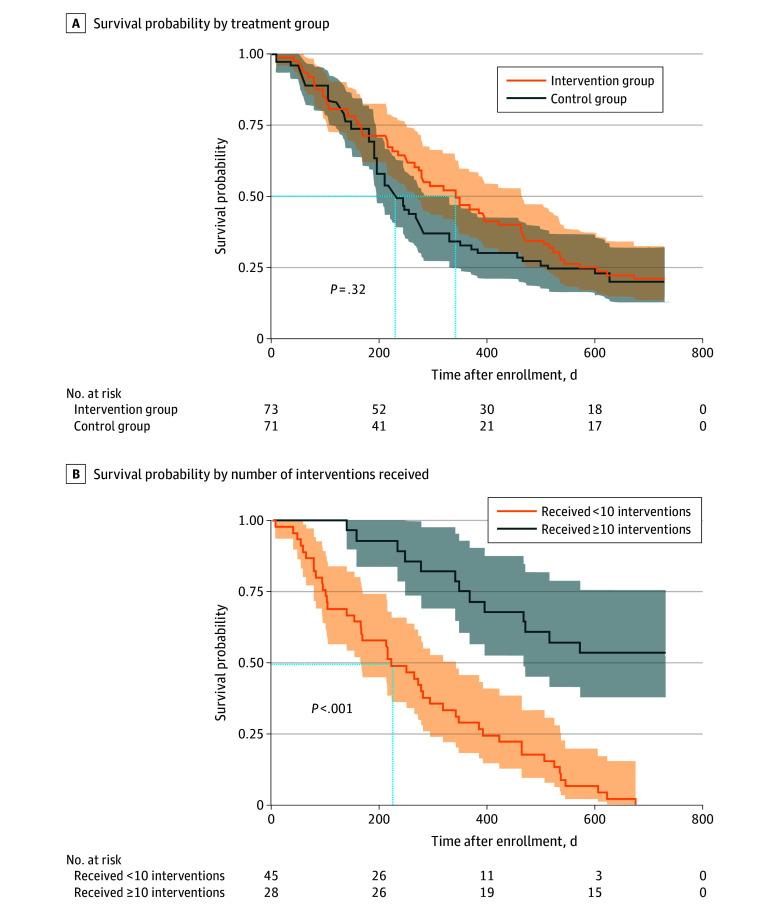
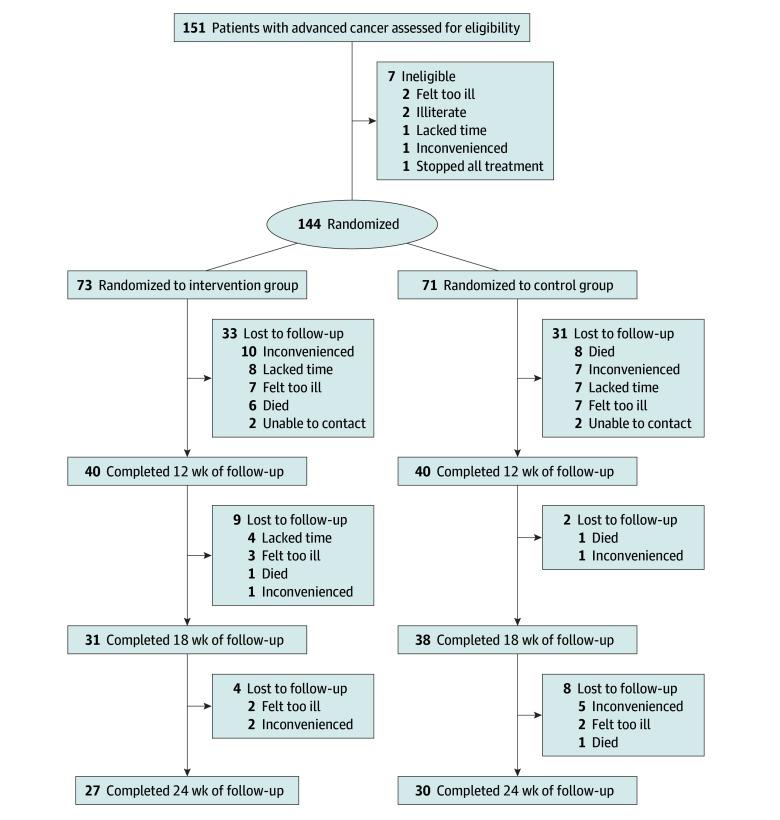
A total of 144 patients (83 males [57.6%]; mean [SD] age, 60.7 (7.2) years) were enrolled, of whom 73 were randomized to the intervention group and 71 to the control group. The intervention group demonstrated significantly greater changes in scores in overall health status or QOL from baseline, especially at 18 weeks (11.00 [95% CI, 0.78-21.22] points; P = .04; effect size = 0.42). However, at 12 and 24 weeks, there were no significant differences observed. Compared with the control group, the intervention group also showed significant improvement in self-management or coping skills over 24 weeks (20.51 [95% CI, 12.41-28.61] points; P < .001; effect size = 0.93). While the overall survival rate was higher in the intervention vs control group, the difference was not significant. In the intervention group, however, those who received 10 or more EPC interventions (eg, telephone coaching sessions and care team meetings) showed a significantly increased probability of 2-year survival (53.6%; P < .001).
CONCLUSIONS AND RELEVANCE
This RCT demonstrated that EPC enhanced QOL at 18 weeks; however, no significant improvements were observed at 12 and 24 weeks. An increased number of interventions sessions was associated with increased 2-year survival rates in the intervention group.
TRIAL REGISTRATION
ClinicalTrials.gov Identifier: NCT03181854.
重要性
有限的数据表明,早期姑息治疗(EPC)可改善晚期癌症患者的生活质量(QOL)并延长生存期。
目的
评估全面的早期姑息治疗是否能改善生活质量;减轻心理、社会和存在负担;提高生存率;并帮助患者培养应对技能。
设计、设置和参与者:这项非盲随机临床试验(RCT)于2017年9月至2018年10月从韩国的12家医院招募患者。年龄在20岁及以上、患有晚期癌症、并非末期疾病但标准化疗无效的患者符合条件。参与者按1:1随机分为对照组(接受常规支持性肿瘤护理)或干预组(接受早期姑息治疗及常规肿瘤护理)。在2022年9月至12月期间进行意向性治疗数据分析。
干预措施
干预组通过结构化的自学教育材料、电话指导以及由综合姑息治疗团队进行的定期评估来接受早期姑息治疗。
主要结局和测量指标
主要结局是从基线到入组后24周总体生活质量评分的变化(使用欧洲癌症研究与治疗组织生活质量问卷核心15项姑息治疗版进行评估),并在12周和18周时也进行评估。次要结局包括社会和存在负担(使用麦吉尔生活质量问卷进行评估)以及危机应对能力和2年生存率。
结果
共招募了144名患者(83名男性[57.6%];平均[标准差]年龄,60.7(7.2)岁),其中73名被随机分配到干预组,71名被分配到对照组。干预组从基线开始在总体健康状况或生活质量评分上显示出显著更大的变化,尤其是在18周时(11.00[95%置信区间,0.78 - 21.22]分;P = 0.04;效应大小 = 0.42)。然而,在12周和24周时,未观察到显著差异。与对照组相比,干预组在24周内自我管理或应对技能也有显著改善(20.51[95%置信区间,12.41 - 28.61]分;P < 0.001;效应大小 = 0.93)。虽然干预组的总体生存率高于对照组,但差异不显著。然而,在干预组中,接受10次或更多早期姑息治疗干预(如电话指导课程和护理团队会议)的患者2年生存率显著增加(53.6%;P < 0.001)。
结论和相关性
这项随机临床试验表明,早期姑息治疗在18周时提高了生活质量;然而,在12周和24周时未观察到显著改善。干预次数的增加与干预组2年生存率的提高相关。
试验注册
ClinicalTrials.gov标识符:NCT03181854。
 Zotero 插件