
使用可见近红外光谱法对完整果实上不同储存期的柚子皮精油进行分析
Analysis of the Pomelo Peel Essential Oils at Different Storage Durations Using a Visible and Near-Infrared Spectroscopic on Intact Fruit.
作者信息
Sirisomboon Panmanas, Duangchang Jittra, Phanomsophon Thitima, Lapcharoensuk Ravipat, Shrestha Bim Prasad, Kasemsamran Sumaporn, Thanapase Warunee, Pornchaloempong Pimpen, Tsuchikawa Satoru
机构信息
Department of Agricultural Engineering, School of Engineering, King Mongkut's Institute of Technology Ladkrabang, Bangkok 10520, Thailand.
Office of Administrative Interdisciplinary Program on Agricultural Technology, School of Agricultural Technology, King Mongkut's Institute of Technology Ladkrabang, Bangkok 10520, Thailand.
出版信息
Foods. 2024 Jul 27;13(15):2379. doi: 10.3390/foods13152379.
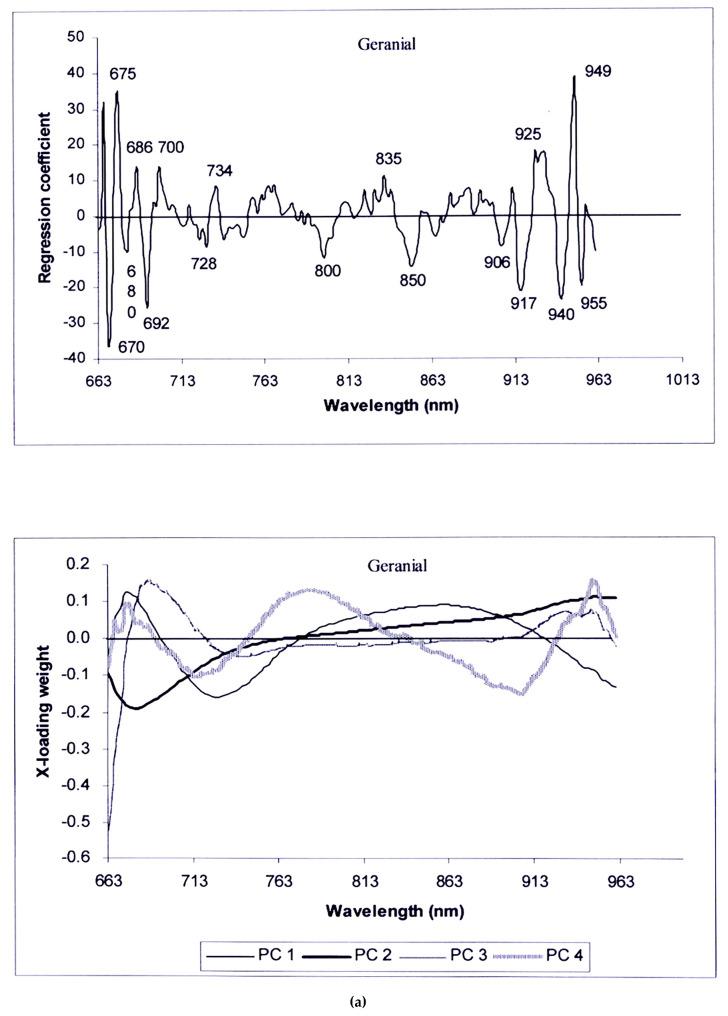
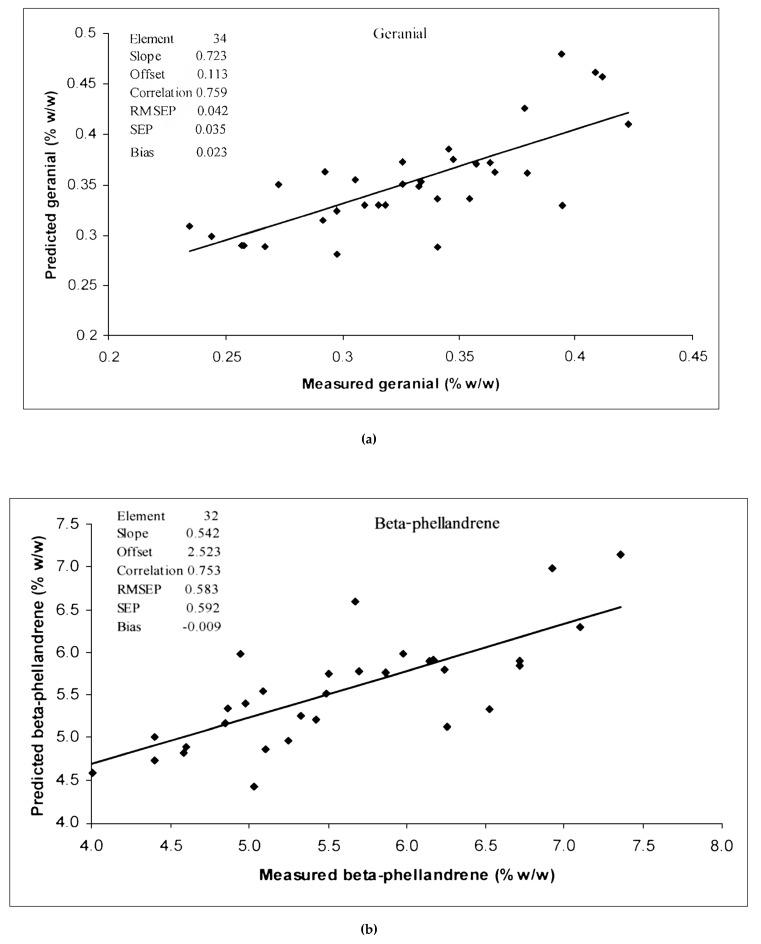
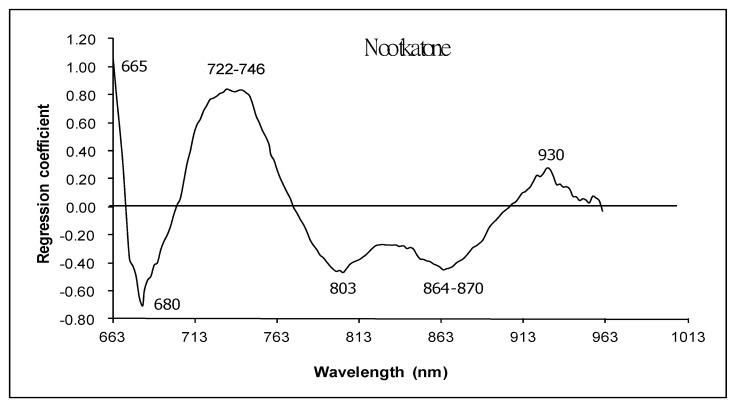
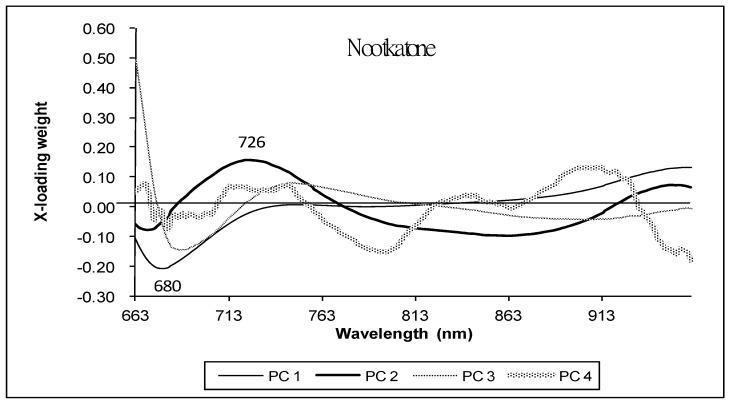
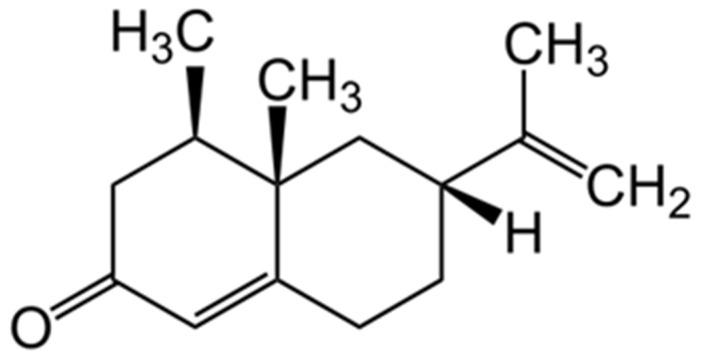
Pomelo fruit pulp mainly is consumed fresh and with very little processing, and its peels are discarded as biological waste, which can cause the environmental problems. The peels contain several bioactive chemical compounds, especially essential oils (EOs). The content of a specific EO is important for the extraction process in industry and in research units such as breeding research. The explanation of the biosynthesis pathway for EO generation and change was included. The chemical bond vibration affected the prediction of EO constituents was comprehensively explained by regression coefficient plots and x-loading plots. Visible and near-infrared spectroscopy (VIS/NIRS) is a prominent rapid technique used for fruit quality assessment. This research work was focused on evaluating the use of VIS/NIRS to predict the composition of EOs found in the peel of the pomelo fruit ( (J. Burm.) Merr. cv Kao Nam Pueng) following storage. The composition of the peel oil was analyzed by gas chromatography-mass spectrometry (GC-MS) at storage durations of 0, 15, 30, 45, 60, 75, 90, 105 and 120 days (at 10 °C and 70% relative humidity). The relationship between the NIR spectral data and the major EO components found in the peel, including nootkatone, geranial, β-phellandrene and limonene, were established using the raw spectral data in conjunction with partial least squares (PLS) regression. Preprocessing of the raw spectra was performed using multiplicative scatter correction (MSC) or second derivative preprocessing. The PLS model of nootkatone with full MSC had the highest correlation coefficient between the predicted and reference values (r = 0.82), with a standard error of prediction (SEP) of 0.11% and bias of 0.01%, while the models of geranial, β-phellandrene and limonene provided too low r values of 0.75, 0.75 and 0.67, respectively. The nootkatone model is only appropriate for use in screening and some other approximate calibrations, though this is the first report of the use of NIR spectroscopy on intact fruit measurement for its peel EO constituents during cold storage.
柚子果肉主要是鲜食,加工很少,其果皮作为生物废料被丢弃,这可能会导致环境问题。果皮含有多种生物活性化合物,尤其是精油(EOs)。特定精油的含量对于工业提取过程以及育种研究等科研单位很重要。文中还包含了对精油生成和变化的生物合成途径的解释。通过回归系数图和x-载荷图全面解释了化学键振动对精油成分预测的影响。可见和近红外光谱(VIS/NIRS)是用于水果品质评估的一种重要的快速技术。本研究工作的重点是评估使用VIS/NIRS来预测柚子((J. Burm.)Merr. cv Kao Nam Pueng)果实贮藏后果皮中发现的精油成分。在贮藏0、15、30、45、60、75、90、105和120天(10℃和70%相对湿度)时,通过气相色谱-质谱联用(GC-MS)分析果皮油的成分。利用原始光谱数据结合偏最小二乘法(PLS)回归,建立了近红外光谱数据与果皮中主要精油成分(包括诺卡酮、香叶醛、β-水芹烯和柠檬烯)之间的关系。原始光谱的预处理采用多元散射校正(MSC)或二阶导数预处理。诺卡酮的全MSC的PLS模型在预测值和参考值之间具有最高的相关系数(r = 0.82),预测标准误差(SEP)为0.11%,偏差为0.01%,而香叶醛模型、β-水芹烯模型和柠檬烯模型的r值分别低至0.75、0.75和0.67。诺卡酮模型仅适用于筛选和一些其他近似校准,尽管这是首次报道在冷藏期间对完整果实进行近红外光谱测量以分析其果皮精油成分。



 Zotero 插件