
局部钙调磷酸酶和哺乳动物雷帕霉素靶蛋白抑制剂在炎症性皮肤病中的应用:当前的挑战和基于纳米技术的前景(综述)。
Topical calcineurin and mammalian target of rapamycin inhibitors in inflammatory dermatoses: Current challenges and nanotechnology‑based prospects (Review).
机构信息
1st Department of Dermatology‑Venereology, School of Medicine, National and Kapodistrian University of Athens, 'A. Sygros' Hospital for Skin and Venereal Diseases, 16121 Athens, Greece.
Research Group of Clinical Pharmacology and Pharmacogenomics, Faculty of Pharmacy, School of Health Sciences, National and Kapodistrian University of Athens, 15771 Athens, Greece.
出版信息
Int J Mol Med. 2024 Oct;54(4). doi: 10.3892/ijmm.2024.5409. Epub 2024 Aug 12.
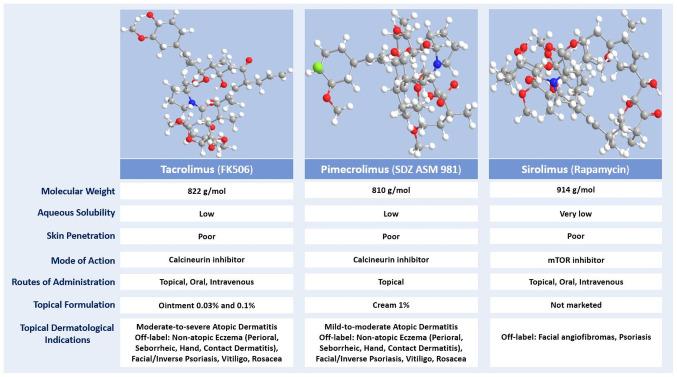
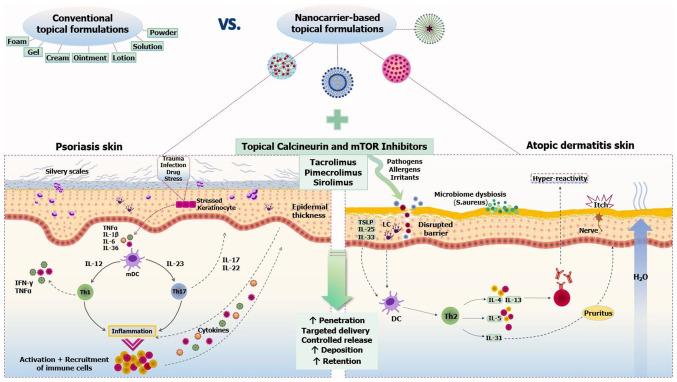
Topical therapy remains a critical component in the management of immune‑mediated inflammatory dermatoses such as psoriasis and atopic dermatitis. In this field, macrolactam immunomodulators, including calcineurin and mammalian target of rapamycin inhibitors, can offer steroid‑free therapeutic alternatives. Despite their potential for skin‑selective treatment compared with topical corticosteroids, the physicochemical properties of these compounds, such as high lipophilicity and large molecular size, do not meet the criteria for efficient penetration into the skin, especially with conventional topical vehicles. Thus, more sophisticated approaches are needed to address the pharmacokinetic limitations of traditional formulations. In this regard, interest has increasingly focused on nanoparticulate systems to optimize penetration kinetics and enhance the efficacy and safety of topical calcineurin and mTOR inhibitors in inflamed skin. Several types of nanovectors have been explored as topical carriers to deliver tacrolimus in both psoriatic and atopic skin, while preclinical data on nanocarrier‑based delivery of topical sirolimus in inflamed skin are also emerging. Given the promising preliminary outcomes and the complexities of drug delivery across inflamed skin, further research is required to translate these nanotherapeutics into clinical settings for inflammatory skin diseases. The present review outlined the dermatokinetic profiles of topical calcineurin and mTOR inhibitors, particularly tacrolimus, pimecrolimus and sirolimus, focusing on their penetration kinetics in psoriatic and atopic skin. It also summarizes the potential anti‑inflammatory benefits of topical sirolimus and explores novel preclinical studies investigating dermally applied nanovehicles to evaluate and optimize the skin delivery, efficacy and safety of these 'hard‑to‑formulate' macromolecules in the context of psoriasis and atopic dermatitis.
局部治疗仍然是治疗免疫介导的炎症性皮肤病(如银屑病和特应性皮炎)的关键组成部分。在这一领域,大环内酯类免疫调节剂,包括钙调神经磷酸酶和哺乳动物雷帕霉素靶蛋白抑制剂,可以提供无类固醇的治疗选择。尽管与局部皮质类固醇相比,这些化合物具有皮肤选择性治疗的潜力,但它们的物理化学性质,如高亲脂性和大分子量,不符合有效渗透皮肤的标准,尤其是使用传统的局部制剂时。因此,需要更复杂的方法来解决传统制剂的药代动力学限制。在这方面,人们越来越关注纳米颗粒系统,以优化渗透动力学,并提高局部钙调神经磷酸酶和 mTOR 抑制剂在炎症皮肤中的疗效和安全性。已经探索了几种类型的纳米载体作为局部载体,以在银屑病和特应性皮炎皮肤中递送他克莫司,而基于纳米载体的局部西罗莫司在炎症皮肤中的递药的临床前数据也在不断涌现。鉴于初步结果很有前景,以及穿过炎症皮肤进行药物输送的复杂性,需要进一步研究将这些纳米疗法转化为炎症性皮肤病的临床应用。本文概述了局部钙调神经磷酸酶和 mTOR 抑制剂(特别是他克莫司、吡美莫司和西罗莫司)的皮肤药代动力学特征,重点关注它们在银屑病和特应性皮炎皮肤中的渗透动力学。本文还总结了局部西罗莫司的潜在抗炎益处,并探讨了新的临床前研究,这些研究调查了经皮应用的纳米载体,以评估和优化这些“难形成”大分子在银屑病和特应性皮炎中的皮肤递送、疗效和安全性。

 Zotero 插件