
非瓣膜性心房颤动高龄患者的预后——ANAFIE注册研究
Patient Outcomes in Very Elderly Patients With Non-Valvular Atrial Fibrillation - ANAFIE Registry.
作者信息
Suzuki Shinya, Yamashita Takeshi, Akao Masaharu, Atarashi Hirotsugu, Ikeda Takanori, Okumura Ken, Koretsune Yukihiro, Shimizu Wataru, Tsutsui Hiroyuki, Toyoda Kazunori, Hirayama Atsushi, Yasaka Masahiro, Yamaguchi Takenori, Teramukai Satoshi, Morishima Yoshiyuki, Fukuzawa Masayuki, Takita Atsushi, Inoue Hiroshi
机构信息
The Cardiovascular Institute Tokyo Japan.
Department of Cardiology, National Hospital Organization Kyoto Medical Center Kyoto Japan.
出版信息
Circ Rep. 2024 Jul 23;6(8):283-293. doi: 10.1253/circrep.CR-24-0061. eCollection 2024 Aug 9.
BACKGROUND
The All Nippon Atrial Fibrillation In the Elderly Registry provides real-world insights into non-valvular atrial fibrillation (NVAF) in >30,000 elderly Japanese patients (aged ≥75 years), including >2,000 nonagenarians. We aimed to investigate outcomes in these patients by age and oral anticoagulant (OAC) type.
METHODS AND RESULTS
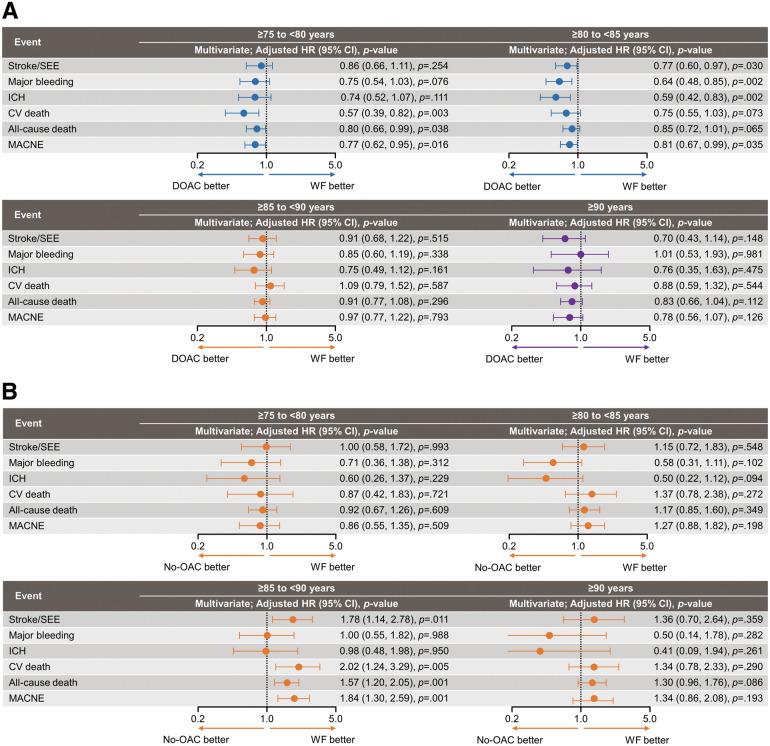
This prospective, multicenter, observational, cohort, 2-year follow-up study included elderly patients with NVAF who were able to attend hospital visits. The incidences of stroke/systemic embolic events (SEE), major bleeding, intracranial hemorrhage (ICH), cardiovascular death, all-cause death, and major adverse cardiovascular or neurological events (MACNE) were evaluated by age. Incidence rates increased significantly with age. Stroke/SEE, major bleeding, and ICH incidences plateaued in patients aged ≥90 years. Direct OACs (DOACs) yielded a numerically lower event incidence vs. warfarin in all age groups and endpoints, except for major bleeding in patients aged ≥90 years. DOACs (vs. warfarin) were significantly associated with a lower risk of stroke/SEE, major bleeding, and ICH in the ≥80-<85 years group, and reduced cardiovascular and all-cause death in the ≥75-<80 years group. In the ≥90 years subgroup, major bleeding history was a risk factor for all-cause death.
CONCLUSIONS
Although DOAC vs. warfarin offers potential benefits for stroke prevention, limitations occurred in reducing major bleeding among those aged ≥90 years, indicating a potential benefit of very-low-dose DOAC for this demographic.
背景
全日空老年房颤登记研究为30000多名日本老年患者(年龄≥75岁)的非瓣膜性房颤(NVAF)提供了真实世界的见解,其中包括2000多名九旬老人。我们旨在按年龄和口服抗凝剂(OAC)类型调查这些患者的预后。
方法和结果
这项前瞻性、多中心、观察性队列2年随访研究纳入了能够到医院就诊的老年NVAF患者。通过年龄评估卒中/全身性栓塞事件(SEE)、大出血、颅内出血(ICH)、心血管死亡、全因死亡和主要不良心血管或神经事件(MACNE)的发生率。发生率随年龄显著增加。≥90岁患者的卒中/SEE、大出血和ICH发生率趋于平稳。在所有年龄组和终点中,除≥90岁患者的大出血外,直接OAC(DOAC)的事件发生率在数值上低于华法林。在≥80-<85岁组中,DOAC(与华法林相比)与较低的卒中/SEE、大出血和ICH风险显著相关,在≥75-<80岁组中,DOAC可降低心血管死亡和全因死亡风险。在≥90岁亚组中,大出血史是全因死亡的危险因素。
结论
尽管DOAC与华法林相比在预防卒中方面具有潜在益处,但在≥90岁人群中减少大出血方面存在局限性,这表明极低剂量DOAC对该人群可能有益。


 Zotero 插件