
海马体的时间动态和空间异质性揭示了双相情感障碍患者后代中的脆弱性标志物。
Hippocampal temporal dynamics and spatial heterogeneity unveil vulnerability markers in the offspring of bipolar patients.
作者信息
Saccaro Luigi F, Delavari Farnaz, Van De Ville Dimitri, Piguet Camille
机构信息
Psychiatry Department, Faculty of Medicine, University of Geneva, Geneva, Switzerland.
Psychiatry Department, Geneva University Hospital, Geneva, Switzerland.
出版信息
Bipolar Disord. 2025 Feb;27(1):17-27. doi: 10.1111/bdi.13487. Epub 2024 Aug 12.
OBJECTIVES
Bipolar disorder (BD) is a highly heritable disorder characterized by emotion dysregulation and recurrent oscillations between mood states. Despite the proven efficacy of early interventions, vulnerability markers in high-risk individuals are still lacking. BD patients present structural alterations of the hippocampus, a pivotal hub of emotion regulation networks composed of multiple subregions with different projections. However, the hippocampal dynamic functional connectivity (dFC) in BD remains unclear. We aim to investigate whether the dFC of hippocampal subdivisions differentiates BD patients, offspring of BD patients (BDoff), and healthy controls (HC); and whether it correlates with symptoms differently between these groups.
METHODS
We studied for the first time the dFC of the hippocampus through a cutting-edge micro-co-activation patterns (μCAPs) analysis of resting-state functional MRI data of 97 subjects (26 BD, 18 BDoff, 53 HC). μCAPs allow a data-driven differentiation within the seed region.
RESULTS
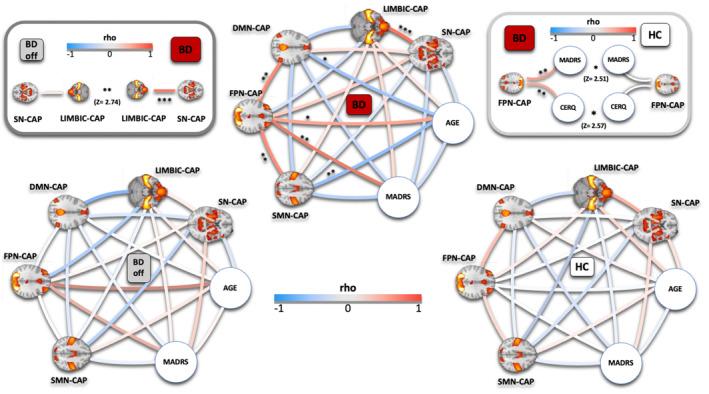
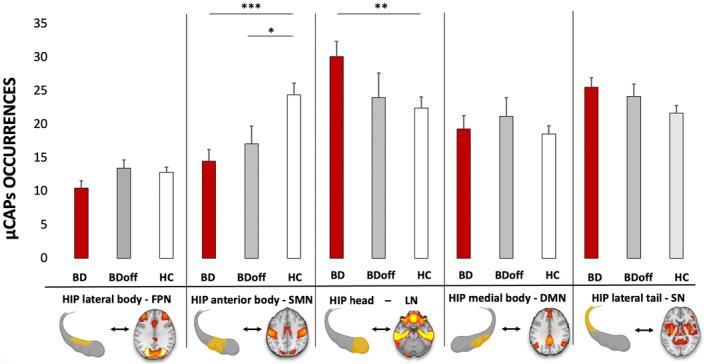
dFC between the hippocampal body and a somatomotor-μCAP was lower both in BD patients (p-value:0.00015) and in BDoff (p-value:0.020) than in HC. Inversely, dFC between the hippocampal head and a limbic-μCAP was higher in BD patients than in HC (p-value: 0.005). Furthermore, the correlations between a frontoparietal-μCAP and both depression and emotion dysregulation symptoms were significantly higher in BD than HC (p-value <0.02).
CONCLUSION
Overall, we observed alterations of large-scale functional brain networks associated with decreased cognitive control flexibility and disrupted somatomotor, saliency, and emotion processing in BD. Interestingly, BDoff presented an intermediate phenotype between BD and HC, suggesting that dFC of hippocampal subregions might represent a marker of vulnerability to BD.
目的
双相情感障碍(BD)是一种高度遗传性疾病,其特征为情绪调节障碍以及情绪状态间的反复波动。尽管早期干预已证实有效,但高危个体中的易感性标志物仍然缺乏。BD患者存在海马结构改变,海马是由多个具有不同投射的子区域组成的情绪调节网络的关键枢纽。然而,BD患者的海马动态功能连接(dFC)仍不清楚。我们旨在研究海马亚区的dFC是否能区分BD患者、BD患者的后代(BDoff)和健康对照(HC);以及在这些组中它与症状的相关性是否不同。
方法
我们首次通过对97名受试者(26名BD患者、18名BDoff、53名HC)的静息态功能磁共振成像数据进行前沿的微共激活模式(μCAPs)分析来研究海马的dFC。μCAPs允许在种子区域内进行数据驱动的区分。
结果
BD患者(p值:0.00015)和BDoff(p值:0.020)中海马体与躯体运动-μCAP之间的dFC均低于HC。相反,BD患者海马头部与边缘-μCAP之间的dFC高于HC(p值:0.005)。此外,BD患者中额顶-μCAP与抑郁和情绪调节障碍症状之间的相关性显著高于HC(p值<0.02)。
结论
总体而言,我们观察到BD患者大脑大规模功能网络的改变,与认知控制灵活性降低以及躯体运动、显著性和情绪处理受损有关。有趣的是,BDoff呈现出BD和HC之间的中间表型,表明海马亚区的dFC可能代表BD易感性的一个标志物。
 Zotero 插件