
全面综述非瑟酮对动物模型结直肠癌的影响:聚焦于细胞和分子机制。
A comprehensive view on the fisetin impact on colorectal cancer in animal models: Focusing on cellular and molecular mechanisms.
机构信息
Department of Physiology, School of Medicine, Hamadan University of Medical Sciences, Hamadan, Iran.
Department of Pharmacology and Toxicology, School of Pharmacy, Hamadan University of Medical Sciences, Hamadan, Iran.
出版信息
Animal Model Exp Med. 2024 Oct;7(5):591-605. doi: 10.1002/ame2.12476. Epub 2024 Aug 13.
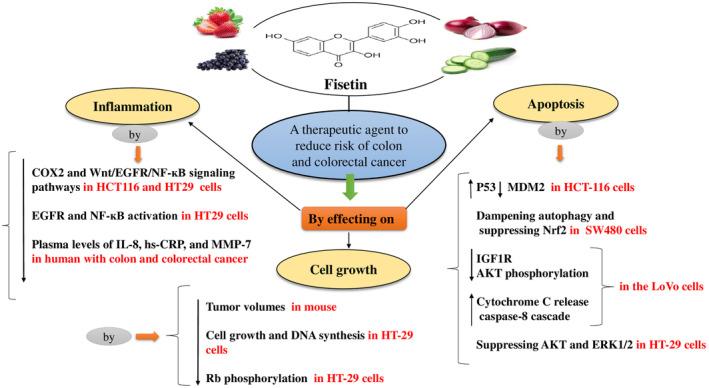
Flavonoids, including fisetin, have been linked to a reduced risk of colorectal cancer (CRC) and have potential therapeutic applications for the condition. Fisetin, a natural flavonoid found in various fruits and vegetables, has shown promise in managing CRC due to its diverse biological activities. It has been found to influence key cell signaling pathways related to inflammation, angiogenesis, apoptosis, and transcription factors. The results of this study demonstrate that fisetin induces colon cancer cell apoptosis through multiple mechanisms. It impacts the p53 pathway, leading to increased levels of p53 and decreased levels of murine double minute 2, contributing to apoptosis induction. Fisetin also triggers the release of important components in the apoptotic process, such as second mitochondria-derived activator of caspase/direct inhibitor of apoptosis-binding protein with low pI and cytochrome c. Furthermore, fisetin inhibits the cyclooxygenase-2 and wingless-related integration site (Wnt)/epidermal growth factor receptor/nuclear factor kappa B signaling pathways, reducing Wnt target gene expression and hindering colony formation. It achieves this by regulating the activities of cyclin-dependent kinase 2 and cyclin-dependent kinase 4, reducing retinoblastoma protein phosphorylation, decreasing cyclin E levels, and increasing p21 levels, ultimately influencing E2 promoter binding factor 1 and cell division cycle 2 (CDC2) protein levels. Additionally, fisetin exhibits various effects on CRC cells, including inhibiting the phosphorylation of Y-box binding protein 1 and ribosomal S6 kinase, promoting the phosphorylation of extracellular signal-regulated kinase 1/2, and disrupting the repair process of DNA double-strand breaks. Moreover, fisetin serves as an adjunct therapy for the prevention and treatment of phosphatidylinositol-4,5-bisphosphate 3-kinase catalytic subunit α (PIK3CA)-mutant CRC, resulting in a reduction in phosphatidylinositol-3 kinase (PI3K) expression, Ak strain transforming phosphorylation, mTOR activity, and downstream target proteins in CRC cells with a PIK3CA mutation. These findings highlight the multifaceted potential of fisetin in managing CRC and position it as a promising candidate for future therapy development.
类黄酮,包括非瑟酮,与结直肠癌(CRC)风险降低有关,并具有治疗该疾病的潜在应用。非瑟酮是一种存在于各种水果和蔬菜中的天然类黄酮,由于其多种生物学活性,在管理 CRC 方面显示出前景。它已被发现影响与炎症、血管生成、细胞凋亡和转录因子相关的关键细胞信号通路。这项研究的结果表明,非瑟酮通过多种机制诱导结肠癌细胞凋亡。它影响 p53 途径,导致 p53 水平升高和鼠双微体 2 水平降低,从而促进凋亡诱导。非瑟酮还触发凋亡过程中重要成分的释放,如第二线粒体衍生的半胱天冬酶激活剂/直接凋亡抑制剂结合蛋白低 pI 和细胞色素 c。此外,非瑟酮抑制环氧化酶-2 和 Wnt/表皮生长因子受体/核因子 kappa B 信号通路,降低 Wnt 靶基因表达并抑制集落形成。它通过调节细胞周期蛋白依赖性激酶 2 和细胞周期蛋白依赖性激酶 4 的活性来实现这一点,降低视网膜母细胞瘤蛋白磷酸化,降低细胞周期蛋白 E 水平,增加 p21 水平,最终影响 E2 启动子结合因子 1 和细胞分裂周期 2(CDC2)蛋白水平。此外,非瑟酮对 CRC 细胞具有多种作用,包括抑制 Y 盒结合蛋白 1 和核糖体 S6 激酶的磷酸化,促进细胞外信号调节激酶 1/2 的磷酸化,并破坏 DNA 双链断裂的修复过程。此外,非瑟酮可作为磷脂酰肌醇-4,5-二磷酸 3-激酶催化亚基 α(PIK3CA)突变型 CRC 的辅助治疗方法,导致磷脂酰肌醇-3 激酶(PI3K)表达降低,Ak 株转化磷酸化,mTOR 活性以及 CRC 细胞中 PIK3CA 突变的下游靶蛋白降低。这些发现强调了非瑟酮在管理 CRC 方面的多方面潜力,并将其定位为未来治疗开发的有前途的候选药物。
 Zotero 插件