
对来自孟加拉国高耐药负担临床环境的患者样本进行靶向下一代测序:经验教训。
Targeted next-generation sequencing of from patient samples: lessons learned from high drug-resistant burden clinical settings in Bangladesh.
机构信息
Infectious Diseases Division, icddr,b, Dhaka, Bangladesh.
Emerging Bacterial Pathogens Unit, IRCCS San Raffaele Scientific Institute, Milan, Italy.
出版信息
Emerg Microbes Infect. 2024 Dec;13(1):2392656. doi: 10.1080/22221751.2024.2392656. Epub 2024 Aug 26.
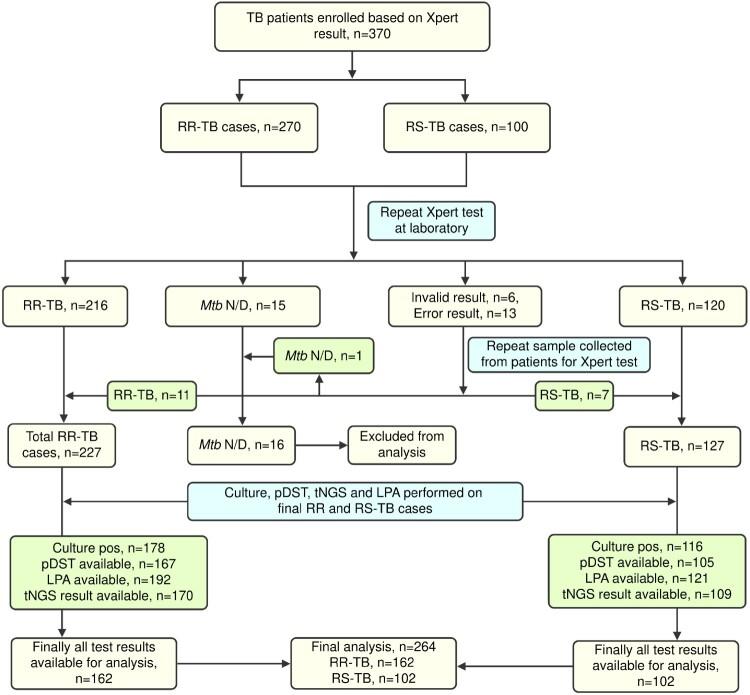
Lack of appropriate early diagnostic tools for drug-resistant tuberculosis (DR-TB) and their incomplete drug susceptibility testing (DST) profiling is concerning for TB disease control. Existing methods, such as phenotypic DST (pDST), are time-consuming, while Xpert MTB/RIF (Xpert) and line probe assay (LPA) are limited to detecting resistance to few drugs. Targeted next-generation sequencing (tNGS) has been recently approved by WHO as an alternative approach for rapid and comprehensive DST. We aimed to investigate the performance and feasibility of tNGS for detecting DR-TB directly from clinical samples in Bangladesh. pDST, LPA and tNGS were performed among 264 sputum samples, either rifampicin-resistant (RR) or rifampicin-sensitive (RS) TB cases confirmed by Xpert assay. Resistotypes of tNGS were compared with pDST, LPA and composite reference standard (CRS, resistant if either pDST or LPA showed a resistant result). tNGS results revealed higher sensitivities for rifampicin (RIF) (99.3%), isoniazid (INH) (96.3%), fluoroquinolones (FQs) (94.4%), and aminoglycosides (AMGs) (100%) but comparatively lower for ethambutol (76.6%), streptomycin (68.7%), ethionamide (56.0%) and pyrazinamide (50.7%) when compared with pDST. The sensitivities of tNGS for INH, RIF, FQs and AMGs were 93.0%, 96.6%, 90.9%, and 100%, respectively and the specificities ranged from 91.3 to 100% when compared with CRS. This proof of concept study, conducted in a high-burden setting demonstrated that tNGS is a valuable tool for identifying DR-TB directly from the clinical specimens. Its feasibility in our laboratory suggests potential implementation and moving tNGS from research settings into clinical settings.
缺乏针对耐药结核病 (DR-TB) 的适当早期诊断工具,且其不完全的药敏试验 (DST) 分析令人担忧,这对结核病控制构成了挑战。现有的方法,如表型 DST (pDST),耗时较长,而 Xpert MTB/RIF (Xpert) 和线探针检测 (LPA) 则限于检测少数几种药物的耐药性。靶向下一代测序 (tNGS) 最近被世界卫生组织批准为一种快速和全面的 DST 替代方法。我们旨在研究 tNGS 直接从孟加拉国临床样本中检测 DR-TB 的性能和可行性。在 264 份痰样本中进行了 pDST、LPA 和 tNGS 检测,这些样本要么是 Xpert 检测证实的利福平耐药 (RR) 或利福平敏感 (RS) 的结核病病例。将 tNGS 的耐药谱与 pDST、LPA 和复合参考标准 (CRS,只要 pDST 或 LPA 显示耐药结果即为耐药) 进行比较。tNGS 结果显示,对利福平 (RIF) (99.3%)、异烟肼 (INH) (96.3%)、氟喹诺酮类 (FQs) (94.4%) 和氨基糖苷类 (AMGs) (100%) 的敏感性较高,但与 pDST 相比,对乙胺丁醇 (76.6%)、链霉素 (68.7%)、乙硫异烟胺 (56.0%)和吡嗪酰胺 (50.7%) 的敏感性较低。与 CRS 相比,tNGS 对 INH、RIF、FQs 和 AMGs 的敏感性分别为 93.0%、96.6%、90.9%和 100%,特异性范围为 91.3%至 100%。这项在高负担环境中进行的概念验证研究表明,tNGS 是一种直接从临床标本中鉴定 DR-TB 的有价值的工具。在我们实验室中的可行性表明,它有可能从研究环境中实施,并将 tNGS 从研究环境转移到临床环境中。

 Zotero 插件