
某些植物生长调节剂对水飞蓟((L.) Gaertn)生理生化特性的影响
Physiological and biochemical characteristics of milk thistle ( (L.) Gaertn) as affected by some plant growth regulators.
作者信息
Fanai Sahar, Bakhshi Davood, Abbaszadeh Bohloul
机构信息
Department of Horticultural Science University Campus 2, University of Guilan Rasht Iran.
Faculty of Agricultural Sciences, Department of Horticultural Science University of Guilan Rasht Iran.
出版信息
Food Sci Nutr. 2024 Jun 11;12(8):6022-6033. doi: 10.1002/fsn3.4233. eCollection 2024 Aug.
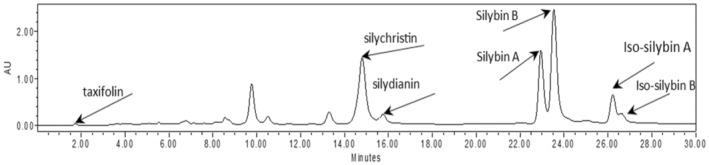
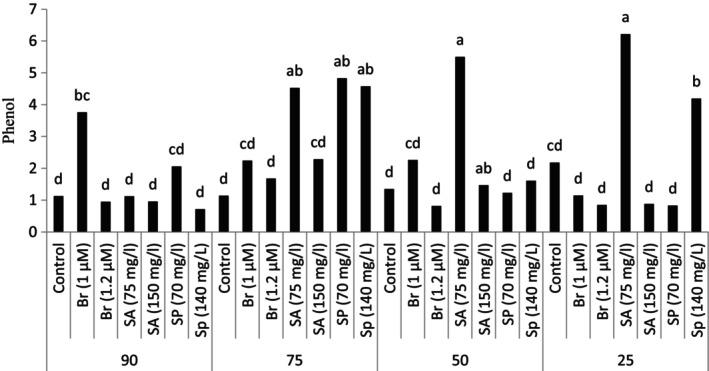
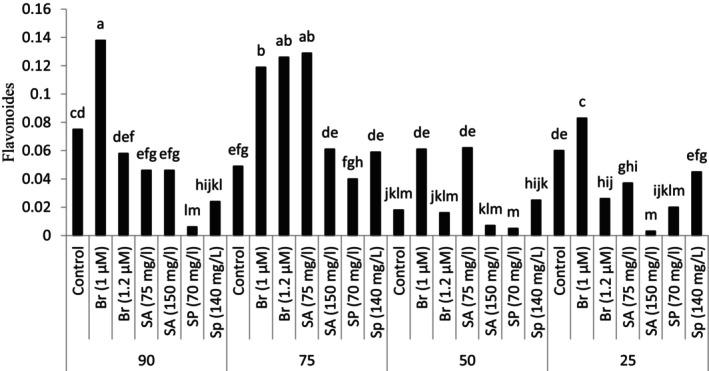
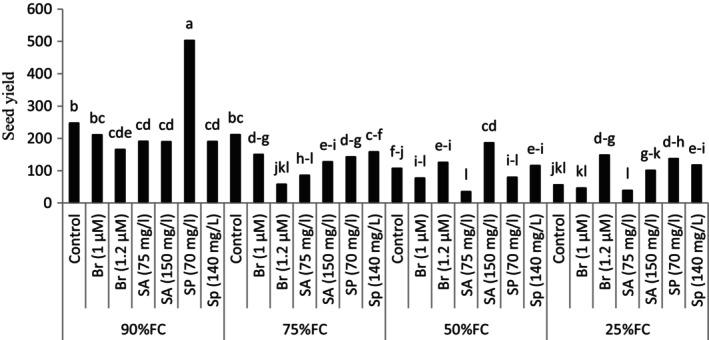
Milk thistle ( (L.) Gaertn) is a globally and widely used medicinal plant that contains silymarin. This plant has antioxidant, antimicrobial, anticancer, hepatoprotective, cardiovascular-protective, and neuroprotective effects. Plant quality, yield, and phytochemicals, especially silymarin content, change under various conditions like drought stress. Therefore, this research studied plant growth regulators (PGRs) like salicylic acid, spermidine, and brassinosteroid to increase plant tolerance to drought stress. Experimental treatments include different levels of irrigation (25%, 50%, 75%, and 90% field capacity), and foliar spraying including salicylic acid (75 and 150 mg/L), spermine (70 and 140 mg/L), and brassinosteroid (1 and 1.2 μM), separately, and water as a control and a secondary factor. The results revealed that the highest amount of leaf phenolic compounds was observed in the highest drought stress level (25%) and 75 mg/L salicylic acid application. Furthermore, brassinosteroid at different concentrations and salicylic acid (75 mg/L) increased leaf flavonoid content compared to other treatments. In 50% field capacity, foliar application of salicylic acid (150 mg/L) significantly increased seed yield by approximately 75% compared to control under the same stress level. Brassinosteroid application (1 μM) under 75% field capacity significantly increased the seed's taxifolin amount by 159%. Additionally, salicylic acid noticeably increased the silychristin concentration. The concentration of silydianin in the seed has also been increased under drought stress and foliar spraying with PGRs. Compared to the control, using spermidine below 75% field capacity caused an increase in its concentrations by over seven times. The highest silybin A amount was obtained in 50% field capacity and foliar150 mg/L salicylic acid. Taxifolin, silychristin, silydianin, silybinin B, iso-silybinin A, and iso-silybinin B compounds were identified in the seed extract. Generally, foliar spraying using plant growth regulators increased the number of silymarin compounds under drought stress conditions and field cultivation conditions.
水飞蓟((L.) Gaertn)是一种在全球广泛使用的药用植物,含有水飞蓟素。这种植物具有抗氧化、抗菌、抗癌、保肝、心血管保护和神经保护作用。植物的质量、产量和植物化学成分,尤其是水飞蓟素含量,会在干旱胁迫等各种条件下发生变化。因此,本研究探讨了水杨酸、亚精胺和油菜素内酯等植物生长调节剂,以提高植物对干旱胁迫的耐受性。实验处理包括不同水平的灌溉(田间持水量的25%、50%、75%和90%),以及叶面喷施,分别为水杨酸(75和150毫克/升)、亚精胺(70和140毫克/升)和油菜素内酯(1和1.2微摩尔),以水作为对照和次要因素。结果表明,在最高干旱胁迫水平(25%)和施用75毫克/升水杨酸时,叶片酚类化合物含量最高。此外,与其他处理相比,不同浓度的油菜素内酯和水杨酸(75毫克/升)增加了叶片类黄酮含量。在田间持水量为50%时,叶面喷施水杨酸(150毫克/升)与相同胁迫水平下的对照相比,种子产量显著提高了约75%。在田间持水量为75%时施用油菜素内酯(1微摩尔),种子中的 taxifolin 含量显著增加了159%。此外,水杨酸显著提高了水飞蓟宾的浓度。在干旱胁迫和叶面喷施植物生长调节剂的情况下,种子中水飞蓟宁的浓度也有所增加。与对照相比,在田间持水量低于75%时使用亚精胺,其浓度增加了七倍以上。在田间持水量为50%和叶面喷施150毫克/升水杨酸时,获得了最高含量的水飞蓟宾A。在种子提取物中鉴定出了 taxifolin、水飞蓟宾、水飞蓟宁、水飞蓟宾B、异水飞蓟宾A和异水飞蓟宾B化合物。一般来说,在干旱胁迫条件和田间种植条件下,叶面喷施植物生长调节剂增加了水飞蓟素化合物的数量。
 Zotero 插件