
晚期黑色素瘤患者的长期生存。
Long-Term Survival in Patients With Advanced Melanoma.
机构信息
Scientific Bureau, Dutch Institute for Clinical Auditing, Leiden, the Netherlands.
Department of Medical Oncology, University Medical Center Utrecht, Utrecht University, Utrecht, the Netherlands.
出版信息
JAMA Netw Open. 2024 Aug 1;7(8):e2426641. doi: 10.1001/jamanetworkopen.2024.26641.
IMPORTANCE
Long-term survival data from clinical trials show that survival curves of patients with advanced melanoma treated with immune checkpoint inhibitors (ICIs) gradually reach a plateau, suggesting that patients have a chance of achieving long-term survival.
OBJECTIVE
To investigate long-term survival in patients with advanced melanoma treated with ICIs outside clinical trials.
DESIGN, SETTING, AND PARTICIPANTS: Cohort study using prospectively collected data from the nationwide Dutch Melanoma Treatment Registry, including patients in the Netherlands with advanced melanoma treated with first-line ICIs from 2012 to 2019. Data were analyzed from January to September 2023.
EXPOSURES
Patients were treated with first-line ipilimumab-nivolumab, antibodies that target programmed cell death (anti-PD-1), or ipilimumab.
MAIN OUTCOMES AND MEASURES
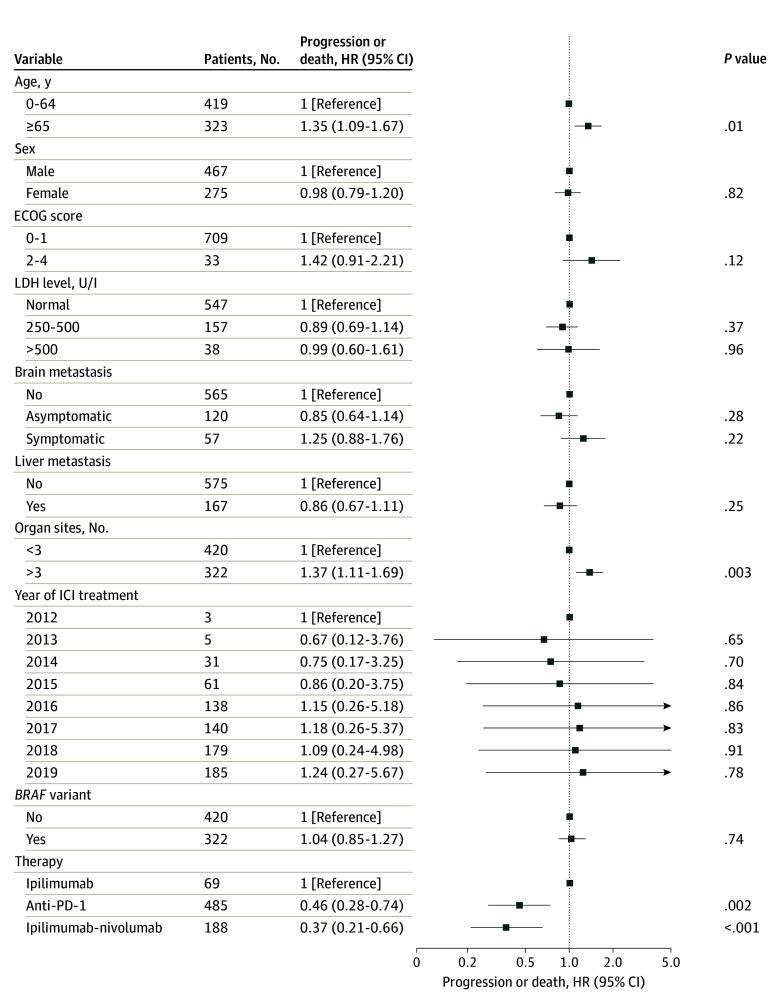
Progression-free survival (PFS) and melanoma-specific survival were analyzed, and a Cox proportional hazards model was used to investigate factors associated with PFS after reaching partial response (PR) or complete response (CR).
RESULTS
A total of 2490 patients treated with first-line ICIs were included (median [IQR] age, 65.0 [55.3-73.0] years; 1561 male patients [62.7%]). Most patients had an Eastern Cooperative Oncology Group Performance Status of 1 or lower (2202 patients [88.5%]) and normal lactate dehydrogenase levels (1715 patients [68.9%]). PFS for all patients was 23.4% (95% CI, 21.7%-25.2%) after 3 years and 19.7% (95% CI, 18.0%-21.4%) after 5 years. Overall survival for all patients was 44.0% (95% CI, 42.1%-46.1%) after 3 years and 35.9% (95% CI, 33.9%-38.0%) after 5 years. Patients with metastases in 3 or more organ sites had a significantly higher hazard of progression after reaching PR or CR (adjusted hazard ratio, 1.37; 95% CI, 1.11-1.69).
CONCLUSIONS AND RELEVANCE
This cohort study of patients with advanced melanoma treated with ICIs in clinical practice showed that their survival reached a plateau, comparable with patients participating in clinical trials. These findings can be used in daily clinical practice to guide long-term surveillance strategies and inform both physicians and patients regarding long-term treatment outcomes.
重要性
临床试验的长期生存数据表明,接受免疫检查点抑制剂 (ICI) 治疗的晚期黑色素瘤患者的生存曲线逐渐达到平台期,这表明患者有机会获得长期生存。
目的
研究在临床试验之外接受 ICI 治疗的晚期黑色素瘤患者的长期生存情况。
设计、地点和参与者:这是一项使用前瞻性收集的来自全国荷兰黑色素瘤治疗登记处的数据的队列研究,包括荷兰接受一线 ICI 治疗的晚期黑色素瘤患者,这些患者于 2012 年至 2019 年接受治疗。数据分析于 2023 年 1 月至 9 月进行。
暴露
患者接受了一线伊匹单抗-纳武单抗、针对程序性细胞死亡 (抗 PD-1) 的抗体或伊匹单抗治疗。
主要结局和测量
无进展生存期 (PFS) 和黑色素瘤特异性生存期进行了分析,并使用 Cox 比例风险模型调查了达到部分缓解 (PR) 或完全缓解 (CR) 后与 PFS 相关的因素。
结果
共纳入 2490 例接受一线 ICI 治疗的患者(中位[IQR]年龄,65.0[55.3-73.0]岁;1561 例男性患者[62.7%])。大多数患者的东部合作肿瘤学组表现状态为 1 级或更低(2202 例[88.5%]),乳酸脱氢酶水平正常(1715 例[68.9%])。所有患者的 PFS 在 3 年后为 23.4%(95%CI,21.7%-25.2%),在 5 年后为 19.7%(95%CI,18.0%-21.4%)。所有患者的总生存期在 3 年后为 44.0%(95%CI,42.1%-46.1%),在 5 年后为 35.9%(95%CI,33.9%-38.0%)。转移到 3 个或更多器官部位的患者在达到 PR 或 CR 后进展的风险显著更高(调整后的危险比,1.37;95%CI,1.11-1.69)。
结论和相关性
这项在临床实践中接受 ICI 治疗的晚期黑色素瘤患者的队列研究表明,他们的生存达到了平台期,与参与临床试验的患者相当。这些发现可用于日常临床实践,以指导长期监测策略,并为医生和患者提供有关长期治疗结果的信息。

 Zotero 插件