
一种具有控制青枯病潜力的裂解性噬菌体PQ43W的分离、特性鉴定及基因组分析
Isolation, characterization, and genomic analysis of a lytic bacteriophage, PQ43W, with the potential of controlling bacterial wilt.
作者信息
Huang Binbin, Ge Long, Xiang Dong, Tan Ge, Liu Lijia, Yang Lei, Jing Yongfeng, Liu Qingshu, Chen Wu, Li Ye, He Haoxin, Sun Huzhi, Pan Qiang, Yi Ke
机构信息
China Tobacco Hunan Industrial Co., Ltd., Changsha, China.
Hunan Provincial Engineering and Technology Research Center for Agricultural Microbiology Application, Hunan Institute of Microbiology, Changsha, China.
出版信息
Front Microbiol. 2024 Aug 1;15:1396213. doi: 10.3389/fmicb.2024.1396213. eCollection 2024.
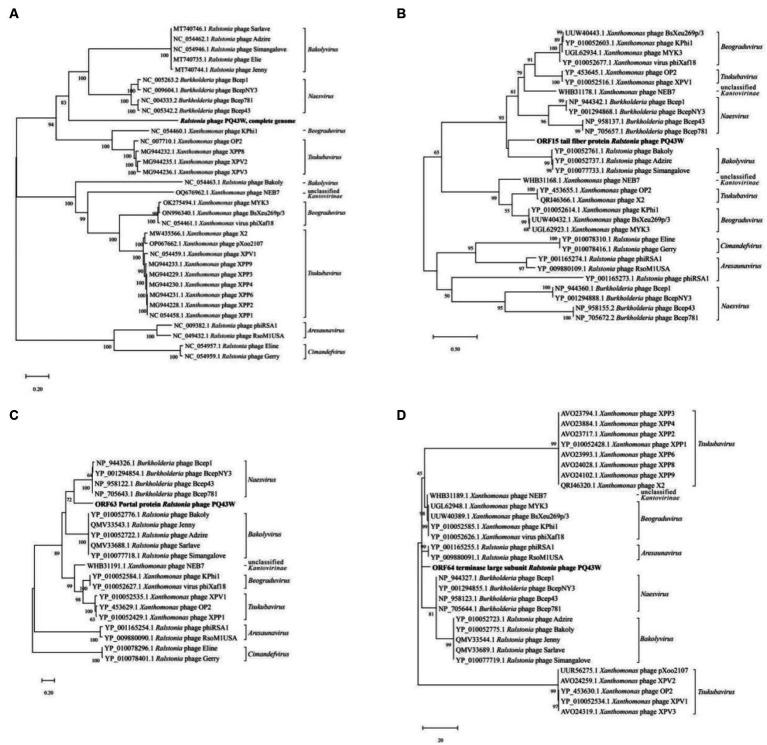
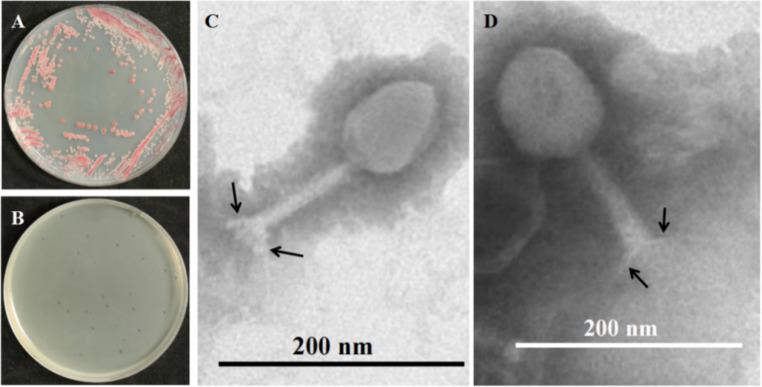
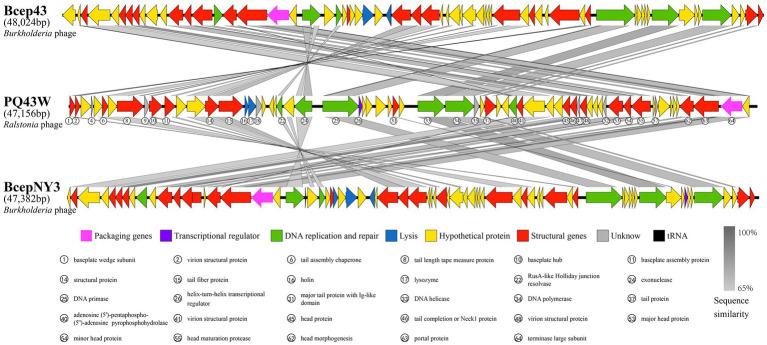
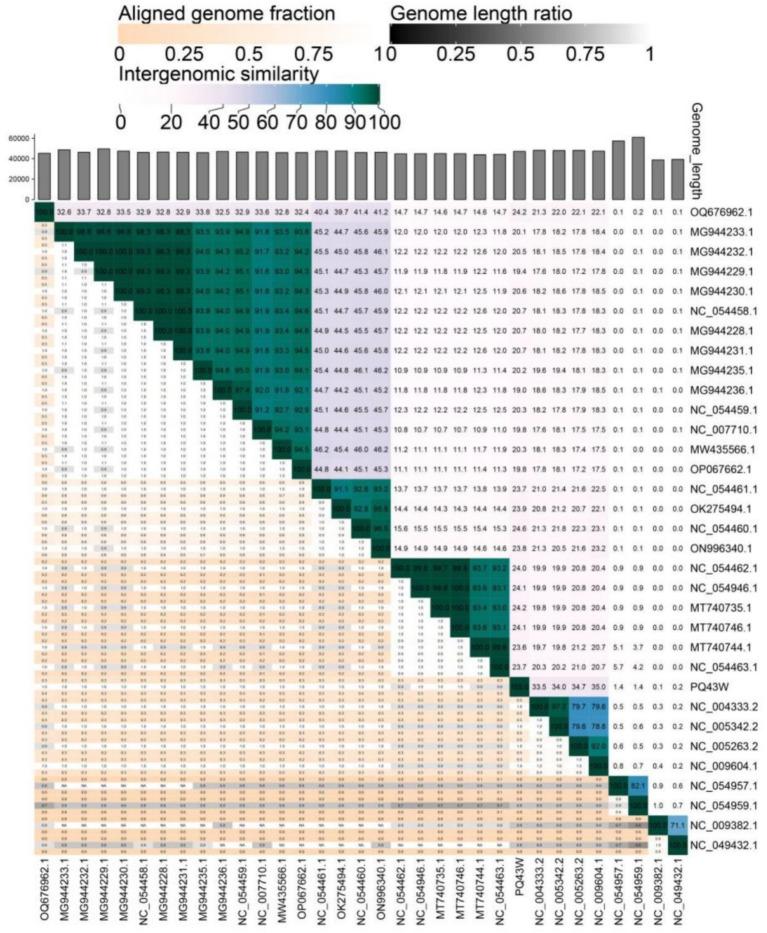
Bacterial wilt (BW) is a devastating plant disease caused by the soil-borne bacterium species complex (Rssc). Numerous efforts have been exerted to control BW, but effective, economical, and environmentally friendly approaches are still not available. Bacteriophages are a promising resource for the control of bacterial diseases, including BW. So, in this study, a crop BW pathogen of lytic bacteriophage was isolated and named PQ43W. Biological characterization revealed PQ43W had a short latent period of 15 min, 74 PFU/cell of brust sizes, and good stability at a wide range temperatures and pH but a weak resistance against UV radiation. Sequencing revealed phage PQ43W contained a circular double-stranded DNA genome of 47,156 bp with 65 predicted open reading frames (ORFs) and genome annotation showed good environmental security for the PQ43W that no tRNA, antibiotic resistance, or virulence genes contained. Taxonomic classification showed PQ43W belongs to a novel genus of subfamily under Subsequently, a dose of PQ43W for phage therapy in controlling crop BW was determined: 10 PFU*20 mL per plant with non-invasive irrigation root application twice by pot experiment. Finally, a field experiment of PQ43W showed a significantly better control effect in crop BW than the conventional bactericide Zhongshengmycin. Therefore, bacteriophage PQ43W is an effective bio-control resource for controlling BW diseases, especially for crop cultivation.
青枯病是由土壤传播的细菌物种复合体(Rssc)引起的一种毁灭性植物病害。人们已经付出了许多努力来控制青枯病,但仍然没有有效的、经济的和环境友好的方法。噬菌体是控制包括青枯病在内的细菌性疾病的一种有前景的资源。因此,在本研究中,分离出一种裂解性噬菌体的作物青枯病病原体,并将其命名为PQ43W。生物学特性表明,PQ43W的潜伏期较短,为15分钟,爆发量为74个噬菌斑形成单位/细胞,在较宽的温度和pH范围内具有良好的稳定性,但对紫外线辐射的抵抗力较弱。测序显示噬菌体PQ43W包含一个47156 bp的环状双链DNA基因组,有65个预测的开放阅读框(ORFs),基因组注释显示PQ43W具有良好的环境安全性,不包含tRNA、抗生素抗性或毒力基因。分类学分类表明,PQ43W属于随后的一个新属的亚科。随后,通过盆栽试验确定了用于噬菌体疗法控制作物青枯病的PQ43W剂量:每株植物10个噬菌斑形成单位×20 mL,采用非侵入性灌溉根部施用,共两次。最后,PQ43W的田间试验表明,其对作物青枯病的防治效果明显优于传统杀菌剂中生菌素。因此,噬菌体PQ43W是控制青枯病的一种有效的生物防治资源,特别是对于作物种植。


 Zotero 插件