
非白念珠菌血症的变化模式:印度尼西亚一家二级教学医院的发生率及药敏情况
CHANGING PATTERN OF NON ALBICANS CANDIDEMIA: OCCURENCE AND SUSCEPTIBILITY PROFILE IN AN INDONESIAN SECONDARY TEACHING HOSPITAL.
作者信息
Veronica Wiwing, Neneng Suryadinata, Nicolaski Lumbuun
机构信息
Department of Microbiology, Faculty of Medicine, University of Pelita Harapan, Tangerang, Indonesia, Jendral Sudirman Boulevard, Lippo Karawaci, Tangerang, Banten, Indonesia 15811.
Faculty of Medicine, University of Pelita Harapan, Tangerang, Indonesia, Jendral Sudirman Boulevard, Lippo Karawaci, Tangerang, Banten, Indonesia 15811.
出版信息
Afr J Infect Dis. 2024 Jul 4;18(2 Suppl):5-9. doi: 10.21010/Ajidv18n2S.2. eCollection 2024.
BACKGROUND
In recent years, bloodstream infections due to non- have been reported significantly among hospitalized patients, mainly among immunocompromised patients with high morbidity and mortality rates. A better understanding and awareness regarding the shift of flora to non- is essentially important to improve treatment outcomes. In this study, we evaluated the distribution of non- and their susceptibility to various antifungals among candidemia patients.
MATERIALS AND METHODS
A total of 123 confirmed Candida blood culture episodes from January 2011 to June 2022 were analyzed by retrospective laboratory-based observation. identity and the activity against antifungal drugs determined by guidelines from the Clinical and Laboratory Standard Institute (CLSI).
RESULTS
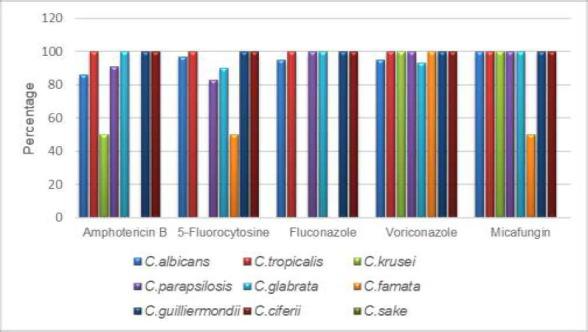
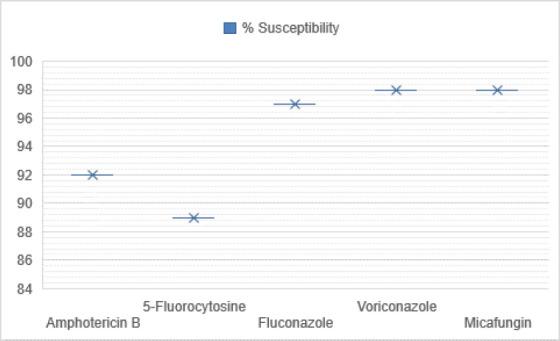
Most candidemia were caused by non-, including (37.4%), Candida tropicalis (17.1%), (13.0%), (3.2%) and others (4.8%). Meanwhile was found in 24.4% of cases. Among the patients, 57.7% were males and 68.3% were admitted to critical care with an age range of ≤ 28 days and 90 years. The pattern of susceptibility showed that 91.9% of the were susceptible to amphotericin B, 89.3% to flucytosine, 97.3% to fluconazole, 98.3% to voriconazole, and 97.9% to echinocandins.
CONCLUSION
Antifungal drug resistance was rare in our observation. The wide range of antifungal activities encourages management to carry out epidemiological surveillance in order to follow the dynamics of candidemia and influence the choice of therapeutic management for at-risk patients.
背景
近年来,住院患者中由非白念珠菌引起的血流感染报告显著增加,主要发生在免疫功能低下的患者中,其发病率和死亡率较高。更好地了解和认识念珠菌菌群向非白念珠菌的转变对于改善治疗结果至关重要。在本研究中,我们评估了念珠菌血症患者中非白念珠菌的分布及其对各种抗真菌药物的敏感性。
材料与方法
通过基于实验室的回顾性观察,分析了2011年1月至2022年6月期间123例确诊的念珠菌血培养病例。根据临床和实验室标准协会(CLSI)的指南确定念珠菌种类及其对抗真菌药物的活性。
结果
大多数念珠菌血症由非白念珠菌引起,包括近平滑念珠菌(37.4%)、热带念珠菌(17.1%)、光滑念珠菌(13.0%)、季也蒙念珠菌(3.2%)和其他(4.8%)。同时,白念珠菌在24.4%的病例中被发现。患者中,57.7%为男性,68.3%入住重症监护病房,年龄范围为≤28天至90岁。念珠菌敏感性模式显示,91.9%的念珠菌对两性霉素B敏感,89.3%对氟胞嘧啶敏感,97.3%对氟康唑敏感,98.3%对伏立康唑敏感,97.9%对棘白菌素敏感。
结论
在我们的观察中,抗真菌药物耐药性罕见。广泛的抗真菌活性促使管理部门开展流行病学监测,以跟踪念珠菌血症的动态变化,并影响对高危患者的治疗管理选择。
 Zotero 插件