
RSJ2 噬菌体的纳米机械弹性和热稳定性。
Nanomechanical resilience and thermal stability of RSJ2 phage.
机构信息
National Center for Genetic Engineering and Biotechnology (BIOTEC), National Science and Technology Development Agency (NSTDA), Pathum Thani, 12120, Thailand.
Department of Mathematics, Faculty of Science, Srinakharinwirot University, Bangkok, 10110, Thailand.
出版信息
Sci Rep. 2024 Aug 20;14(1):19389. doi: 10.1038/s41598-024-70056-8.
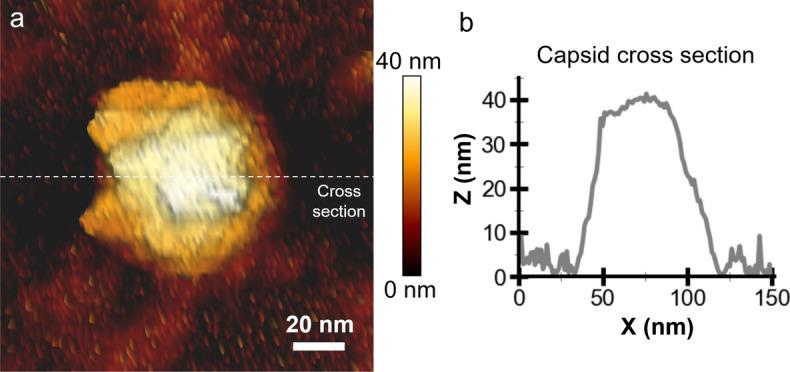
As the world moves toward a green economy and sustainable agriculture, bacterial viruses or bacteriophages (phages) become attractive biocontrol agents for controlling crop diseases. Effective utilization of phages in farms requires integrated knowledge of crops, pathogens, phages, and surroundings. Phages must encounter environmental fluctuations, including temperature, and must remain infectious for successful bacteria lysis. This work studied a soilborne RSJ2 phage discovered in Thailand, which can eliminate Ralstonia solanacearum, causing bacterial wilt disease in chili. We investigated how phage infectivity and nanomechanics responded to thermal changes. The plaque-based assay showed that the infectivity of the RSJ2 phage was stable within 24-40 °C, an average temperature fluctuation in tropical regions. The structural examination also showed that the phage remained intact. The nanomechanical property of the phage was inspected by the atomic force microscopy-based nanoindentation. The result revealed that the phage stiffness within 24-40 °C was statistically similar (0.05-0.06 N/m). Upon heating at 40 °C for 1, 5, and 10 h and resting at 25 °C, the stiffness of the phage particles increased to 0.09-0.11 N/m (54-83% increase). The stiffness results suggest structural adaptation of the protein subunits as a response to thermal alteration. The study exhibits that the phage structure is highly dynamic and can nanomechanically respond to varying temperatures. The phage stiffness may reveal insight into phage adaptation to environmental factors. Equipped with the knowledge of phage infectivity, structure, and nanomechanics, we can design practical guidelines for effective phage usage in farming and propelling green and safe agriculture.
随着世界向绿色经济和可持续农业发展,细菌病毒或噬菌体(噬菌体)成为控制作物病害的有吸引力的生物防治剂。在农场中有效利用噬菌体需要综合了解作物、病原体、噬菌体和环境。噬菌体必须应对包括温度在内的环境波动,并保持感染力以实现对细菌的成功裂解。这项工作研究了一种在泰国发现的土传 RSJ2 噬菌体,它可以消灭引起辣椒细菌性萎蔫病的罗尔斯通氏菌。我们研究了噬菌体感染力和纳米力学如何响应温度变化。基于噬菌斑的测定表明,RSJ2 噬菌体在 24-40°C 之间的感染性稳定,这是热带地区的平均温度波动。结构检查还表明噬菌体保持完整。噬菌体的纳米力学特性通过基于原子力显微镜的纳米压痕进行检查。结果表明,噬菌体在 24-40°C 范围内的刚度在统计学上相似(0.05-0.06 N/m)。在 40°C 加热 1、5 和 10 小时并在 25°C 下休息后,噬菌体颗粒的刚度增加到 0.09-0.11 N/m(增加 54-83%)。刚度结果表明蛋白质亚基的结构适应是对热变化的响应。该研究表明噬菌体结构具有高度动态性,可以对不同的温度进行纳米力学响应。噬菌体的刚度可以揭示噬菌体对环境因素的适应能力。通过了解噬菌体的感染力、结构和纳米力学特性,我们可以为在农业中有效使用噬菌体并推动绿色和安全农业制定实用指南。




 Zotero 插件