
基于CT的放射组学模型的开发与验证,用于预测胰腺导管腺癌的生存分级纤维化。
Development and validation of a CT-based radiomics model to predict survival-graded fibrosis in pancreatic ductal adenocarcinoma.
作者信息
Shi Siya, Liu Ruihao, Zhou Jian, Liu Jiawei, Lin Hongxin, Mo Junyang, Zhang Jian, Diao Xianfen, Luo Yanji, Huang Bingsheng, Feng Shi-Ting
机构信息
Department of Radiology, The First Affiliated Hospital, Sun Yat-sen University.
Marshall Laboratory of Biomedical Engineering, Shenzhen University.
出版信息
Int J Surg. 2025 Jan 1;111(1):950-961. doi: 10.1097/JS9.0000000000002059.
BACKGROUND
Tumor fibrosis plays an important role in chemotherapy resistance in pancreatic ductal adenocarcinoma (PDAC); however, there remains a contradiction in the prognostic value of fibrosis. The authors aimed to investigate the relationship between tumor fibrosis and survival in patients with PDAC, classify patients into high- and low-fibrosis groups, and develop and validate a CT-based radiomics model to non-invasively predict fibrosis before treatment.
MATERIALS AND METHODS
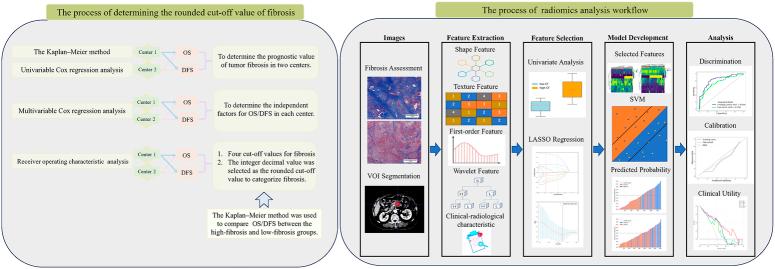
This retrospective, bicentric study included 295 patients with PDAC without any treatments before surgery. Tumor fibrosis was assessed using the collagen fraction (CF). Cox regression analysis was used to evaluate the associations of CF with overall survival (OS) and disease-free survival (DFS). Receiver operating characteristic (ROC) analyses were used to determine the rounded threshold of CF. An integrated model (IM) was developed by incorporating selected radiomic features and clinical-radiological characteristics. The predictive performance was validated in the test cohort (Center 2).
RESULTS
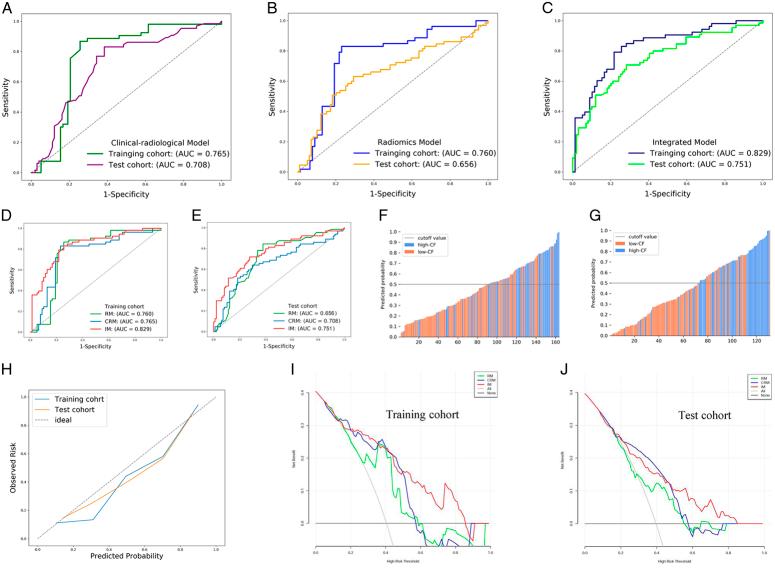
The CFs were 38.22±6.89% and 38.44±8.66% in center 1 (131 patients, 83 males) and center 2 (164 patients, 100 males), respectively ( P =0.814). Multivariable Cox regression revealed that CF was an independent risk factor in the OS and DFS analyses at both centers. ROCs revealed that 40% was the rounded cut-off value of CF. IM predicted CF with areas under the curves (AUCs) of 0.829 (95% CI: 0.753-0.889) and 0.751 (95% CI: 0.677-0.815) in the training and test cohorts, respectively. Decision curve analyses revealed that IM outperformed radiomics model and clinical-radiological model for CF prediction in both cohorts.
CONCLUSIONS
Tumor fibrosis was an independent risk factor for survival of patients with PDAC, and a rounded cut-off value of 40% provided a good differentiation of patient prognosis. The model combining CT-based radiomics and clinical-radiological features can satisfactorily predict survival-grade fibrosis in patients with PDAC.
背景
肿瘤纤维化在胰腺导管腺癌(PDAC)的化疗耐药中起重要作用;然而,纤维化的预后价值仍存在矛盾。作者旨在研究PDAC患者肿瘤纤维化与生存之间的关系,将患者分为高纤维化组和低纤维化组,并开发和验证基于CT的放射组学模型以在治疗前无创预测纤维化。
材料与方法
这项回顾性、双中心研究纳入了295例术前未接受任何治疗的PDAC患者。使用胶原分数(CF)评估肿瘤纤维化。采用Cox回归分析评估CF与总生存期(OS)和无病生存期(DFS)的关联。受试者工作特征(ROC)分析用于确定CF的四舍五入阈值。通过纳入选定的放射组学特征和临床放射学特征开发了一个综合模型(IM)。在测试队列(中心2)中验证了预测性能。
结果
中心1(131例患者,83例男性)和中心2(164例患者,100例男性)的CF分别为38.22±6.89%和38.44±8.66%(P = 0.814)。多变量Cox回归显示,在两个中心的OS和DFS分析中,CF都是一个独立的危险因素。ROC显示40%是CF的四舍五入临界值。IM在训练队列和测试队列中预测CF的曲线下面积(AUC)分别为0.829(95%CI:0.753 - 0.889)和0.751(95%CI:0.677 - 0.815)。决策曲线分析显示,在两个队列中,IM在CF预测方面优于放射组学模型和临床放射学模型。
结论
肿瘤纤维化是PDAC患者生存的独立危险因素,40%的四舍五入临界值能很好地区分患者预后。结合基于CT的放射组学和临床放射学特征的模型可以令人满意地预测PDAC患者的生存分级纤维化。



 Zotero 插件