
2022 年泰国 111 家医院耐抗生素血流感染的频率。
Frequency of antimicrobial-resistant bloodstream infections in 111 hospitals in Thailand, 2022.
机构信息
The Office of Permanent Secretary, Ministry of Public Health, Nonthaburi, Thailand.
Mahidol Oxford Tropical Medicine Research Unit, Faculty of Tropical Medicine, Mahidol University, Bangkok, Thailand.
出版信息
J Infect. 2024 Oct;89(4):106249. doi: 10.1016/j.jinf.2024.106249. Epub 2024 Aug 22.
OBJECTIVES
To evaluate the frequency of antimicrobial-resistant bloodstream infections (AMR BSI) in Thailand.
METHODS
We analyzed data from 2022, generated by 111 public hospitals in health regions 1 to 12, using the AutoMated tool for Antimicrobial resistance Surveillance System (AMASS), and submitted to the Ministry of Public Health, Thailand. Multilevel Poisson regression models were used.
RESULTS
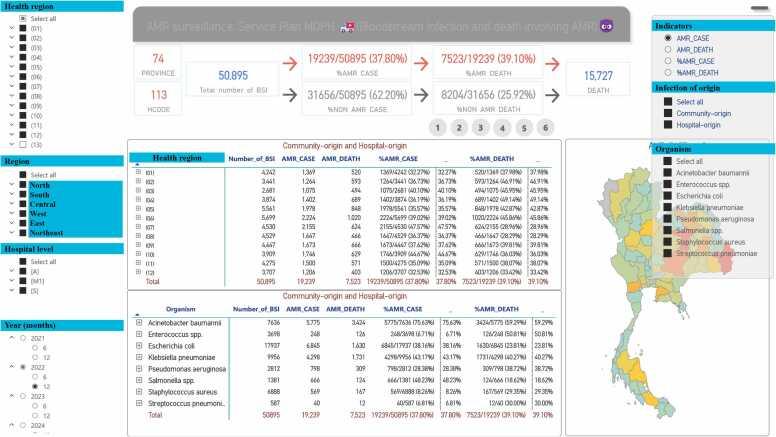
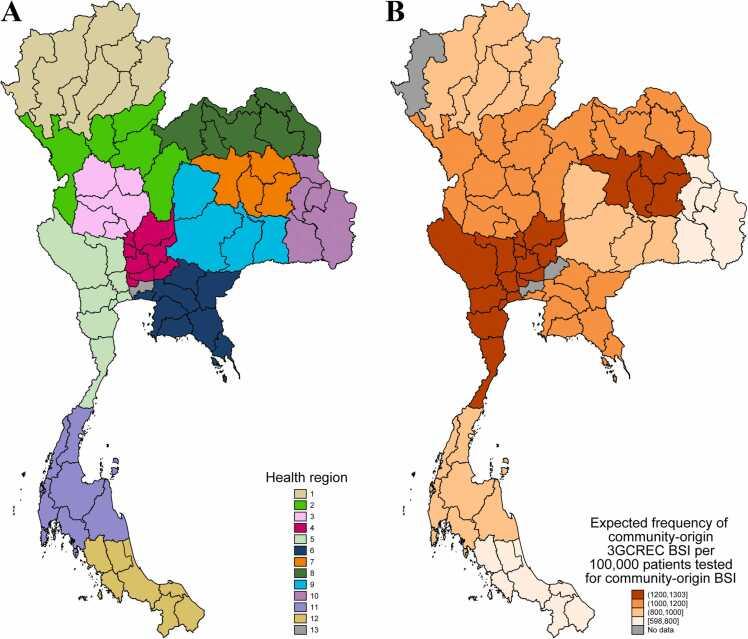
The most common cause of community-origin AMR BSI was third-generation cephalosporin-resistant Escherichia coli (3GCREC, 65.6%; 5101/7773 patients) and of hospital-origin AMR BSI was carbapenem-resistant Acinetobacter baumannii (CRAB, 51.2%, 4968/9747 patients). The percentage of patients tested for BSI was negatively associated with the frequency of community-origin 3GCREC BSI and hospital-origin CRAB BSI (per 100,000 tested patients). Hospitals in health regions 4 (lower central region) had the highest frequency of community-origin 3GCREC BSI (adjusted incidence rate ratio, 2.06; 95% confidence interval: 1.52-2.97). Health regions were not associated with the frequency of hospital-origin CRAB BSI, and between-hospital variation was high, even adjusting for hospital level and size.
CONCLUSION
The high between-hospital variation of hospital-origin CRAB BSI suggests the importance of hospital-specific factors. Our approach and findings highlight health regions and hospitals where actions against AMR infection, including antimicrobial stewardship and infection control, should be prioritized.
目的
评估泰国抗菌药物耐药血流感染(AMR BSI)的频率。
方法
我们分析了 2022 年来自泰国卫生部的 111 家公立医院的数据,这些数据是通过 AutoMated tool for Antimicrobial resistance Surveillance System(AMASS)生成的,并提交给了卫生部。我们使用多水平泊松回归模型进行分析。
结果
社区获得性 AMR BSI 最常见的病原体是第三代头孢菌素耐药大肠埃希菌(3GCREC,65.6%,5101/7773 例),医院获得性 AMR BSI 最常见的病原体是碳青霉烯类耐药鲍曼不动杆菌(CRAB,51.2%,4968/9747 例)。BSI 检测率与社区获得性 3GCREC BSI 和医院获得性 CRAB BSI 的频率呈负相关(每 10 万检测患者)。4 区(中南部)的医院社区获得性 3GCREC BSI 发生率最高(调整后发病率比,2.06;95%置信区间:1.52-2.97)。医院所在的卫生区域与医院获得性 CRAB BSI 的频率无关,即使调整了医院级别和规模,医院间的差异仍然很大。
结论
医院获得性 CRAB BSI 存在很大的医院间差异,这表明医院特定因素的重要性。我们的方法和发现强调了需要优先采取行动的卫生区域和医院,以对抗 AMR 感染,包括抗菌药物管理和感染控制。
 Zotero 插件