
前列腺癌干细胞及其靶向治疗
Prostate cancer stem cells and their targeted therapies.
作者信息
Su Huilan, Huang Liqun, Zhou Jianjun, Yang Guosheng
机构信息
Research Center for Translational Medicine, Cancer Stem Cell Institute, Shanghai East Hospital, Tongji University School of Medicine, Shanghai, China.
Department of Urology, Shanghai East Hospital, Tongji University School of Medicine, Shanghai, China.
出版信息
Front Cell Dev Biol. 2024 Aug 8;12:1410102. doi: 10.3389/fcell.2024.1410102. eCollection 2024.
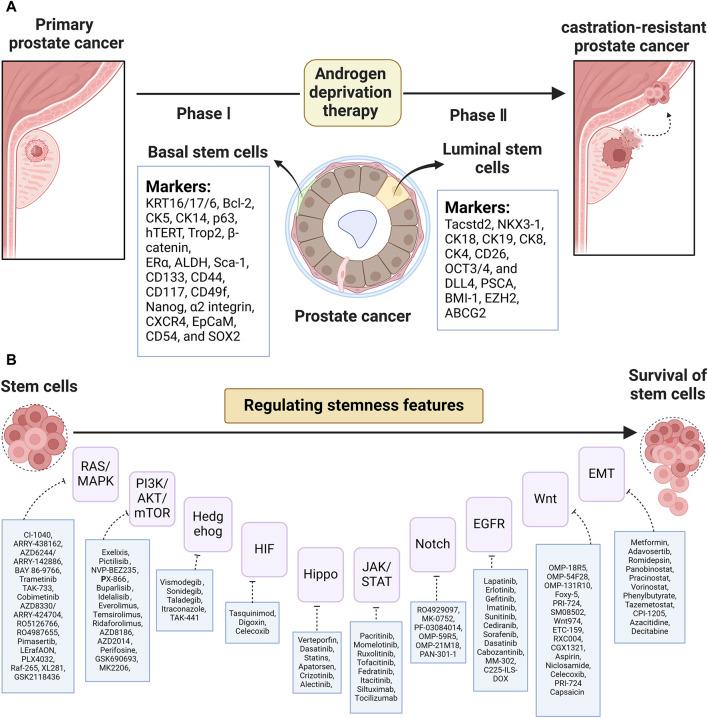
Prostate cancer (PCa) is the most common malignancy among men worldwide. Through androgen receptor signaling inhibitor (ARSI) treatment, patients eventually succumb to castration-resistant prostate cancer (CRPC). For this, the prostate cancer stem cells (PCSCs), as a minor population of tumor cells that can promote tumor relapse, ARSI resistance, and disease progression, are gaining attention. Therefore, specific therapy targeting PCSCs has momentum. This study reviewed the identification and characterization of PCSCs and PCSC-based putative biomarkers and summarized their mechanisms of action. We further discussed clinical trials of novel therapeutic interventions focused on PCSC-related pathways, the PCSC microenvironment, cutting-edge miRNA therapy, and immunotherapy approaches from a mechanistic standpoint. This review provides updated insights into PCSC plasticity, identifying new PCSC biomarkers and optimized treatments for patients with advanced PCa.
前列腺癌(PCa)是全球男性中最常见的恶性肿瘤。通过雄激素受体信号抑制剂(ARSI)治疗,患者最终会发展为去势抵抗性前列腺癌(CRPC)。为此,前列腺癌干细胞(PCSCs)作为一小部分能够促进肿瘤复发、ARSI耐药和疾病进展的肿瘤细胞,正受到关注。因此,针对PCSCs的特异性治疗具有发展势头。本研究综述了PCSCs的鉴定和特征以及基于PCSCs的假定生物标志物,并总结了它们的作用机制。我们还从机制角度进一步讨论了针对PCSC相关途径、PCSC微环境、前沿miRNA治疗和免疫治疗方法的新型治疗干预措施的临床试验。这篇综述提供了关于PCSC可塑性的最新见解,确定了新的PCSC生物标志物以及晚期PCa患者的优化治疗方法。
 Zotero 插件