
合理运用常见参数和技术工具对猪的猪肺炎支原体感染进行跟踪。
Rationalizing the use of common parameters and technological tools to follow up Mycoplasma hyopneumoniae infections in pigs.
作者信息
Sonalio Karina, Boyen Filip, Devriendt Bert, Chantziaras Ilias, Beuckelaere Lisa, Biebaut Evelien, Haesebrouck Freddy, Santamarta Irene, de Oliveira Luís Guilherme, Maes Dominiek
机构信息
Department of Internal Medicine, Reproduction and Population Medicine, Faculty of Veterinary Medicine, Ghent University, Merelbeke, Belgium.
Department of Veterinary Clinic and Surgery, School of Agricultural and Veterinarian Sciences, São Paulo State University (Unesp), Jaboticabal, Brazil.
出版信息
Porcine Health Manag. 2024 Aug 23;10(1):31. doi: 10.1186/s40813-024-00381-x.
BACKGROUND
Mycoplasma (M.) hyopneumoniae is associated with respiratory disease in pigs and is the primary agent of enzootic pneumonia. Quantification of M. hyopneumoniae-related outcome parameters can be difficult, expensive, and time-consuming, in both research and field settings. In addition to well-established methods, technological tools are becoming available to monitor various aspects of relevant animal- and environment-related features, often in real-time. Therefore, this study aimed to assess whether certain parameters, such as animal movement and body temperature using microchips (IMT), correlate with established parameters and whether the currently used parameters can be rationalized.
RESULTS
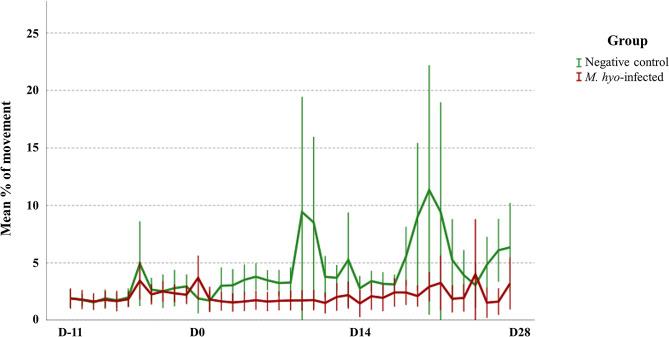
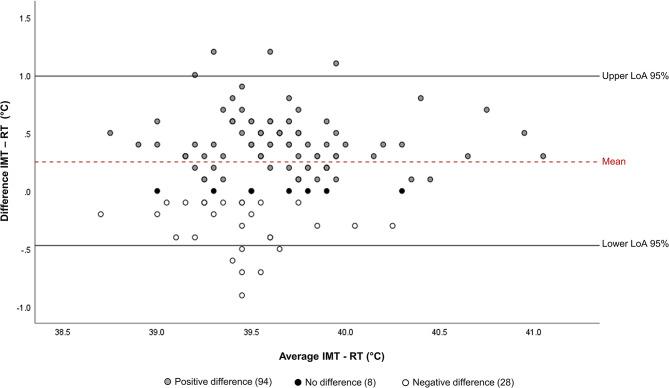
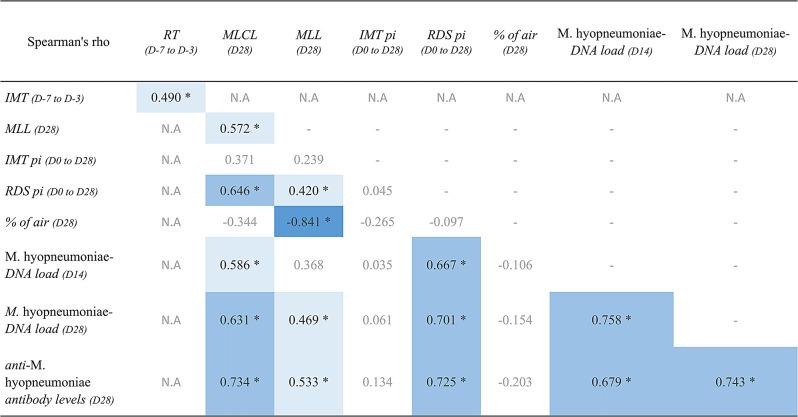
The percentage of movement was significantly reduced by M. hyopneumoniae infection in pigs (p < 0.05), where the M. hyopneumoniae-infected group showed a lower percentage of movement (1.9%) when compared to the negative control group (6.9%). On the other hand, macroscopic (MLCL) and microscopic (MLL) lung lesions, respiratory disease score (RDS), M. hyopneumoniae-DNA load, and anti-M. hyopneumoniae antibody levels increased significantly in the M. hyopneumoniae-infected group 28 days post-inoculation (p < 0.05). Moderate (r > 0.30) to very strong correlations (> 0.80) were observed between the abovementioned parameters (p < 0.05), except for IMT. A significant and moderate correlation was reported between IMT and rectal temperature (r = 0.49; p < 0.05). Last, the average daily weight gain and the percentage of air in the lung were not affected by M. hyopneumoniae infection (p > 0.05).
CONCLUSIONS
M. hyopneumoniae infection significantly reduced the movement of piglets and increased lung lesions, M. hyopneumoniae-DNA load, and anti-M. hyopneumoniae antibody levels; and, good correlations were observed between most parameters, indicating a direct relationship between them. Thus, we suggest that changes in movement might be a reliable indicator of M. hyopneumoniae infection in pigs, and that a selected group of parameters-specifically RDS, MLCL, MLL, M. hyopneumoniae-DNA load, anti-M. hyopneumoniae antibody levels, and movement-are optimal to assess M. hyopneumoniae infection under experimental conditions.
背景
猪肺炎支原体与猪的呼吸道疾病有关,是地方性肺炎的主要病原体。在研究和实际应用中,对猪肺炎支原体相关结果参数进行量化可能困难、昂贵且耗时。除了成熟的方法外,技术工具也越来越多地用于实时监测与动物和环境相关的各种特征。因此,本研究旨在评估某些参数,如使用微芯片(IMT)监测的动物活动和体温,是否与既定参数相关,以及当前使用的参数是否合理。
结果
猪肺炎支原体感染显著降低了猪的活动百分比(p < 0.05),与阴性对照组(6.9%)相比,猪肺炎支原体感染组的活动百分比更低(1.9%)。另一方面,接种后28天,猪肺炎支原体感染组的宏观(MLCL)和微观(MLL)肺损伤、呼吸道疾病评分(RDS)、猪肺炎支原体DNA载量以及抗猪肺炎支原体抗体水平均显著升高(p < 0.05)。除IMT外,上述参数之间均观察到中度(r > 0.30)至非常强的相关性(> 0.80)(p < 0.05)。IMT与直肠温度之间存在显著的中度相关性(r = 0.49;p < 0.05)。最后,猪肺炎支原体感染对平均日增重和肺内空气百分比没有影响(p > 0.05)。
结论
猪肺炎支原体感染显著降低了仔猪的活动量,增加了肺损伤、猪肺炎支原体DNA载量以及抗猪肺炎支原体抗体水平;并且,大多数参数之间观察到良好的相关性,表明它们之间存在直接关系。因此,我们建议活动变化可能是猪感染猪肺炎支原体的可靠指标,并且一组特定的参数——特别是RDS、MLCL、MLL、猪肺炎支原体DNA载量、抗猪肺炎支原体抗体水平和活动量——是在实验条件下评估猪肺炎支原体感染的最佳指标。

 Zotero 插件