
中医不同证型糖尿病前期代谢组学的综合生物标志物分析
Comprehensive biomarker analysis of metabolomics in different syndromes in traditional Chinese medical for prediabetes mellitus.
作者信息
Lan Qin, Li Xue, Fang Jianhe, Yu Xinyu, Wu Zhanxuan E, Yang Caiyun, Jian Hui, Li Fei
机构信息
Jiangxi University of Traditional Chinese Medicine, Nanchang, 330004, China.
Outpatient Department, Hongdu Traditional Chinese Medicine Hospital Affiliated to Jiangxi University of Traditional Chinese Medicine, Nanchang, 330006, China.
出版信息
Chin Med. 2024 Aug 25;19(1):114. doi: 10.1186/s13020-024-00983-1.
BACKGROUND
Prediabetes mellitus (PreDM) is a high-risk state for developing type 2 diabetes mellitus (T2DM) and often goes undiagnosed, which is closely associated with obesity and characterized by insulin resistance that urgently needs to be treated.
PURPOSE
To obtain a better understanding of the biological processes associated with both "spleen-dampness" syndrome individuals and those with dysglycaemic control at its earliest stages, we performed a detailed metabolomic analysis of individuals with various early impairments in glycaemic control, the results can facilitate clinicians' decision making and benefit individuals at risk.
METHODS
According to the diagnostic criteria of TCM patterns and PreDM, patients were divided into 4 groups with 20 cases, patients with syndrome of spleen deficiency with dampness encumbrance and PreDM (PDMPXSK group), patients with syndrome of dampness-heat in the spleen and PreDM (PDMSRYP group), patients with syndrome of spleen deficiency with dampness encumbrance and normal blood glucose (NDMPXSK group), and patients with syndrome of dampness-heat in the spleen and normal blood glucose (NDMSRYP group). Plasma samples from patients were collected for clinical index assessment and untargeted metabolomics using liquid chromatography-mass spectrometry.
RESULTS
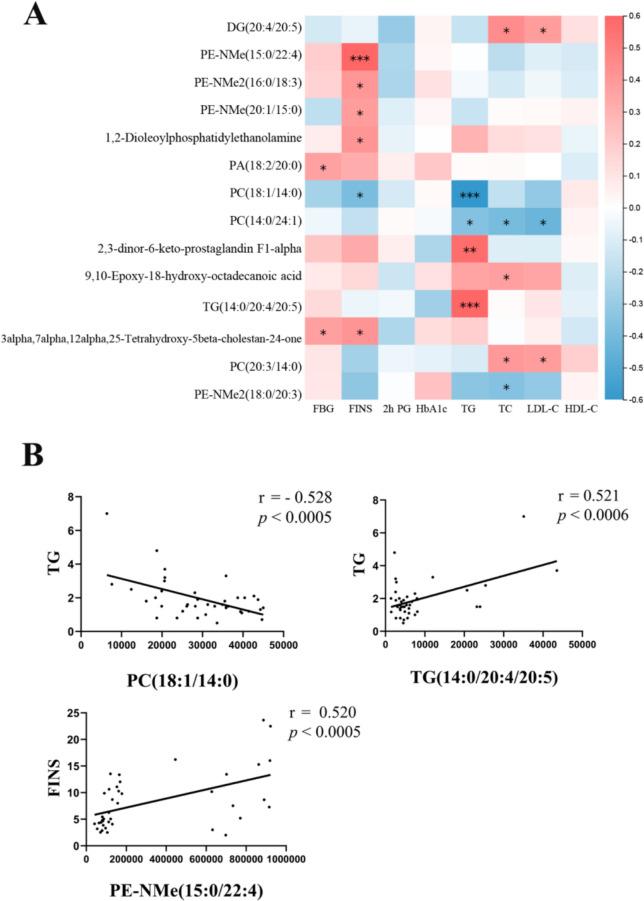
Among patients with the syndrome of spleen deficiency with dampness encumbrance (PXSK), those with PreDM (PDMPXSK group) had elevated levels of 2-hour post-load blood glucose (2-h PG), glycosylated hemoglobin (HbA1c), high-density lipoprotein cholesterol (HDL-C), and systolic blood pressure (SBP) than those in the normal blood glucose group (NDMPXSK group, P < 0.01). Among patients with the syndrome of dampness-heat in the spleen (SRYP), the levels of body mass index (BMI), fasting blood glucose (FBG), 2-h PG, HbA1c, and fasting insulin (FINS) were higher in the PreDM group (PDMSRYP group) than those in the normal blood glucose group (NDMSRYP group, P < 0.05). In both TCM syndromes, the plasma metabolomic profiles of PreDM patients were mainly discriminatory from the normal blood glucose controls of the same syndrome in the levels of lipid species, with the PXSK syndrome showing a more pronounced and broader spectrum of alterations than the SRYP syndrome. Changes associated with PreDM common to both syndromes included elevations in the levels of 27 metabolites which were mainly lipid species encompassing glycerophospholipids (GPs), diglycerides (DGs) and triglycerides (TGs), cholesterol and derivatives, and decreases in 5 metabolites consisting 1 DG, 1 TG, 2 N,N-dimethyl phosphatidylethanolamine (PE-NMe2) and iminoacetic acid. Correlation analysis identified significant positive correlations of 3α,7α,12α,25-Tetrahydroxy-5β-cholestane-24-one with more than one glycaemia-related indicators, whereas DG (20:4/20:5) and PC (20:3/14:0) were positively and PC (18:1/14:0) was inversely correlated with more than one lipid profile-related indicators. Based on the value of correlation coefficient, the top three correlative pairs were TG with PC (18:1/14:0) (r = - 0.528), TG with TG (14:0/22:4/22:5) (r = 0.521) and FINS with PE-NMe (15:0/22:4) (r = 0.52).
CONCLUSION
Our results revealed PreDM patients with different TCM syndromes were characterized by different clinical profiles. Common metabolite markers associated with PreDM shared by the two TCM syndromes were mainly lipid species encompassing GP, GL, cholesterol and derivatives. Our findings were in line with the current view that altered lipid metabolism is a conserved and early event of dysglycaemia. Our study also implied the possible involvement of perturbed bile acid homeostasis and dysregulated PE methylation during development of dysglycaemia.
背景
糖尿病前期是发展为2型糖尿病(T2DM)的高危状态,常未被诊断出来,它与肥胖密切相关,以胰岛素抵抗为特征,急需治疗。
目的
为了更好地了解与“脾虚湿困”证个体以及血糖控制最早阶段血糖异常个体相关的生物学过程,我们对血糖控制存在各种早期损害的个体进行了详细的代谢组学分析,结果有助于临床医生决策并使有风险的个体受益。
方法
根据中医证型和糖尿病前期的诊断标准,将患者分为4组,每组20例,分别为脾虚湿困证合并糖尿病前期患者(PDMPXSK组)、脾胃湿热证合并糖尿病前期患者(PDMSRYP组)、脾虚湿困证血糖正常患者(NDMPXSK组)、脾胃湿热证血糖正常患者(NDMSRYP组)。收集患者的血浆样本用于临床指标评估,并采用液相色谱 - 质谱法进行非靶向代谢组学分析。
结果
在脾虚湿困(PXSK)证患者中,糖尿病前期患者(PDMPXSK组)的餐后2小时血糖(2-h PG)、糖化血红蛋白(HbA1c)、高密度脂蛋白胆固醇(HDL-C)和收缩压(SBP)水平高于血糖正常组(NDMPXSK组,P < 0.01)。在脾胃湿热(SRYP)证患者中,糖尿病前期组(PDMSRYP组)的体重指数(BMI)、空腹血糖(FBG)、2-h PG、HbA1c和空腹胰岛素(FINS)水平高于血糖正常组(NDMSRYP组,P < 0.05)。在两种中医证型中,糖尿病前期患者的血浆代谢组学谱在脂质种类水平上主要与同一证型的血糖正常对照有差异,脾虚湿困证显示出比脾胃湿热证更明显、更广泛的变化谱。两种证型中与糖尿病前期共同相关的变化包括27种代谢物水平升高,这些代谢物主要是脂质种类,包括甘油磷脂(GPs)、甘油二酯(DGs)和甘油三酯(TGs)、胆固醇及其衍生物,以及5种代谢物水平降低,包括1种DG、1种TG、2种N,N - 二甲基磷脂酰乙醇胺(PE - NMe2)和亚氨基乙酸。相关性分析确定3α,7α,12α,25 - 四羟基 - 5β - 胆甾烷 - 24 -酮与多种血糖相关指标呈显著正相关,而DG(20:4/20:5)和PC(20:3/14:0)与多种脂质谱相关指标呈正相关,PC(18:1/14:0)呈负相关。根据相关系数值,前三对相关组合为TG与PC(18:1/14:0)(r = - 0.528)、TG与TG(14:0/22:4/22:5)(r = 0.521)以及FINS与PE - NMe(15:0/22:4)(r = 0.52)。
结论
我们的结果表明,不同中医证型的糖尿病前期患者具有不同的临床特征。两种中医证型中与糖尿病前期共同相关的代谢物标志物主要是脂质种类,包括GP、GL、胆固醇及其衍生物。我们的发现与当前观点一致,即脂质代谢改变是血糖异常的一个保守且早期事件。我们的研究还暗示在血糖异常发展过程中可能涉及胆汁酸稳态紊乱和PE甲基化失调。


 Zotero 插件