
用于高血糖和高血脂监测的基于血液的生物忆阻器
Blood-based biomemristor for hyperglycemia and hyperlipidemia monitoring.
作者信息
Gao Kaikai, Sun Bai, Zhou Guangdong, Cao Zelin, Xiang Linbiao, Yu Jiawei, Wang Ruixin, Yao Yingmin, Lin Fulai, Li Zhuoqun, Ren Fenggang, Lv Yi, Lu Qiang
机构信息
Department of Geriatric Surgery, The First Affiliated Hospital of Xi'an Jiaotong University, Xi'an, Shaanxi, 710061, China.
National Local Joint Engineering Research Center for Precision Surgery and Regenerative Medicine, The First Affiliated Hospital of Xi'an Jiaotong University, Xi'an, Shaanxi, 710061, China.
出版信息
Mater Today Bio. 2024 Jul 29;28:101169. doi: 10.1016/j.mtbio.2024.101169. eCollection 2024 Oct.
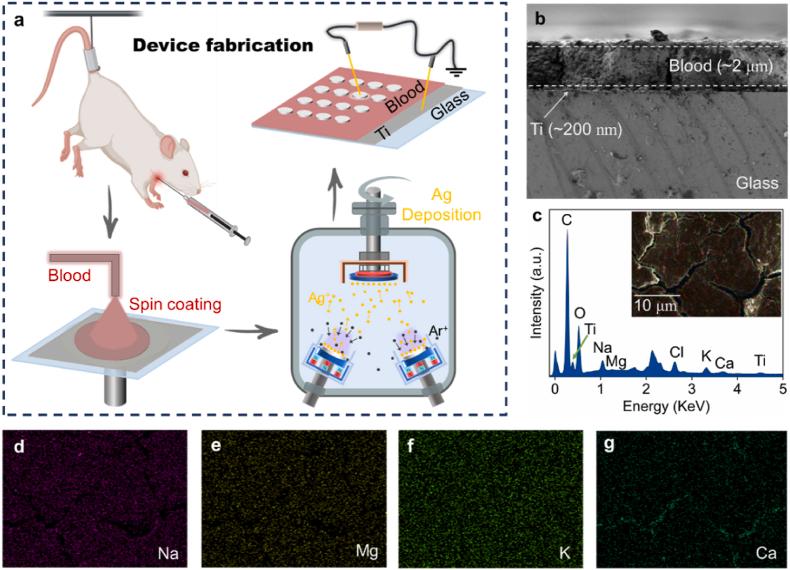
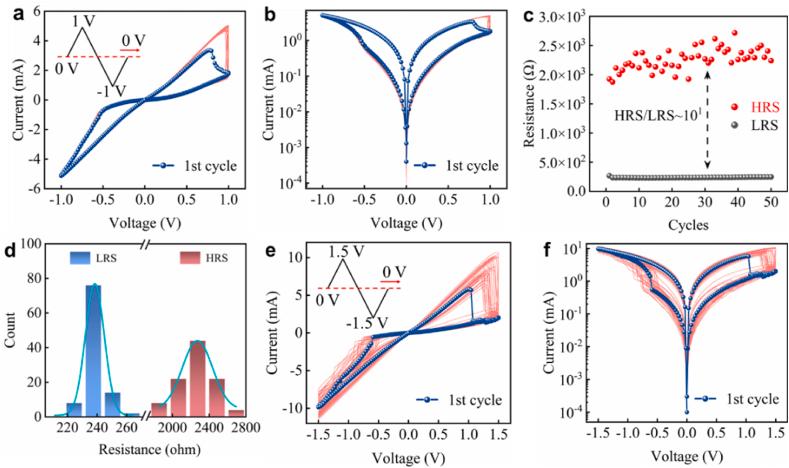
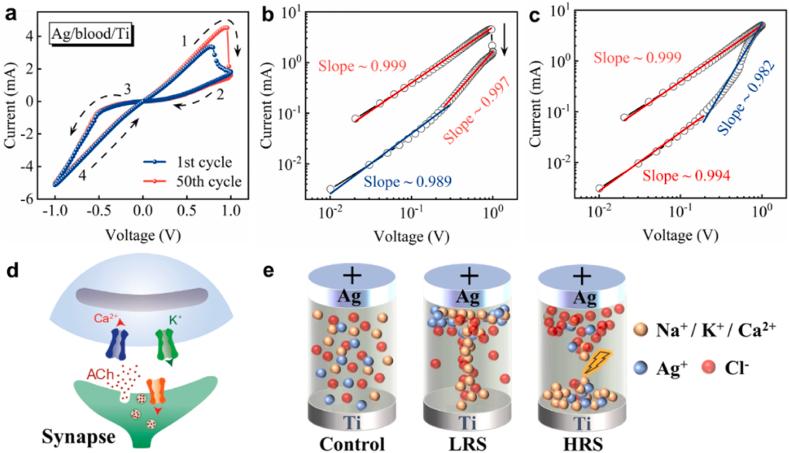
Thanks to its structural characteristics and signal patterns similar to those of human brain synapses, memristors are widely believed to be applicable for neuromorphic computing. However, to our knowledge, memristors have not been effectively applied in the biomedical field, especially in disease diagnosis and health monitoring. In this work, a blood-based biomemristor was prepared for in vitro detection of hyperglycemia and hyperlipidemia. It was found that the device exhibits excellent resistance switching (RS) behavior at lower voltage biases. Through mechanism analysis, it has been confirmed that the RS behavior is driven by Ohmic conduction and ion rearrangement. Furthermore, the hyperglycemia and hyperlipidemia detection devices were constructed for the first time based on memristor logic circuits, and circuit simulations were conducted. These results confirm the feasibility of blood-based biomemristors in detecting hyperglycemia and hyperlipidemia, providing new prospects for the important application of memristors in the biomedical field.
由于忆阻器的结构特性和信号模式与人类大脑突触相似,人们普遍认为忆阻器适用于神经形态计算。然而,据我们所知,忆阻器尚未在生物医学领域得到有效应用,尤其是在疾病诊断和健康监测方面。在这项工作中,制备了一种基于血液的生物忆阻器用于体外检测高血糖和高血脂。研究发现,该器件在较低的电压偏置下表现出优异的电阻开关(RS)行为。通过机理分析,证实了RS行为是由欧姆传导和离子重排驱动的。此外,首次基于忆阻器逻辑电路构建了高血糖和高血脂检测装置,并进行了电路模拟。这些结果证实了基于血液的生物忆阻器在检测高血糖和高血脂方面的可行性,为忆阻器在生物医学领域的重要应用提供了新的前景。



 Zotero 插件