
一种利用相似性信息进行药物-靶点亲和力预测的多分支神经网络。
A Multibranch Neural Network for Drug-Target Affinity Prediction Using Similarity Information.
作者信息
Chen Jing, Yang Xiaolin, Wu Haoyu
机构信息
School of Artificial Intelligence and Computer Science, Jiangnan University, Wuxi 214122, China.
Jiangsu Provincial Engineering Laboratory of Pattern Recognition and Computing Intelligence, Jiangnan University, Wuxi 214122, China.
出版信息
ACS Omega. 2024 Aug 12;9(33):35978-35989. doi: 10.1021/acsomega.4c05607. eCollection 2024 Aug 20.
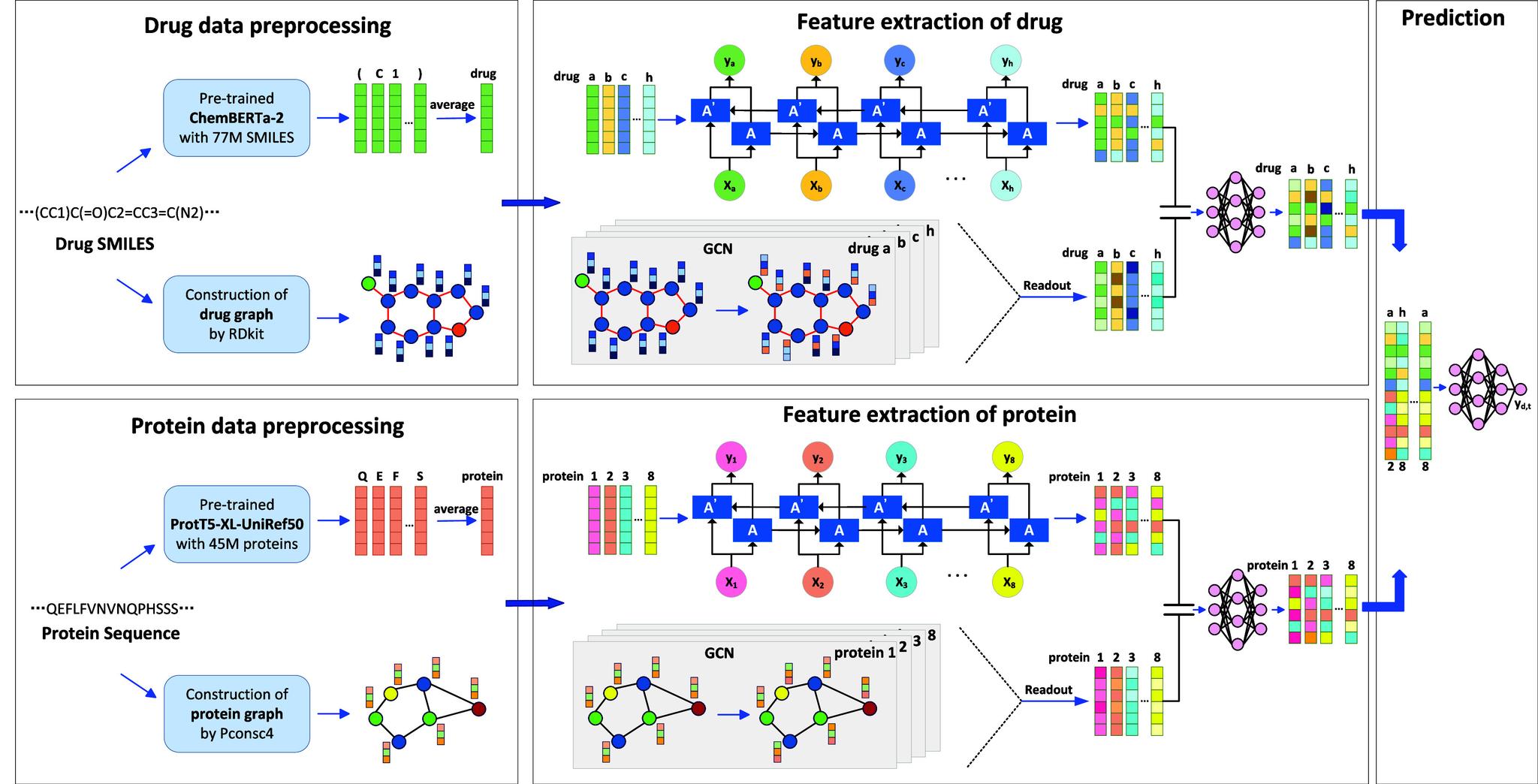
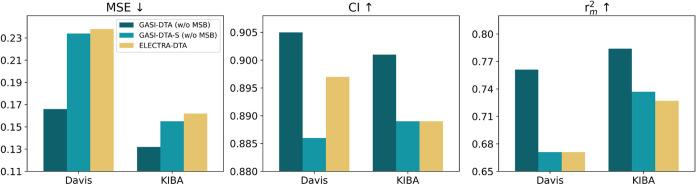
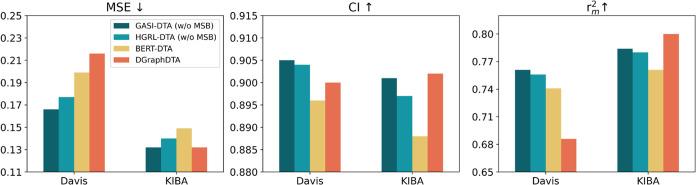
Predicting drug-target affinity (DTA) is beneficial for accelerating drug discovery. In recent years, graph structure-based deep learning models have garnered significant attention in this field. However, these models typically handle drug or target protein in isolation and only extract the molecular structure information on the drug or protein itself. To address this limitation, existing network-based models represent drug-target interactions or affinities as a knowledge graph to capture the interaction information. In this study, we propose a novel solution. Specifically, we introduce drug similarity information and protein similarity information into the field of DTA prediction. Moreover, we propose a network framework that autonomously extracts similarity information, avoiding reliance on knowledge graphs. Based on this framework, we design a multibranch neural network called GASI-DTA. This network integrates similarity information, sequence information, and molecular structure information. Comprehensive experimental results conducted on two benchmark data sets and three cold-start scenarios demonstrate that our model outperforms state-of-the-art graph structure-based methods in nearly all metrics. Furthermore, it exhibits significant advantages over existing network-based models, outperforming the best of them in the majority of metrics. Our study's code and data are openly accessible at http://github.com/XiaoLin-Yang-S/GASI-DTA.
预测药物-靶点亲和力(DTA)有助于加速药物研发。近年来,基于图结构的深度学习模型在该领域备受关注。然而,这些模型通常孤立地处理药物或靶点蛋白,仅提取药物或蛋白质本身的分子结构信息。为解决这一局限性,现有的基于网络的模型将药物-靶点相互作用或亲和力表示为知识图谱,以捕捉相互作用信息。在本研究中,我们提出了一种新颖的解决方案。具体而言,我们将药物相似性信息和蛋白质相似性信息引入DTA预测领域。此外,我们提出了一种自主提取相似性信息的网络框架,避免依赖知识图谱。基于此框架,我们设计了一个名为GASI-DTA的多分支神经网络。该网络整合了相似性信息、序列信息和分子结构信息。在两个基准数据集和三种冷启动场景下进行的综合实验结果表明,我们的模型在几乎所有指标上均优于基于图结构的现有方法。此外,它相对于现有的基于网络的模型具有显著优势,在大多数指标上超过了其中最好的模型。我们研究的代码和数据可在http://github.com/XiaoLin-Yang-S/GASI-DTA上公开获取。




 Zotero 插件