
溃疡性结肠炎患者接受阿达木单抗治疗期间肠道微生物群组成的动态变化:对治疗反应预测和治疗靶点的意义
Dynamic changes in the gut microbiota composition during adalimumab therapy in patients with ulcerative colitis: implications for treatment response prediction and therapeutic targets.
作者信息
Oh Han Na, Shin Seung Yong, Kim Jong-Hwa, Baek Jihye, Kim Hyo Jong, Lee Kang-Moon, Park Soo Jung, Kim Seok-Young, Choi Hyung-Kyoon, Kim Wonyong, Sul Woo Jun, Choi Chang Hwan
机构信息
Department of Systems Biotechnology, Chung-Ang University, Anseong, 17546, Republic of Korea.
Inflamm-Aging Translational Research Center, Ajou University Medical Center, Suwon, Republic of Korea.
出版信息
Gut Pathog. 2024 Aug 26;16(1):44. doi: 10.1186/s13099-024-00637-5.
BACKGROUND
While significant research exists on gut microbiota changes after anti-tumor necrosis factor-alpha (anti TNF-α) therapy for ulcerative colitis, little is known about the longitudinal changes related to the effects of anti TNF-α. This study aimed to investigate the dynamics of gut microbiome changes during anti TNF-α (adalimumab) therapy in patients with ulcerative colitis (UC).
RESULTS
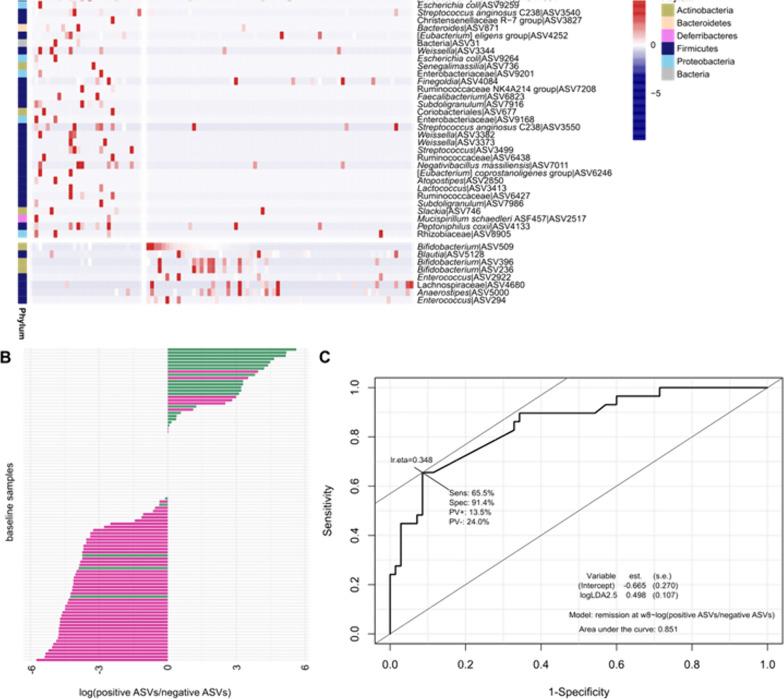
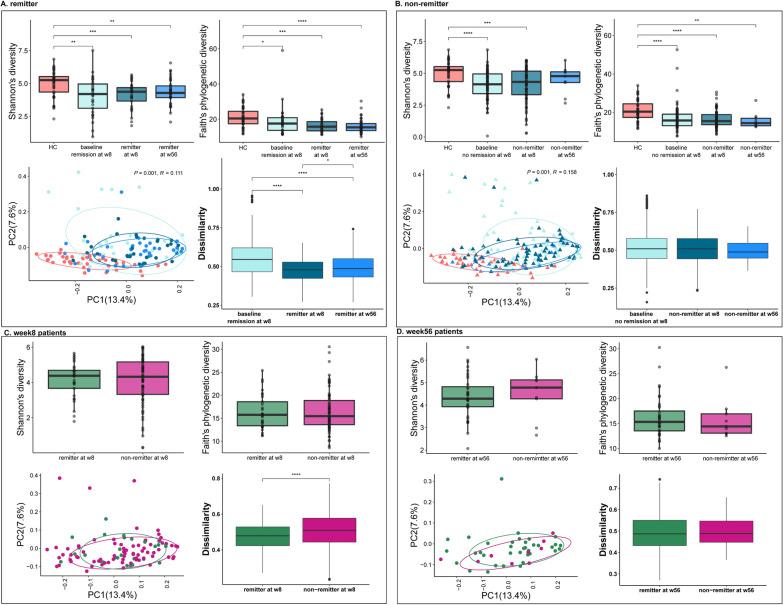
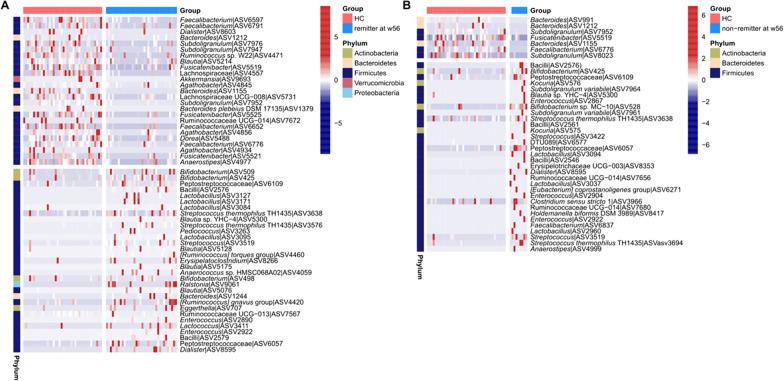
The microbiota composition was affected by the disease severity and extent in patients with UC. Regardless of clinical remission status at each time point, patients with UC exhibited microbial community distinctions from healthy controls. Distinct amplicon sequence variants (ASVs) differences were identified throughout the course of Adalimumab (ADA) treatment at each time point. A notable reduction in gut microbiome dissimilarity was observed only in remitters. Remitters demonstrated a decrease in the relative abundances of Burkholderia-Caballeronia-Paraburkholderia and Staphylococcus as the treatment progressed. Additionally, there was an observed increase in the relative abundances of Bifidobacterium and Dorea. Given the distribution of the 48 ASVs with high or low relative abundances in the pre-treatment samples according to clinical remission at week 8, a clinical remission at week 8 with a sensitivity and specificity of 72.4% and 84.3%, respectively, was predicted on the receiver operating characteristic curve (area under the curve, 0.851).
CONCLUSIONS
The gut microbiota undergoes diverse changes according to the treatment response during ADA treatment. These changes provide insights into predicting treatment responses to ADA and offer new therapeutic targets for UC.
背景
虽然针对溃疡性结肠炎的抗肿瘤坏死因子-α(抗TNF-α)治疗后肠道微生物群变化已有大量研究,但对于与抗TNF-α作用相关的纵向变化知之甚少。本研究旨在调查溃疡性结肠炎(UC)患者在抗TNF-α(阿达木单抗)治疗期间肠道微生物组变化的动态情况。
结果
UC患者的微生物群组成受疾病严重程度和范围的影响。无论每个时间点的临床缓解状态如何,UC患者的微生物群落与健康对照存在差异。在阿达木单抗(ADA)治疗的每个时间点的整个过程中,都发现了明显的扩增子序列变体(ASV)差异。仅在缓解者中观察到肠道微生物组差异显著降低。随着治疗的进行,缓解者中伯克霍尔德菌-卡瓦列罗尼亚-副伯克霍尔德菌属和葡萄球菌属的相对丰度降低。此外,还观察到双歧杆菌属和多雷亚菌属的相对丰度增加。根据第8周的临床缓解情况,在预处理样本中按照相对丰度高低分布48个ASV,在受试者工作特征曲线上预测第8周的临床缓解,敏感性和特异性分别为72.4%和84.3%(曲线下面积为0.851)。
结论
在ADA治疗期间,肠道微生物群根据治疗反应发生多种变化。这些变化为预测对ADA的治疗反应提供了见解,并为UC提供了新的治疗靶点。


 Zotero 插件