
供体来源无细胞 DNA 在肾移植后抗体介导排斥反应中的作用:定义使用范围和临床意义。
Perspective for Donor-Derived Cell-Free DNA in Antibody-Mediated Rejection After Kidney Transplantation: Defining Context of Use and Clinical Implications.
机构信息
Department of Nephrology and Intensive Care, Charité-Universitätsmedizin Berlin, Berlin, Germany.
Department of Clinical Pharmacology, University Medical Center Göttingen, Göttingen, Germany.
出版信息
Transpl Int. 2024 Aug 12;37:13239. doi: 10.3389/ti.2024.13239. eCollection 2024.
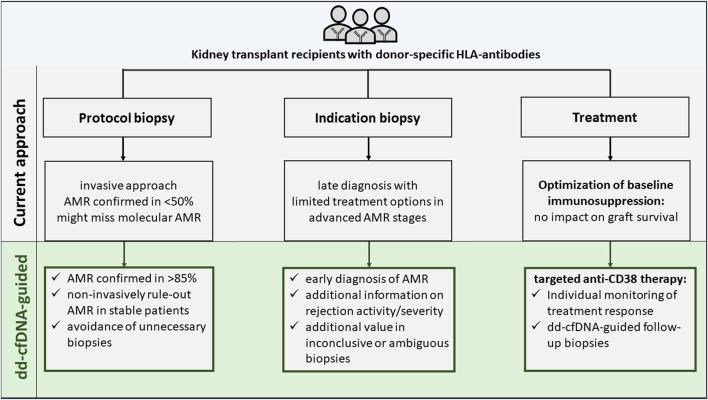
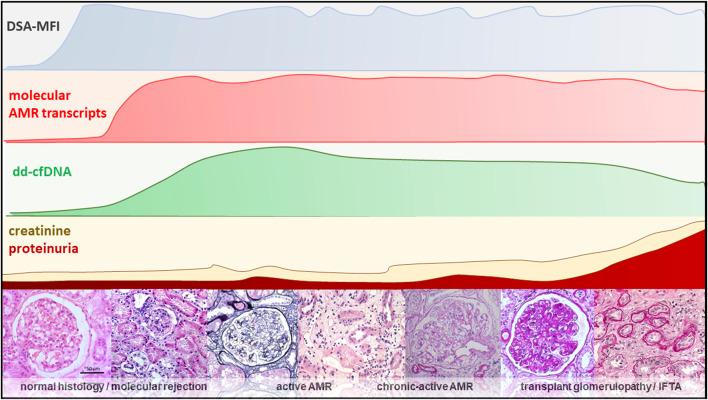
Antibody-mediated rejection (AMR) is a major cause of graft failure limiting long-term graft survival after kidney transplantation. Current diagnostic strategy to detect AMR is suboptimal and requires further improvement. Previously suggested treatment regimens for AMR could not demonstrate efficacy, however novel therapeutic agents are currently under investigation. Donor-derived cell-free DNA (dd-cfDNA) is a novel non-invasive biomarker for allograft injury, that has been mainly studied in the context of rejection. Its short-half-life in circulation and injury-dependent release are its key advantages that contribute to its superior diagnostic accuracy, compared to traditional biomarkers. Moreover, previous studies showed that dd-cfDNA-release is well-linked to histological and molecular features of AMR, and thus able to reflect real-time injury. Further observations suggest that dd-cfDNA can be used as a suitable screening tool for early detection of AMR in patients with donor-specific-anti-HLA-antibodies (DSA), as well as for monitoring AMR activity after anti-rejection treatment. The weight of evidence suggests that the integration of dd-cfDNA in the graft surveillance of patients with AMR, or those suspicious of AMR (e.g., due to the presence of donor-specific anti-HLA-antibodies) has an added value and might have a positive impact on outcomes in this specific cohort.
抗体介导的排斥反应(AMR)是导致肾移植后移植物失功的主要原因,限制了移植物的长期存活。目前用于检测 AMR 的诊断策略并不理想,需要进一步改进。虽然之前提出的 AMR 治疗方案未能显示出疗效,但目前正在研究新的治疗药物。供体来源的无细胞 DNA(dd-cfDNA)是一种新型的非侵入性同种异体损伤生物标志物,主要在排斥反应的背景下进行研究。其在循环中的半衰期短且损伤依赖性释放是其优于传统生物标志物的关键优势,有助于提高其诊断准确性。此外,先前的研究表明,dd-cfDNA 释放与 AMR 的组织学和分子特征密切相关,因此能够实时反映损伤情况。进一步的观察表明,dd-cfDNA 可作为一种合适的筛查工具,用于检测有供体特异性 HLA 抗体(DSA)的患者的 AMR 早期,以及在抗排斥治疗后监测 AMR 活性。有证据表明,dd-cfDNA 在 AMR 患者或疑似 AMR 患者(例如,由于存在供体特异性 HLA 抗体)的移植物监测中的整合具有附加价值,并可能对该特定患者队列的结局产生积极影响。
 Zotero 插件