
在哺乳动物 293F 细胞中表达的可溶性重组克里米亚-刚果出血热病毒糖蛋白 Gc 的纯化和表征。
Purification and characterization of soluble recombinant Crimean-Congo hemorrhagic fever virus glycoprotein Gc expressed in mammalian 293F cells.
机构信息
Division of Virology, School of Pathology, Faculty of Health Sciences, University of the Free State, Bloemfontein, 9301, South Africa.
Division of Virology, National Health Laboratory Service, Bloemfontein, 9301, South Africa.
出版信息
BMC Biotechnol. 2024 Aug 27;24(1):59. doi: 10.1186/s12896-024-00885-y.
BACKGROUND
Crimean-Congo hemorrhagic fever (CCHF) is a tick-borne zoonotic disease that presents with severe hemorrhagic manifestations and is associated with significant fatality rates. The causative agent, Crimean-Congo Hemorrhagic Fever Virus (CCHFV), is a high-priority pathogen identified by the World Health Organization with no approved vaccine or specific treatment available. In addition, there is a critical need for enhanced diagnostic tools to improve public health awareness, prevention measures, and disease control strategies.
METHODS
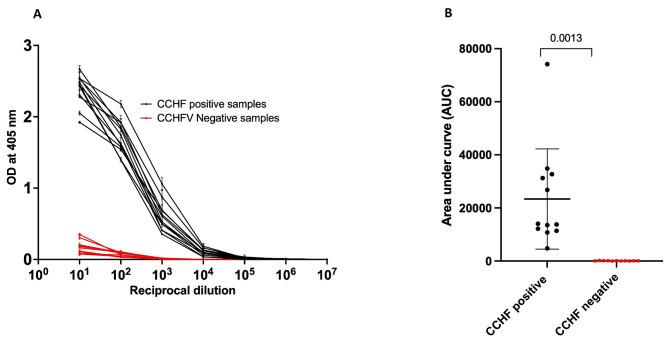
We designed plasmids to enable the purification of soluble CCHFV glycoprotein Gc expressed in mammalian 293 F cells, followed by purification using affinity and size exclusion chromatography. The purified antigen was analyzed by SDS-PAGE and Western blotting to confirm its reactivity to antibodies from CCHF survivors. Additionally, an in-house indirect ELISA was developed using the purified Gc as a coating antigen.
RESULTS
The optimized expression system successfully produced soluble and pure Gc antigen after affinity chromatography. The protein showed specific reactivity with CCHFV-positive serum antibodies in Western blot analysis. The indirect ELISA assay demonstrated high efficacy in distinguishing between CCHFV-positive and -negative serum samples, indicating its potential as a valuable diagnostic tool. Size exclusion chromatography further confirmed the presence of aggregates in our protein preparation.
CONCLUSIONS
The purified Gc antigen shows promise for developing direct diagnostic assays for CCHFV. The antigen's suitability for subunit vaccine development and its application as bait for monoclonal antibody isolation from survivors could be investigated further. This work lays the foundation for future research into the development of rapid diagnostic tests for field deployment.
背景
克里米亚-刚果出血热(CCHF)是一种蜱传的人畜共患病,表现为严重的出血症状,死亡率较高。病原体为克里米亚-刚果出血热病毒(CCHFV),世界卫生组织将其列为高优先级病原体,目前尚无获批的疫苗或特效疗法。此外,迫切需要改进诊断工具,以提高公众的健康意识、预防措施和疾病控制策略。
方法
我们设计了质粒,使在哺乳动物 293F 细胞中表达的可溶性克里米亚-刚果出血热病毒糖蛋白 Gc 得以纯化,然后通过亲和层析和大小排阻层析进行纯化。通过 SDS-PAGE 和 Western blot 分析纯化的抗原,以确认其对克里米亚-刚果出血热幸存者抗体的反应性。此外,还使用纯化的 Gc 作为包被抗原开发了内部间接 ELISA。
结果
优化的表达系统通过亲和层析成功生产出可溶性和纯的 Gc 抗原。该蛋白在 Western blot 分析中与克里米亚-刚果出血热病毒阳性血清抗体特异性反应。间接 ELISA 检测表明,该方法能够有效区分克里米亚-刚果出血热病毒阳性和阴性血清样本,表明其具有作为有价值的诊断工具的潜力。大小排阻层析进一步证实了我们蛋白制剂中存在聚集体。
结论
纯化的 Gc 抗原有望用于开发克里米亚-刚果出血热病毒的直接诊断检测。该抗原适合作为亚单位疫苗的开发,并可进一步用于从幸存者中分离单克隆抗体的诱饵。这项工作为未来开发现场部署的快速诊断测试奠定了基础。


 Zotero 插件