
I型干扰素在系统性自身免疫性风湿病中的作用:发病机制、临床特征及治疗选择
Type I Interferons in Systemic Autoimmune Rheumatic Diseases: Pathogenesis, Clinical Features and Treatment Options.
作者信息
Drougkas Konstantinos, Skarlis Charalampos, Mavragani Clio
机构信息
Department of Physiology, School of Medicine, National and Kapodistrian University of Athens, Athens, Greece.
Joint Academic Rheumatology Program, National and Kapodistrian University of Athens, Athens, Greece.
出版信息
Mediterr J Rheumatol. 2024 Jun 30;35(Suppl 2):365-380. doi: 10.31138/mjr.270324.tis. eCollection 2024 Jun.
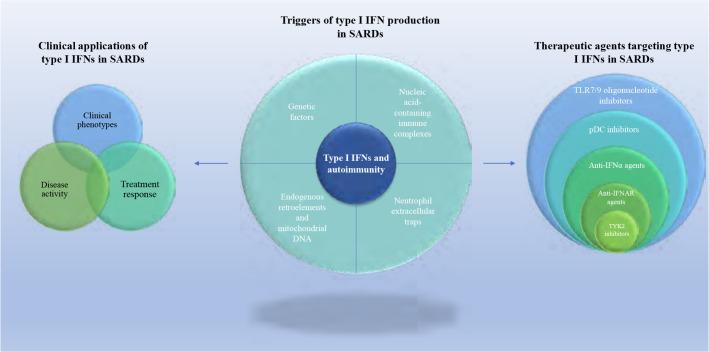
Type I interferon (IFN) pathway dysregulation plays a crucial role in the pathogenesis of several systemic autoimmune rheumatic diseases (SARDs), including systemic lupus erythematosus (SLE), Sjögren's disease (SjD), systemic sclerosis (SSc), dermatomyositis (DM) and rheumatoid arthritis (RA). Genetic and epigenetic alterations have been involved in dysregulated type I IFN responses in systemic autoimmune disorders. Aberrant type I IFN production and secretion have been associated with distinct clinical phenotypes, disease activity, and severity as well as differentiated treatment responses among SARDs. In this review, we provide an overview of the role of type I IFNs in systemic autoimmune diseases including SLE, RA, SjD, SSc, and DM focusing on pathophysiological, clinical, and therapeutical aspects.
I型干扰素(IFN)信号通路失调在几种系统性自身免疫性风湿病(SARDs)的发病机制中起关键作用,这些疾病包括系统性红斑狼疮(SLE)、干燥综合征(SjD)、系统性硬化症(SSc)、皮肌炎(DM)和类风湿关节炎(RA)。遗传和表观遗传改变与系统性自身免疫性疾病中I型干扰素反应失调有关。I型干扰素的异常产生和分泌与不同的临床表型、疾病活动度和严重程度以及SARDs之间不同的治疗反应相关。在本综述中,我们概述了I型干扰素在系统性自身免疫性疾病(包括SLE、RA、SjD、SSc和DM)中的作用,重点关注病理生理、临床和治疗方面。

 Zotero 插件