
陶瓷微滤与负载光催化剂的聚醚砜球混合处理工艺中微塑料的去除及气水反冲洗
Removal of Microplastics in a Hybrid Treatment Process of Ceramic Microfiltration and Photocatalyst-Mounted PES Spheres with Air Backwashing.
作者信息
Song Minjoo, Park Jin Yong
机构信息
Department of Environmental Sciences & Biotechnology, Hallym University, Chuncheon 24252, Republic of Korea.
出版信息
Membranes (Basel). 2024 Jul 31;14(8):169. doi: 10.3390/membranes14080169.
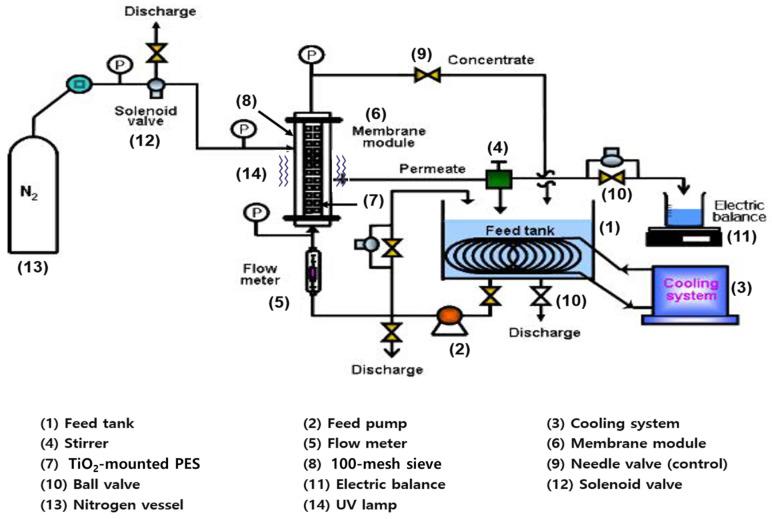
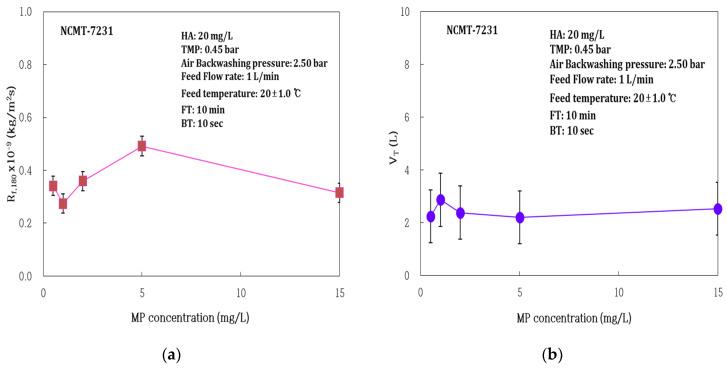
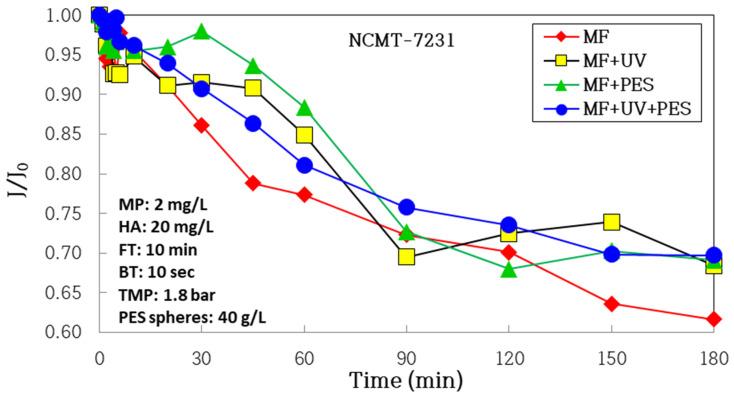
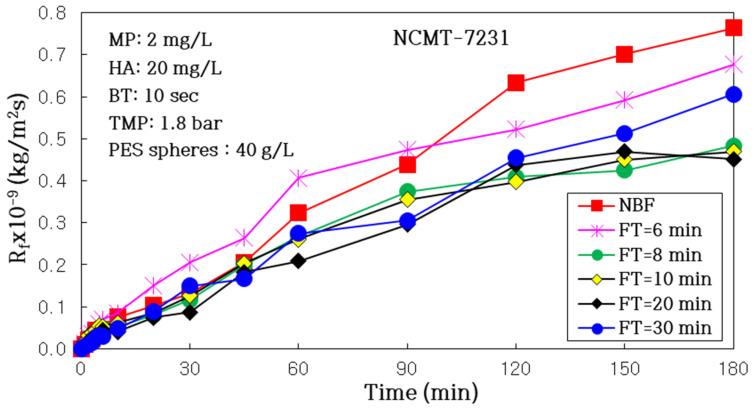
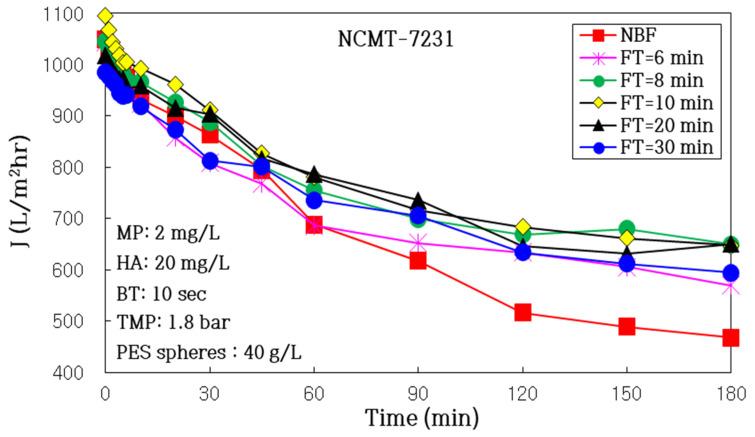
Microplastics (MPs), which are defined as plastics with a size of less than 5 mm, cannot be treated completely in wastewater treatment plants (WWTPs) and discharged to a water body because they are too small in size. It has been reported that MPs can have adverse effects on human beings and water ecosystems. There is a need to combine existing drinking water treatment plants (DWTPs) and WWTPs with the traditional treatment process and technology with high removal efficiency of MPs or to develop a new technology to separate MPs from water and wastewater. In this study, the effects of MPs (polyethylene (PE), 125 μm) and organic matter (humic acid) were researched in a hybrid treatment process of ceramic microfiltration (MF) and photocatalyst (TiO)-mounted polyether sulfone (PES) spheres with air backwashing. The roles of the MF, photooxidation, and adsorption of PES spheres were confirmed in a single MF process (MF), an MF process with UV irradiation (MF+UV), MF and PES sphere adsorption without UV irradiation (MF+PES), and a hybrid process incorporating MF and PES spheres with UV irradiation (MF+PES+UV). The impact of the air backwashing cycle (filtration time, FT) on filtration characteristics and treatment efficiencies in the hybrid process was studied. In the MF process, membrane fouling increased with increasing organic matter (HA, humic acid). The treatment efficiency of MPs increased; however, that of dissolved organic matter (DOM) decreased with increasing HA. As MPs increased, the membrane fouling decreased; however, total filtration volume (V) remained almost constant. The treatment efficiency of MPs increased a little, and that of DOM showed a dropping trend. In the hybrid process, the membrane fouling was controlled via the adsorption and UV photooxidation of the PES spheres, and the DOM treatment efficiency increased by combining processes from MF to MF+PES+UV. The optimal FT was 10 min at BT 10 s in this hybrid process. The results could be applied to separate MPs effectively in DWTPs/WWTPs.
微塑料(MPs)被定义为尺寸小于5毫米的塑料,由于其尺寸过小,无法在污水处理厂(WWTPs)中得到完全处理并排放到水体中。据报道,微塑料会对人类和水生态系统产生不利影响。有必要将现有的饮用水处理厂(DWTPs)和污水处理厂与具有高微塑料去除效率的传统处理工艺和技术相结合,或者开发一种从水和废水中分离微塑料的新技术。在本研究中,研究了微塑料(聚乙烯(PE),125μm)和有机物(腐殖酸)在陶瓷微滤(MF)和负载光催化剂(TiO)的聚醚砜(PES)球与空气反冲洗的混合处理工艺中的影响。在单一微滤工艺(MF)、紫外线照射的微滤工艺(MF+UV)、无紫外线照射的微滤和PES球吸附工艺(MF+PES)以及结合微滤和PES球与紫外线照射的混合工艺(MF+PES+UV)中,确认了微滤、光氧化和PES球吸附的作用。研究了空气反冲洗周期(过滤时间,FT)对混合工艺中过滤特性和处理效率的影响。在微滤工艺中,膜污染随着有机物(HA,腐殖酸)的增加而增加。微塑料的处理效率提高;然而,溶解有机物(DOM)的处理效率随着HA的增加而降低。随着微塑料的增加,膜污染减少;然而,总过滤体积(V)几乎保持不变。微塑料的处理效率略有提高,而DOM的处理效率呈下降趋势。在混合工艺中,通过PES球的吸附和紫外线光氧化控制膜污染,并且通过从MF到MF+PES+UV的工艺组合提高了DOM处理效率。在该混合工艺中,最佳过滤时间在BT为10 s时为10分钟。该结果可应用于在饮用水处理厂/污水处理厂中有效分离微塑料。









 Zotero 插件