
遗传工程与创新培育策略提高微藻中叶黄素的产量。
Genetic Engineering and Innovative Cultivation Strategies for Enhancing the Lutein Production in Microalgae.
机构信息
Aquatic Environment and Quality, Cell Blue Biotech and Food Integrity, Flanders Research Institute for Agriculture, Fisheries and Food (ILVO), Jacobsenstraat 1, 8400 Ostend, Belgium.
Plant Sciences Unit, Flanders Research Institute for Agriculture, Fisheries and Food (ILVO), Caritasstraat 39, 9090 Melle, Belgium.
出版信息
Mar Drugs. 2024 Jul 23;22(8):329. doi: 10.3390/md22080329.
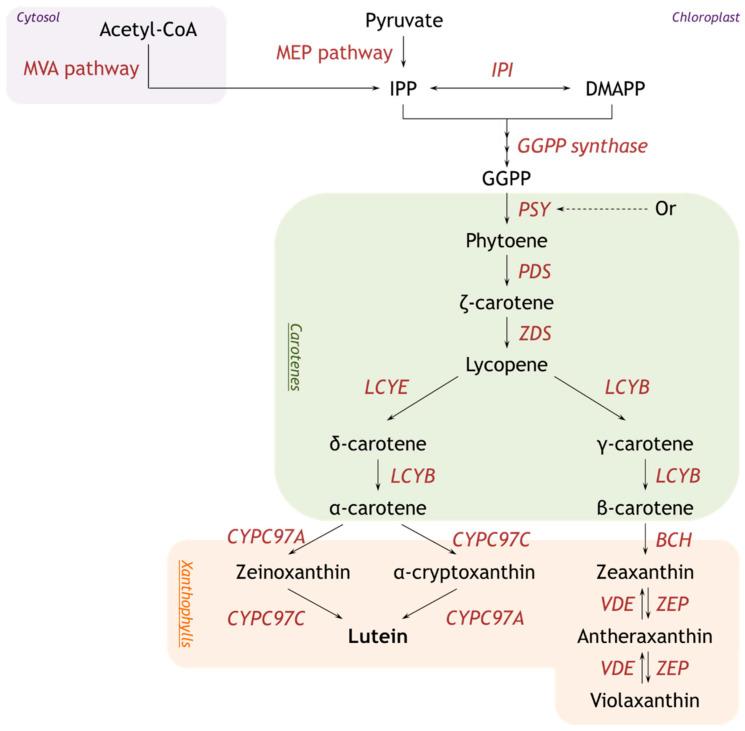
Carotenoids, with their diverse biological activities and potential pharmaceutical applications, have garnered significant attention as essential nutraceuticals. Microalgae, as natural producers of these bioactive compounds, offer a promising avenue for sustainable and cost-effective carotenoid production. Despite the ability to cultivate microalgae for its high-value carotenoids with health benefits, only astaxanthin and β-carotene are produced on a commercial scale by and respectively. This review explores recent advancements in genetic engineering and cultivation strategies to enhance the production of lutein by microalgae. Techniques such as random mutagenesis, genetic engineering, including CRISPR technology and multi-omics approaches, are discussed in detail for their impact on improving lutein production. Innovative cultivation strategies are compared, highlighting their advantages and challenges. The paper concludes by identifying future research directions, challenges, and proposing strategies for the continued advancement of cost-effective and genetically engineered microalgal carotenoids for pharmaceutical applications.
类胡萝卜素具有多种生物活性和潜在的药用应用价值,作为必需的营养保健品受到了极大的关注。微藻作为这些生物活性化合物的天然生产者,为可持续和具有成本效益的类胡萝卜素生产提供了有前途的途径。尽管可以培养微藻来生产具有健康益处的高价值类胡萝卜素,但只有虾青素和β-胡萝卜素分别由 和 以商业规模生产。本综述探讨了遗传工程和培养策略的最新进展,以提高微藻中叶黄素的产量。详细讨论了随机诱变、遗传工程,包括 CRISPR 技术和多组学方法,以及它们对提高叶黄素产量的影响。比较了创新的培养策略,突出了它们的优点和挑战。本文最后确定了未来的研究方向、挑战,并提出了用于继续推进具有成本效益和基因工程的用于药物应用的微藻类胡萝卜素的策略。

 Zotero 插件