
生物活性化合物食品胶体递送系统的批判性综述:物理表征与应用
Critical Review of Food Colloidal Delivery System for Bioactive Compounds: Physical Characterization and Application.
作者信息
Wang Bijie, LvYe Jiayi, Yang Shaoming, Shi Ying, Chen Qihe
机构信息
Department of Food Science and Nutrition, Zhejiang University, Hangzhou 310058, China.
Zhejiang Longquan ZhengDa Biotech Co., Ltd., Lishui 323000, China.
出版信息
Foods. 2024 Aug 19;13(16):2596. doi: 10.3390/foods13162596.
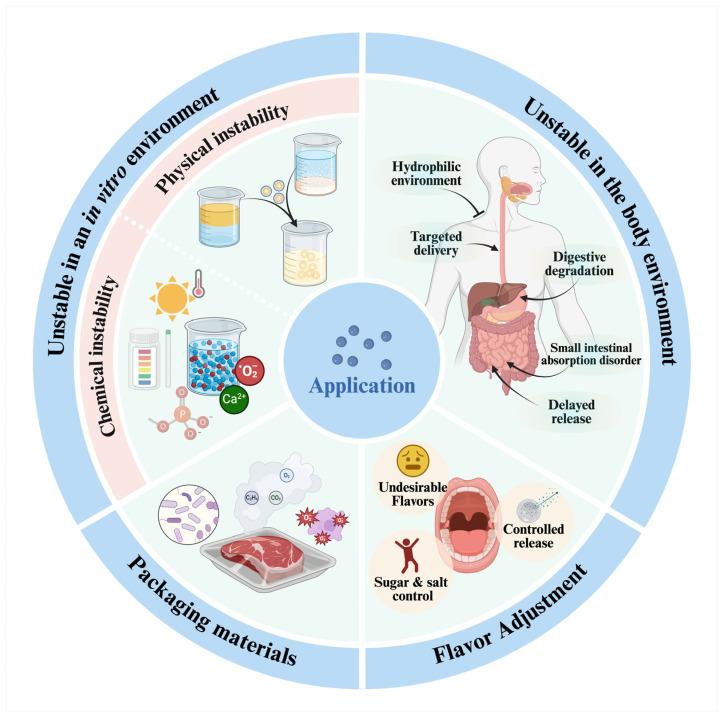
Bioactive compounds (BACs) have attracted much attention due to their potential health benefits. However, such substances have problems such as difficulty dissolving in water, poor stability, and low intestinal absorption, leading to serious limitations in practical applications. Nowadays, food colloidal delivery carriers have become a highly promising solution due to their safety, controllability, and efficiency. The use of natural macromolecules to construct delivery carriers can not only regulate the solubility, stability, and intestinal absorption of BACs but also effectively enhance the nutritional added value of functional foods, improve sensory properties, and extend shelf life. Moreover, smart-responsive colloidal delivery carriers can control the release characteristics of BACs, thus improving their absorption rate in the human body. This review describes the characteristics of several typical food colloid delivery carriers, focuses on their physical properties from static structure to dynamic release, summarizes their applications in delivery systems, and provides an outlook on the future development of food colloid delivery carriers. The different compositions and structures of food colloids tend to affect their stability and release behaviors, and the different surface properties and rheological characteristics of the carriers predestine their different application scenarios. The control of in vivo release properties and the effect on food media should be emphasized in the future exploration of safer and more controllable carrier systems.
生物活性化合物(BACs)因其潜在的健康益处而备受关注。然而,这类物质存在诸如难溶于水、稳定性差和肠道吸收低等问题,导致其在实际应用中受到严重限制。如今,食品胶体递送载体因其安全性、可控性和高效性已成为一种极具前景的解决方案。利用天然大分子构建递送载体不仅可以调节BACs的溶解性、稳定性和肠道吸收,还能有效提高功能性食品的营养附加值、改善感官特性并延长保质期。此外,智能响应性胶体递送载体可以控制BACs的释放特性,从而提高其在人体中的吸收率。本文综述描述了几种典型食品胶体递送载体的特性,重点介绍了它们从静态结构到动态释放的物理性质,总结了它们在递送系统中的应用,并对食品胶体递送载体的未来发展进行了展望。食品胶体的不同组成和结构往往会影响其稳定性和释放行为,而载体的不同表面性质和流变特性决定了它们不同的应用场景。在未来对更安全、更可控的载体系统的探索中,应强调对体内释放特性的控制以及对食品介质的影响。


 Zotero 插件