
高危神经母细胞瘤:基于抗体的细胞免疫疗法面临的挑战与机遇
High-Risk Neuroblastoma Challenges and Opportunities for Antibody-Based Cellular Immunotherapy.
作者信息
Persaud Natasha V, Park Jeong A, Cheung Nai Kong V
机构信息
Department of Pediatrics Memorial Sloan Kettering Cancer Center, New York, NY 10065, USA.
Pediatrics Inha University Hospital, Icheon 22332, Republic of Korea.
出版信息
J Clin Med. 2024 Aug 13;13(16):4765. doi: 10.3390/jcm13164765.
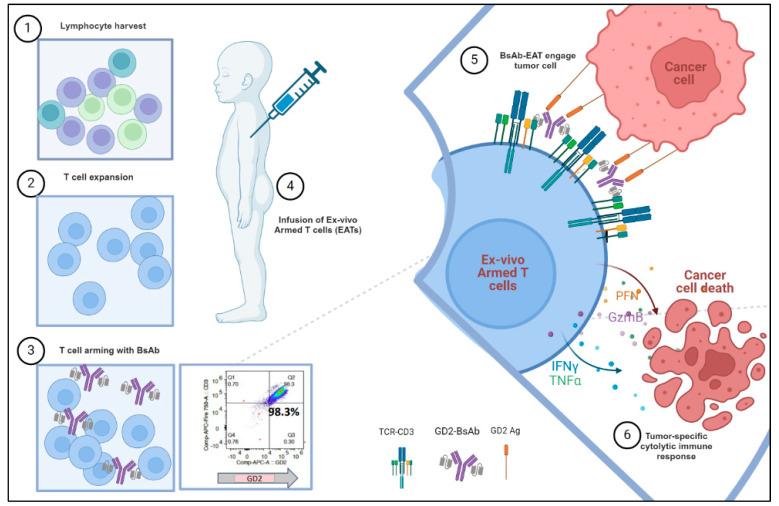
Immunotherapy has emerged as an attractive option for patients with relapsed or refractory high-risk neuroblastoma (HRNB). Neuroblastoma (NB), a sympathetic nervous system cancer arising from an embryonic neural crest cell, is heterogeneous clinically, with outcomes ranging from an isolated abdominal mass that spontaneously regresses to a widely metastatic disease with cure rates of about 50% despite intensive multimodal treatment. Risk group stratification and stage-adapted therapy to achieve cure with minimal toxicities have accomplished major milestones. Targeted immunotherapeutic approaches including monoclonal antibodies, vaccines, adoptive cellular therapies, their combinations, and their integration into standard of care are attractive therapeutic options, although curative challenges and toxicity concerns remain. In this review, we provide an overview of immune approaches to NB and the tumor microenvironment (TME) within the clinical translational framework. We propose a novel T cell-based therapeutic approach that leverages the unique properties of tumor surface antigens such as ganglioside GD2, incorporating specific monoclonal antibodies and recent advancements in adoptive cell therapy.
免疫疗法已成为复发或难治性高危神经母细胞瘤(HRNB)患者的一个有吸引力的选择。神经母细胞瘤(NB)是一种起源于胚胎神经嵴细胞的交感神经系统癌症,临床异质性强,其预后范围从可自发消退的孤立腹部肿块到广泛转移性疾病,尽管进行了强化多模式治疗,治愈率约为50%。风险组分层和适应阶段的治疗以实现治愈且毒性最小化已取得了重大进展。包括单克隆抗体、疫苗、过继性细胞疗法、它们的组合以及将它们整合到标准治疗中的靶向免疫治疗方法是有吸引力的治疗选择,尽管仍存在治愈方面的挑战和对毒性的担忧。在本综述中,我们在临床转化框架内概述了针对NB和肿瘤微环境(TME)的免疫方法。我们提出了一种基于T细胞的新型治疗方法,该方法利用肿瘤表面抗原如神经节苷脂GD2的独特特性,结合特异性单克隆抗体和过继性细胞疗法的最新进展。
 Zotero 插件