
嗜酸性粒细胞性支气管扩张症:患病率、严重程度及相关特征——一项队列研究
Eosinophilic Bronchiectasis: Prevalence, Severity, and Associated Features-A Cohort Study.
作者信息
Campisi Raffaele, Nolasco Santi, Mancuso Manuel, Spinella Miriam, Vignera Fabio, Crimi Nunzio, Vancheri Carlo, Crimi Claudia
机构信息
Respiratory Medicine Unit, Policlinico "G. Rodolico-San Marco" University Hospital, 95123 Catania, Italy.
Department of Clinical and Experimental Medicine, University of Catania, 95123 Catania, Italy.
出版信息
J Clin Med. 2024 Aug 21;13(16):4932. doi: 10.3390/jcm13164932.
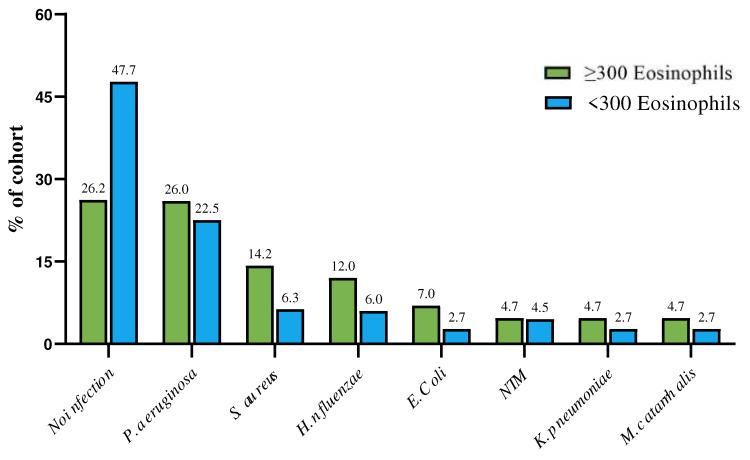
Bronchiectasis (BE) has been traditionally associated with neutrophilic inflammation, but eosinophilic bronchiectasis (EB) has recently emerged. Data about prevalence, clinical features, and disease severity are lacking. This study aimed to assess the EB prevalence, compare EB with non-EB, evaluate the Type-2 (T2) high endotype in BE (T2-high EB) versus non-T2-high EB, and identify EB predictors. We conducted a prospective study involving 153 BE patients. The data collected included clinical, radiological, and microbiological findings. BE severity was assessed using the bronchiectasis severity index (BSI), FACED and E-FACED scores, and the bronchiectasis etiology and comorbidity index (BACI). EB was defined as a blood eosinophil count (BEC) ≥ 300 cells/μL, and T2-high EB as BEC ≥ 300 cells/μL with fractional exhaled nitric oxide (FeNO) ≥ 25 ppb. Prevalence was 27% for EB and 20% for T2-high EB. EB patients exhibited poorer lung function and more severe radiologic features, with significantly higher severity scores [BSI, FACED, E-FACED, BACI ( < 0.05)], and a higher median exacerbation rate [4 (2-5) in EB vs. 2 (1-4) in non-EB, = 0.0002], compared with non-EB patients. T2-high EB patients showed higher severity scores [BSI, FACED, E-FACED ( < 0.05)], as well as worse lung function parameters [FEV%, FVC%, FEF % ( < 0.05)] compared with non-T2-high EB patients. In our study, patients with EB exhibited notably worsened lung function and higher BE severity scores compared with their non-EB counterparts, with exacerbations playing a major role in these differences. We found statistically significant positive correlations between BEC and disease severity scores, such as BSI, FACED, and mMRC, as well as an inverse relationship with pulmonary function. The likelihood of EB being present was significantly higher in association with mMRC ≥ 1 (OR = 2.53; 95% CI, 1.26-5.64), exacerbations/year ≥ 1 (OR = 1.27; 95% CI, 1.0-1.63), and chronic PA colonization (OR = 3.9; 95% CI, 1.08-15.8). EB is a distinct endotype. Dyspnea, exacerbations, and PA colonization may be predictive of EB, emphasizing the importance of early detection for improved outcomes. BEC could serve as a useful biomarker of disease severity to consider when diagnosing EB.
支气管扩张症(BE)传统上与嗜中性粒细胞炎症相关,但嗜酸性粒细胞性支气管扩张症(EB)最近已出现。目前缺乏关于其患病率、临床特征和疾病严重程度的数据。本研究旨在评估EB的患病率,将EB与非EB进行比较,评估BE中的2型(T2)高内型(T2高EB)与非T2高EB,并确定EB的预测因素。我们进行了一项前瞻性研究,纳入了153例BE患者。收集的数据包括临床、放射学和微生物学检查结果。使用支气管扩张症严重程度指数(BSI)、FACED和E-FACED评分以及支气管扩张症病因和合并症指数(BACI)评估BE的严重程度。EB定义为血嗜酸性粒细胞计数(BEC)≥300个细胞/μL,T2高EB定义为BEC≥300个细胞/μL且呼出气一氧化氮分数(FeNO)≥25 ppb。EB的患病率为27%,T2高EB的患病率为20%。与非EB患者相比,EB患者的肺功能较差,放射学特征更严重,严重程度评分显著更高[BSI、FACED、E-FACED、BACI(<0.05)],且中位加重率更高[EB组为4(2 - 5),非EB组为2(1 - 4),P = 0.0002]。与非T2高EB患者相比,T2高EB患者的严重程度评分更高[BSI、FACED、E-FACED(<0.05)],肺功能参数也更差[FEV%、FVC%、FEF%(<0.05)]。在我们的研究中,与非EB患者相比,EB患者的肺功能明显恶化,BE严重程度评分更高,加重在这些差异中起主要作用。我们发现BEC与疾病严重程度评分(如BSI、FACED和mMRC)之间存在统计学上显著的正相关,与肺功能呈负相关。mMRC≥1(OR = 2.53;95%CI,1.26 - 5.64)、每年加重次数≥1(OR = 1.27;95%CI,1.0 - 1.63)和慢性肺部厌氧菌定植(OR = 3.9;95%CI,1.08 - 15.8)时,EB存在的可能性显著更高。EB是一种独特的内型。呼吸困难、加重和肺部厌氧菌定植可能是EB的预测因素,强调了早期检测对改善预后的重要性。BEC可作为诊断EB时考虑的疾病严重程度的有用生物标志物。



 Zotero 插件