
神经内分泌肿瘤铂类化疗敏感性相关改变途径概述:优势与前景。
An Overview of Altered Pathways Associated with Sensitivity to Platinum-Based Chemotherapy in Neuroendocrine Tumors: Strengths and Prospects.
机构信息
Department of Biological and Environmental Sciences and Technologies (DiSTeBA), University of Salento, Via Monteroni, I-73100 Lecce, Italy.
出版信息
Int J Mol Sci. 2024 Aug 6;25(16):8568. doi: 10.3390/ijms25168568.
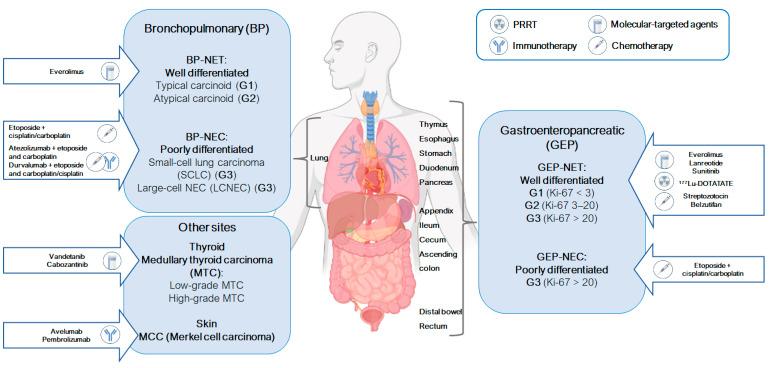
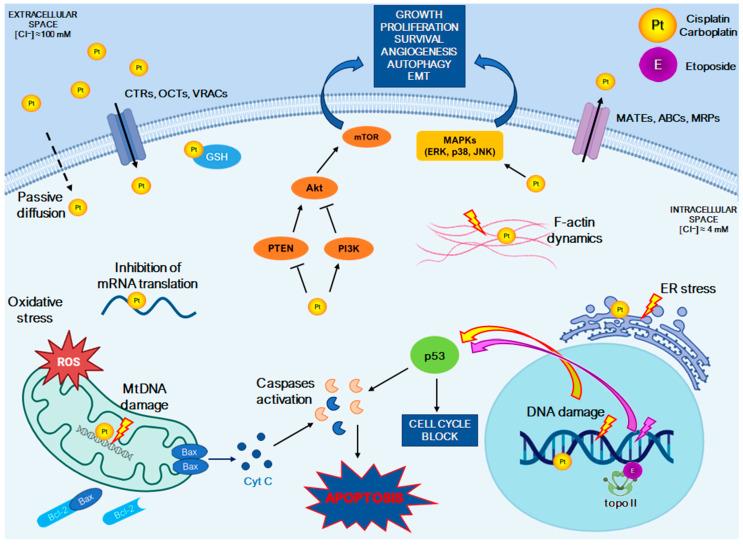
Neuroendocrine neoplasms (NENs) are a diverse group of malignancies with a shared phenotype but varying prognosis and response to current treatments. Based on their morphological features and rate of proliferation, NENs can be classified into two main groups with a distinct clinical behavior and response to treatment: (i) well-differentiated neuroendocrine tumors (NETs) or carcinoids (with a low proliferation rate), and (ii) poorly differentiated small- or large-cell neuroendocrine carcinomas (NECs) (with a high proliferation rate). For certain NENs (such as pancreatic tumors, higher-grade tumors, and those with DNA damage repair defects), chemotherapy is the main therapeutic approach. Among the different chemotherapic agents, cisplatin and carboplatin, in combination with etoposide, have shown the greatest efficacy in treating NECs compared to NETs. The cytotoxic effects of cisplatin and carboplatin are primarily due to their binding to DNA, which interferes with normal DNA transcription and/or replication. Consistent with this, NECs, which often have mutations in pathways involved in DNA repair (such as Rb, MDM2, BRCA, and PTEN), have a high response to platinum-based chemotherapy. Identifying mutations that affect molecular pathways involved in the initiation and progression of NENs can be crucial in predicting the response to platinum chemotherapy. This review aims to highlight targetable mutations that could serve as predictors of therapeutic response to platinum-based chemotherapy in NENs.
神经内分泌肿瘤(NENs)是一组具有不同临床表现的恶性肿瘤,其预后和对当前治疗的反应各不相同。根据其形态学特征和增殖率,NENs 可分为两类,具有明显不同的临床行为和对治疗的反应:(i)分化良好的神经内分泌肿瘤(NETs)或类癌(增殖率低),以及(ii)分化差的小细胞或大细胞神经内分泌癌(NECs)(增殖率高)。对于某些 NENs(如胰腺肿瘤、高级别肿瘤和具有 DNA 损伤修复缺陷的肿瘤),化疗是主要的治疗方法。在不同的化疗药物中,顺铂和卡铂联合依托泊苷在治疗 NECs 方面比 NETs 显示出更大的疗效。顺铂和卡铂的细胞毒性作用主要归因于它们与 DNA 的结合,这会干扰正常的 DNA 转录和/或复制。与此一致的是,经常发生 DNA 修复途径(如 Rb、MDM2、BRCA 和 PTEN)突变的 NECs 对铂类化疗有很高的反应。确定影响 NENs 起始和进展的分子途径的突变,对于预测对铂类化疗的反应可能至关重要。本综述旨在强调可作为 NENs 对铂类化疗治疗反应预测指标的靶向突变。


 Zotero 插件