
特应性皮炎患者循环皮肤归巢和非皮肤组织记忆 T 细胞异质性产生的白细胞介素 9
Heterogeneous IL-9 Production by Circulating Skin-Tropic and Extracutaneous Memory T Cells in Atopic Dermatitis Patients.
机构信息
Immunologia Translacional, Departament de Biologia Cellular, Fisiologia i Immunologia, Facultat de Biologia, Universitat de Barcelona (UB), Parc Científic de Barcelona (PCB), 08028 Barcelona, Spain.
Departament de Dermatologia, Hospital del Mar, Institut Hospital del Mar d'Investigacions Mèdiques (IMIM), Universitat Autònoma de Barcelona (UAB), 08003 Barcelona, Spain.
出版信息
Int J Mol Sci. 2024 Aug 6;25(16):8569. doi: 10.3390/ijms25168569.
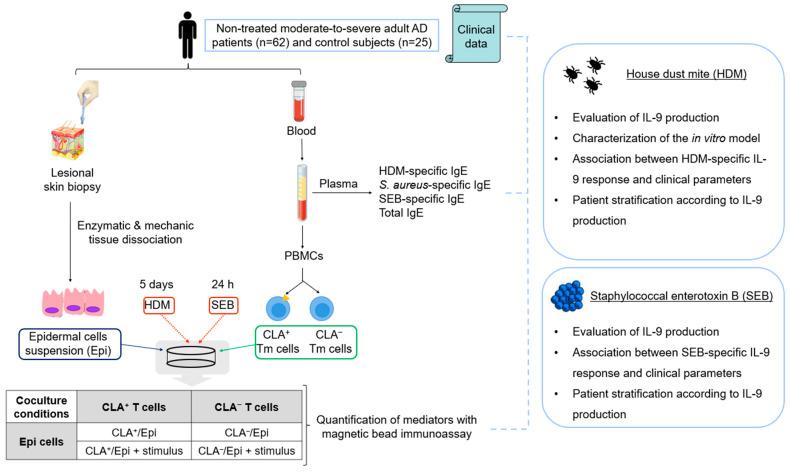
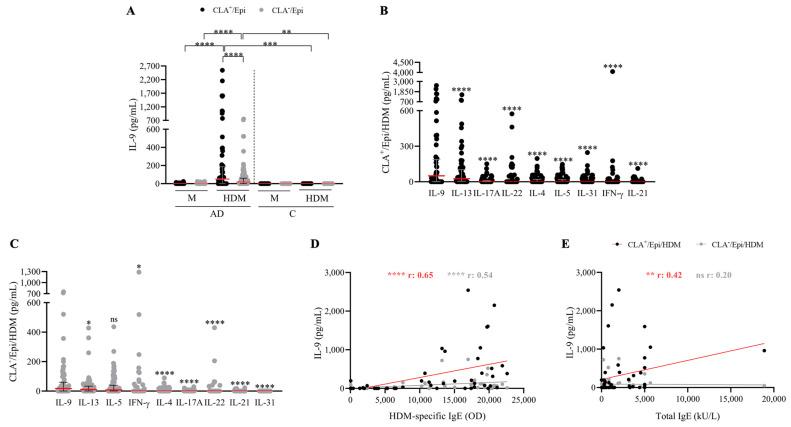
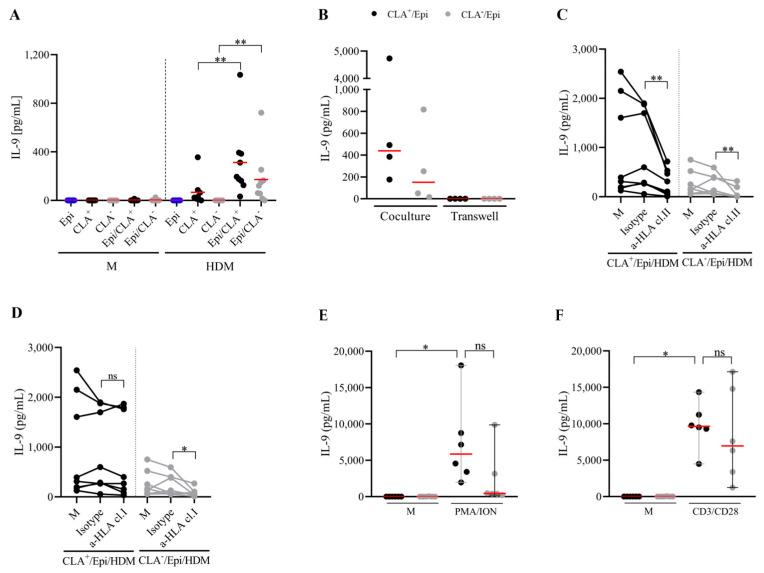
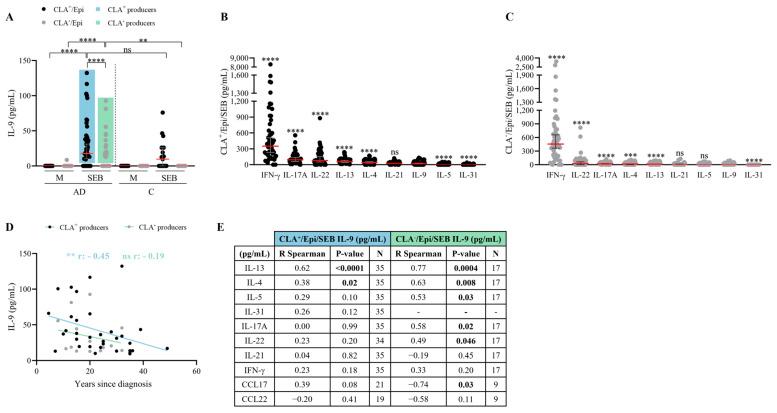
Interleukin (IL)-9 is present in atopic dermatitis (AD) lesions and is considered to be mainly produced by skin-homing T cells expressing the cutaneous lymphocyte-associated antigen (CLA). However, its induction by AD-associated triggers remains unexplored. Circulating skin-tropic CLA and extracutaneous/systemic CLA memory T cells cocultured with autologous lesional epidermal cells from AD patients were activated with house dust mite (HDM) and staphylococcal enterotoxin B (SEB). Levels of AD-related mediators in response to both stimuli were measured in supernatants, and the cytokine response was associated with different clinical characteristics. Both HDM and SEB triggered heterogeneous IL-9 production by CLA and CLA T cells in a clinically homogenous group of AD patients, which enabled patient stratification into IL-9 producers and non-producers, with the former group exhibiting heightened HDM-specific and total IgE levels. Upon allergen exposure, IL-9 production depended on the contribution of epidermal cells and class II-mediated presentation; it was the greatest cytokine produced and correlated with HDM-specific IgE levels, whereas SEB mildly induced its release. This study demonstrates that both skin-tropic and extracutaneous memory T cells produce IL-9 and suggests that the degree of allergen sensitization reflects the varied IL-9 responses in vitro, which may allow for patient stratification in a clinically homogenous population.
白细胞介素 (IL)-9 存在于特应性皮炎 (AD) 病变中,被认为主要由表达皮肤归巢 T 细胞相关抗原 (CLA) 的皮肤归巢 T 细胞产生。然而,其被 AD 相关触发因素诱导的机制仍未被探索。循环皮肤归巢 CLA 和非皮肤/系统性 CLA 记忆 T 细胞与来自 AD 患者的自身病变表皮细胞共培养,用屋尘螨 (HDM) 和葡萄球菌肠毒素 B (SEB) 激活。在两种刺激物的反应中测量 AD 相关介质的水平,并将细胞因子反应与不同的临床特征相关联。HDM 和 SEB 均可在临床同质的 AD 患者群体中引发 CLA 和 CLA T 细胞产生异质的 IL-9,这使得患者能够分层为 IL-9 产生者和非产生者,前者表现出更高的 HDM 特异性和总 IgE 水平。在过敏原暴露后,IL-9 的产生取决于表皮细胞和 II 类介导的呈递的贡献;它是产生的最大细胞因子,与 HDM 特异性 IgE 水平相关,而 SEB 则轻微诱导其释放。本研究表明,皮肤归巢和非皮肤记忆 T 细胞均可产生 IL-9,并表明过敏原致敏程度反映了体外不同的 IL-9 反应,这可能允许在临床同质人群中进行患者分层。

 Zotero 插件