
肠道微生物群与腹膜透析患者的认知障碍有关。
Gut Microbiome Is Related to Cognitive Impairment in Peritoneal Dialysis Patients.
机构信息
Biomedical Research Unit 02, Specialties Hospital, Western National Medical Center, Mexican Institute of Social Security, Belisario Dominguez #1000, Guadalajara 44320, Mexico.
Laboratory of Pathology, Department of Microbiology and Pathology, Health Sciences University Center, University of Guadalajara, Sierra Mojada #950, Guadalajara 44350, Mexico.
出版信息
Nutrients. 2024 Aug 12;16(16):2659. doi: 10.3390/nu16162659.
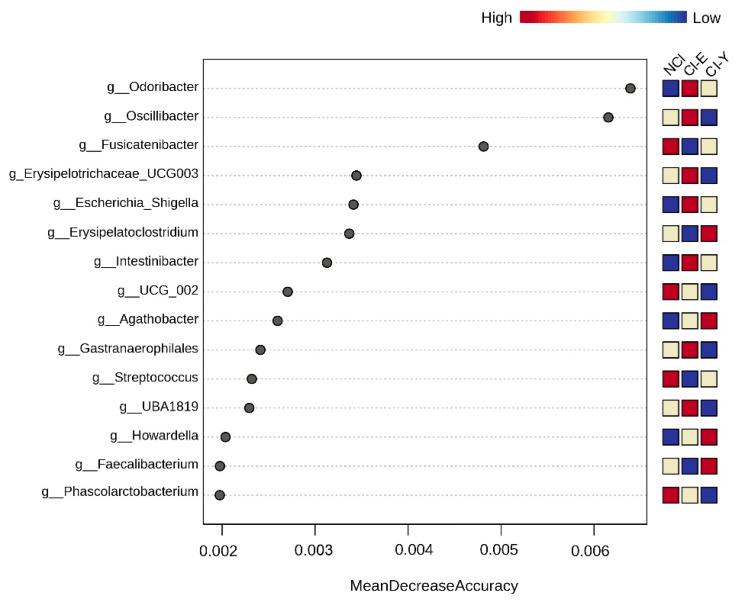
Gut microbiota disturbances may influence cognitive function, increasing uremic toxins and inflammation in dialysis patients; therefore, we aimed to evaluate the association of the gut microbiota profile with cognitive impairment (CI) in patients on automated peritoneal dialysis (APD). In a cross-sectional study, cognitive function was evaluated using the Montreal Cognitive Assessment in 39 APD patients and classified as normal cognitive function and CI. The gut microbiota was analyzed using the 16S rRNA gene sequencing approach. All patients had clinical, biochemical and urea clearance evaluations. Eighty-two percent of patients were men, with a mean age of 47 ± 24 years and 11 (7-48) months on PD therapy; 64% had mild CI. Patients with CI were older (53 ± 16 vs. 38 ± 14, = 0.006) and had a higher frequency of diabetes mellitus (56% vs. 21%, = 0.04) and constipation (7% vs. 48%, = 0.04) and lower creatinine concentrations (11.3 ± 3.7 vs. 14.9 ± 5.4, = 0.02) compared to normal cognitive function patients. Patients with CI showed a preponderance of S24_7, Rikenellaceae, Odoribacteraceae, and , while patients without CI had a greater abundance of , , and (LDA score (Log) > 2.5; < 0.05). After glucose and age adjustment, Odoribacter was still associated with CI. In conclusion, patients with CI had a different gut microbiota characterized by the higher abundance of indole-producing and mucin-fermenting bacteria compared to normal cognitive function patients.
肠道微生物群紊乱可能会影响认知功能,增加透析患者的尿毒症毒素和炎症;因此,我们旨在评估肠道微生物群特征与自动化腹膜透析 (APD) 患者认知障碍 (CI) 的相关性。在一项横断面研究中,39 名 APD 患者使用蒙特利尔认知评估评估认知功能,并分为正常认知功能和 CI。使用 16S rRNA 基因测序方法分析肠道微生物群。所有患者均进行临床、生化和尿素清除评估。82%的患者为男性,平均年龄为 47 ± 24 岁,PD 治疗时间为 11(7-48)个月;64%的患者有轻度 CI。CI 患者年龄较大(53 ± 16 岁比 38 ± 14 岁, = 0.006),糖尿病(56%比 21%, = 0.04)和便秘(7%比 48%, = 0.04)的频率较高,且肌酐浓度较低(11.3 ± 3.7 比 14.9 ± 5.4, = 0.02)。与正常认知功能患者相比,CI 患者的 S24_7、Rikenellaceae、Odoribacteraceae 和 增多,而无 CI 患者的 、 、 和 (LDA 评分(Log)> 2.5; < 0.05)丰度更高。在调整葡萄糖和年龄后,Odoribacter 仍与 CI 相关。总之,CI 患者的肠道微生物群存在差异,其吲哚产生菌和黏蛋白发酵菌的丰度较高。


 Zotero 插件