
儿童肺炎球菌结合疫苗对塞尔维亚侵袭性疾病血清型的影响。
Effect of Childhood Pneumococcal Conjugate Vaccination on Invasive Disease Serotypes in Serbia.
作者信息
Opavski Nataša, Jovićević Miloš, Kabić Jovana, Kekić Dušan, Gajić Ina
机构信息
Institute of Microbiology and Immunology, Faculty of Medicine, University of Belgrade, 11000 Belgrade, Serbia.
出版信息
Vaccines (Basel). 2024 Aug 22;12(8):940. doi: 10.3390/vaccines12080940.
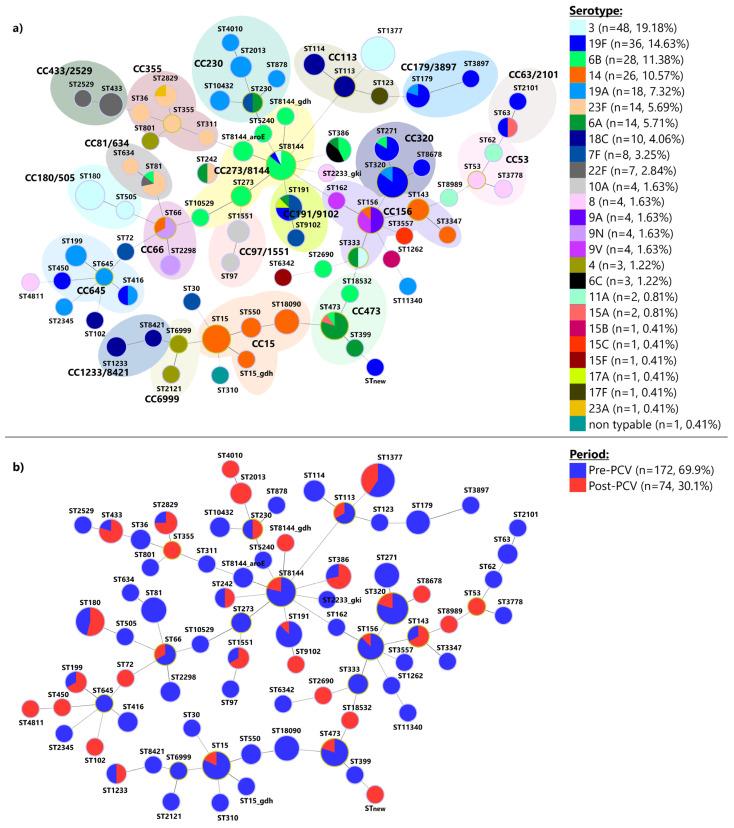
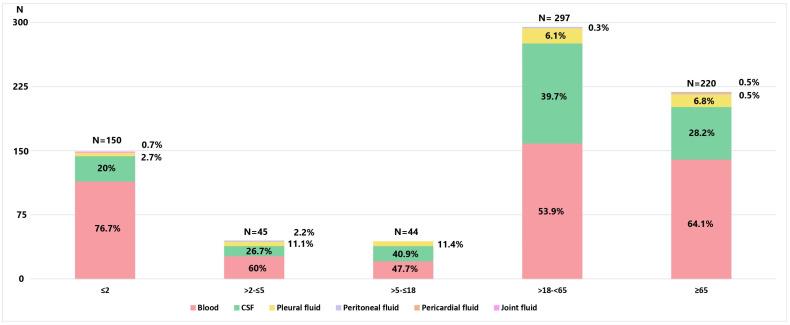
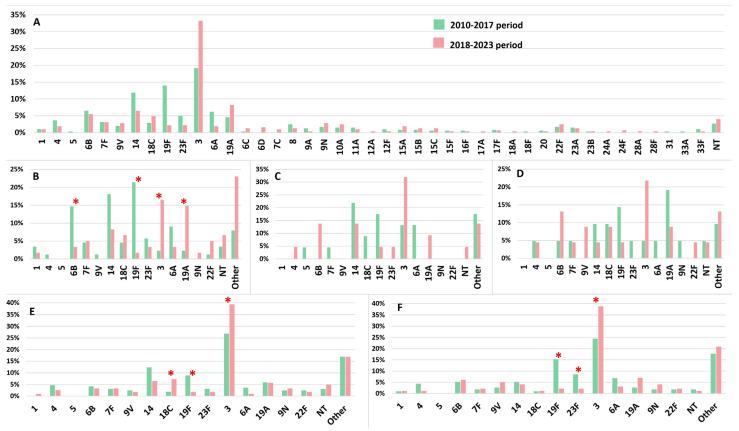
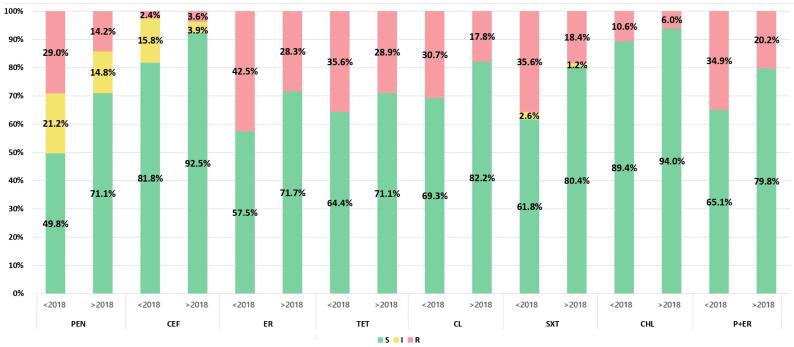
In Serbia, PCV10 was introduced into the routine immunization for children under 2 in 2018 and replaced by PCV13 in 2022. We evaluated their impact on the distribution of invasive pneumococcal disease (IPD) serotypes across all age groups. Overall, 756 isolates were obtained from patients with IPD between 2010 and 2023 through laboratory surveillance. In the post-vaccination period, serotypes 14, 19F, 23F, and 6A significantly declined, while 3 and 19A considerably increased. This was especially evident in the ≤2 years group, making these serotypes the most prevalent among them. Serotype 3 dominated, representing 19.1% of all invasive isolates prior to 2018 and 33.1% thereafter. While serotype coverage of PCV10 has significantly decreased in the ≤2 years group (from 74.2% before 2018 to 29.5% after 2018), PCV13 coverage was 63.9% after 2018. In the post-PCV period, non-PCV13 serotypes, such as 9N, 10A, 15A, 15B, 15C, 22F, 6C, 6D, and 7C, increased across all isolates. Antibiotic non-susceptibility considerably decreased after 2018. MLST analysis showed shifts in sequence type prevalence, with pre-PCV lineages replaced and ongoing serotype 3 persistence, alongside potential capsule-switching events. These findings emphasize a noticeable shift in the distribution of serotypes and adaptability of pneumococcal populations, highlighting the importance of ongoing surveillance and the requirement for the urgent introduction of higher valent vaccines into the National Immunization Program.
在塞尔维亚,2018年10价肺炎球菌结合疫苗(PCV10)被引入2岁以下儿童的常规免疫程序,并于2022年被13价肺炎球菌结合疫苗(PCV13)取代。我们评估了它们对各年龄组侵袭性肺炎球菌疾病(IPD)血清型分布的影响。总体而言,2010年至2023年期间,通过实验室监测从IPD患者中获得了756株分离株。在疫苗接种后时期,14型、19F型、23F型和6A型血清型显著下降,而3型和19A型则大幅增加。这在≤2岁年龄组中尤为明显,使这些血清型成为该年龄组中最常见的血清型。3型占主导地位,在2018年之前占所有侵袭性分离株的19.1%,之后占33.1%。虽然≤2岁年龄组中PCV10的血清型覆盖率显著下降(从2018年之前的74.2%降至2018年之后的29.5%),但2018年之后PCV13的覆盖率为63.9%。在PCV接种后时期,非PCV13血清型,如9N型、10A型、15A型、15B型、15C型、22F型、6C型、6D型和7C型,在所有分离株中均有所增加。2018年之后抗生素不敏感性显著降低。多位点序列分型(MLST)分析显示序列型流行情况发生了变化,PCV接种前的谱系被取代,3型血清型持续存在,同时可能存在荚膜转换事件。这些发现强调了血清型分布的显著变化以及肺炎球菌群体的适应性,突出了持续监测的重要性以及迫切需要将更高价疫苗引入国家免疫规划。

 Zotero 插件